

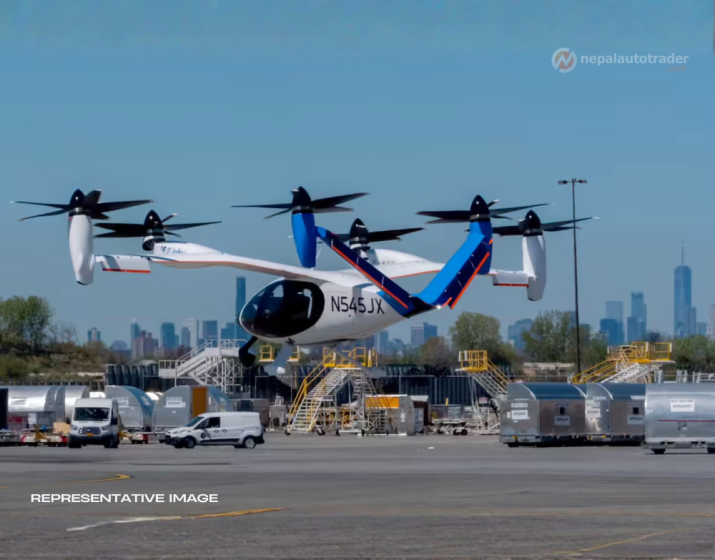
Joby Aviation has taken a decisive step, bringing its electric air taxi technology into one of the world’s most complex urban airspaces, New York. These are not symbolic flights. They are calculated, deliberate, and deeply strategic.
The company’s flight tests in New York represent a critical milestone in its broader push to commercialize urban air mobility. Tight air corridors, dense infrastructure, and relentless congestion make the city an ideal proving ground. If it works here, it works anywhere. That matters.
These tests are part of a phased approach, one that blends aircraft validation, regulatory alignment, and real-world operational stress testing. The aircraft itself, a fully electric vertical takeoff and landing vehicle, is designed to bypass gridlock entirely. Straight up. Straight across. Minimal noise, zero tailpipe emissions.
It sounds futuristic. It isn’t. It’s already happening.
The Joby eVTOL aircraft is central to this push. While the company has not disclosed every granular specification in this particular update, the platform is widely recognized for its multi-rotor electric propulsion system and focus on quiet, efficient urban operations.
Here is a snapshot of what defines the system in this testing phase:
| Category | Details | Relevance |
|---|---|---|
| Aircraft Type | Electric vertical takeoff and landing, eVTOL | Urban-friendly operation |
| Energy Source | Fully electric | Zero emissions at point of use |
| Operational Focus | Short-distance urban transport | Reduces congestion impact |
| Noise Profile | Low acoustic footprint | Critical for city adoption |
The goal is not just to fly. It is to integrate. Seamlessly, safely, and at scale. This changes things.
Each test contributes to refining flight performance, route mapping, and energy efficiency under real urban conditions. Controlled environments are one thing. New York is something else entirely.
Choosing New York is not accidental. It is strategic. The city’s chronic traffic congestion, combined with high-value commuter routes, creates a compelling case for air taxi deployment.
More importantly, infrastructure conversations are already underway. Vertiports, charging systems, and air traffic coordination are all part of the equation. Joby is not operating in isolation. It is working alongside stakeholders to shape a viable ecosystem.
Key drivers behind this move include:
This is about timing as much as technology. The industry is converging, regulators are engaging, and public acceptance is slowly shifting. The window is open.
Flight tests are the visible part. The harder work sits beneath, in regulatory frameworks and infrastructure readiness.
Joby Aviation must align with aviation authorities, ensuring compliance with safety, certification, and operational standards. Urban air mobility cannot afford shortcuts. Every system must be validated, every contingency accounted for.
Infrastructure is equally critical. Without a network of vertiports, charging stations, and integrated booking systems, the concept stalls. The aircraft alone is not enough.
| Challenge Area | Current Status | Impact |
|---|---|---|
| Regulatory Approval | Ongoing coordination | Determines commercial launch timeline |
| Vertiport Infrastructure | Planning stage | Defines route viability |
| Public Acceptance | Gradual awareness | Influences adoption rates |
| Airspace Integration | Under evaluation | Ensures safety and efficiency |
It is a complex puzzle. Each piece matters. Miss one, and the system falters.
For deeper context on how emerging mobility tech integrates into cities, see our analysis on future urban mobility systems.
Joby Aviation is not alone. The race toward commercial air taxi services is intensifying, with multiple players pushing similar visions. What sets Joby apart, at least for now, is its aggressive testing strategy and visible progress in real-world environments.
New York adds credibility. It signals readiness. It tells investors, regulators, and competitors that this is not a distant concept. It is imminent.
The broader landscape includes:
For comparison with electric mobility trends on the ground, explore our coverage of electric vehicle adoption trends.
The difference is altitude. The principle remains the same, efficiency, sustainability, and speed.
The New York flight tests are a beginning, not a conclusion. The next phase will likely focus on expanding test operations, refining infrastructure partnerships, and moving closer to commercial certification.
There is still distance to cover. Certification timelines, infrastructure buildout, and operational scaling will define the pace. But the direction is clear.
Urban mobility is evolving. Roads alone are no longer enough. Airspace is becoming the next frontier.
And Joby is already there.
That matters.
For a closer look at how next-gen aviation compares to traditional transport, read our feature on future aviation technologies.
Q: What is Joby Aviation testing in New York?
A: Joby Aviation is conducting flight tests of its electric air taxi, an eVTOL aircraft designed for short urban trips. These tests evaluate real-world performance and integration into city airspace.
Q: When will air taxis become available in New York?
A: A specific launch date has not been announced. Commercial availability depends on regulatory approvals, infrastructure readiness, and successful completion of ongoing test phases.
Q: How does Joby’s air taxi reduce travel time?
A: The aircraft uses vertical takeoff and direct aerial routes, bypassing road congestion entirely. This can significantly cut travel time between key urban locations.
Q: Are Joby air taxis environmentally friendly?
A: Yes, the aircraft is fully electric, producing zero emissions at the point of use and designed for a low noise footprint in urban environments.
Q: What infrastructure is needed for air taxis to operate?
A: Cities need vertiports, charging stations, and integrated air traffic systems. These are currently in planning or early development stages.
Q: Who are Joby Aviation’s main competitors?
A: Several companies are developing eVTOL aircraft and air taxi services, creating a competitive and rapidly evolving urban mobility landscape.

Nepal Auto-Trader is one-stop platform for all automotive needs. We provide unbiased and unparalleled news/reviews of all auto-motives being launched in Nepalese Auto-Industry. Find recent updates and price of bikes/cars, compare and review recently launched bikes/cars, buy/sell/trade reconditioned cars/bikes and all government news about changing rules and regulation, road safety by subscribing us.

Subscribe to our Newsletter
© Copyright 2026, Nepal Autotrader



.png)
.png)