

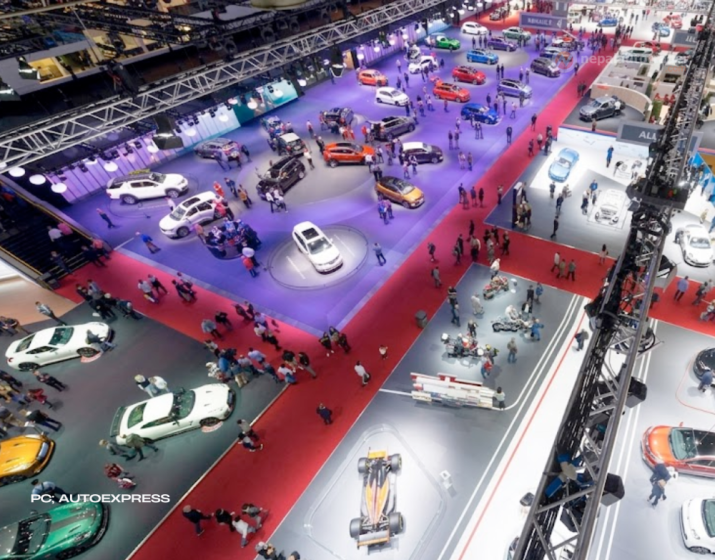
The 2026 Beijing Auto Show did not just break records, it redefined scale. The exhibition stretched across 380,000 square meters, making it the largest automotive event ever staged. Over a ten day run, it pulled in 1.28 million visitors, a figure that puts most global motor shows into the shadows. That matters.
The numbers stack up quickly. 1,451 vehicles filled the halls, supported by 181 global debuts and 71 concept cars. Two venues carried the load, turning Beijing into the undisputed center of the automotive world, at least for ten days.
There is no importer or dealership narrative here in the traditional sense. This is not a single-market product launch. It is a global convergence point, where brands, suppliers, and ecosystems collide. Ownership of the narrative has shifted from individual automakers to entire technology stacks.
This is not just a car show anymore. It feels closer to a systems exhibition. That changes things.
The headline is simple, but the implications are not. Artificial intelligence has moved from feature to foundation. Across the show floor, automakers presented vehicles powered by large AI models, capable of anticipating real world scenarios instead of reacting to them.
It is a clear step forward from traditional driver assistance systems. The industry is now pushing toward predictive intelligence, what some are calling physical AI.
Chinese brands are leading this shift aggressively. Global manufacturers are responding, but often through partnerships with local tech firms. That dependence is visible across the halls.
The hierarchy is changing. Software is no longer secondary. It is the product. That matters.
The hardware side tells the same story. LiDAR, once reserved for flagship prototypes, is now appearing as standard equipment in mid to high end models. At the same time, Level 3 autonomous driving is no longer experimental. It is being deployed.
| Technology | Current Status | Industry Direction |
|---|---|---|
| LiDAR systems | Standard in mid to high end models | Scaling into broader segments |
| Level 3 autonomy | Widely applied | Moving toward higher autonomy levels |
| AI driving systems | Integrated with large models | Predictive intelligence evolution |
The pace is relentless. What was considered advanced two years ago now feels outdated. Automakers are not just competing on performance or design anymore, they are competing on intelligence stacks.
This is not incremental progress. It is a structural shift.
If intelligence is one pillar, electrification remains the other. And here, the numbers are just as aggressive. Several companies showcased next generation battery systems exceeding 400 Wh/kg energy density. That translates into claimed ranges of more than 1,500 kilometers.
Charging technology is closing the gap with internal combustion convenience. BYD demonstrated flash charging capable of delivering significant range in just 9 minutes. Even extreme conditions are being addressed, with stable charging performance reported at minus 30 degrees Celsius.
The message is clear. Range anxiety is being engineered out of existence. Charging anxiety is next.
This is where EVs stop being a compromise. They start becoming the default.
Walk the halls and one trend becomes impossible to ignore. Chinese domestic brands are no longer challengers. They are leaders. Their presence spans not just volume segments, but increasingly the high end market as well.
Global automakers are still here, and in force. But the strategy has changed. Instead of imposing global platforms, they are integrating into China’s ecosystem. Local R&D, local partnerships, local software stacks.
Even the absence of Tesla stands out. At a show of this scale, not being present is a statement in itself.
| Segment | Chinese Brands | Global Brands |
|---|---|---|
| AI and autonomy | Leading development and deployment | Partnering with local tech firms |
| EV technology | Strong battery and charging innovation | Adapting platforms for China |
| Market positioning | Expanding into premium segments | Defending share through localization |
The balance of power is shifting. Quietly, but decisively.
This is not about catching up anymore. It is about who defines the future.
The scale of Auto China 2026 is impressive. The direction it signals is more important. Intelligence and electrification are no longer parallel trends. They are converging into a single architecture.
Expect acceleration, not stabilization. Expect more AI integration, faster charging, deeper ecosystem control. And expect China to remain at the center of that evolution.
The future is no longer being previewed. It is being deployed. That matters.
Q: How many vehicles were displayed at Auto China 2026?
A: A total of 1,451 vehicles were showcased, including 181 debut models and 71 concept cars, marking a record for the event.
Q: What were the biggest technology trends at the show?
A: Artificial intelligence integration, Level 3 autonomous driving, LiDAR adoption, and next generation battery technologies were the dominant trends.
Q: How fast is the new EV charging technology shown at the event?
A: BYD demonstrated flash charging capable of significantly recharging a vehicle in around 9 minutes, bringing EV convenience closer to gasoline refueling.
Q: What battery advancements were revealed?
A: Some companies showcased batteries exceeding 400 Wh/kg energy density, enabling driving ranges of over 1,500 kilometers.
Q: Why was Tesla’s absence significant?
A: Tesla’s absence stood out at the world’s largest auto show, especially as global competitors and Chinese brands showcased rapid advancements in AI and EV technology.

Nepal Auto-Trader is one-stop platform for all automotive needs. We provide unbiased and unparalleled news/reviews of all auto-motives being launched in Nepalese Auto-Industry. Find recent updates and price of bikes/cars, compare and review recently launched bikes/cars, buy/sell/trade reconditioned cars/bikes and all government news about changing rules and regulation, road safety by subscribing us.

Subscribe to our Newsletter
© Copyright 2026, Nepal Autotrader



.png)
.png)