

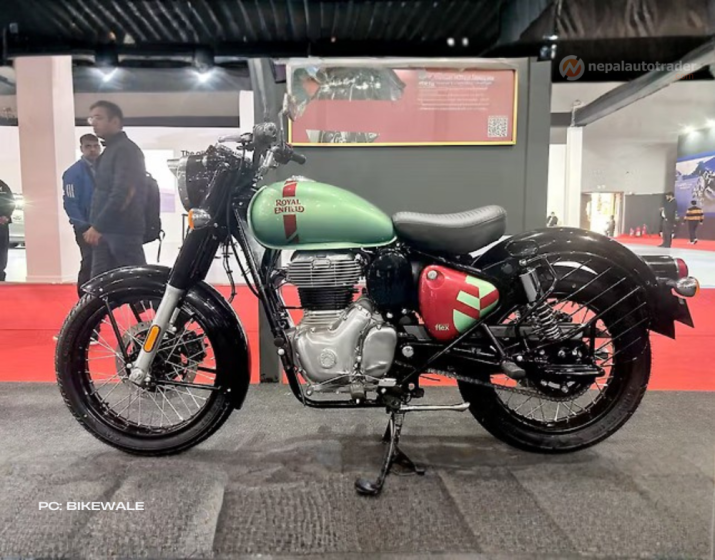
The familiar silhouette is unmistakable. That teardrop tank, the relaxed stance, the old-school road presence. But what rolled out during recent test sightings is not just another Royal Enfield Classic 350. This is something else. Something quietly important.
The Classic 350 Flex Fuel has been spotted undergoing road testing, marking the brand’s first visible step toward ethanol-compatible motorcycles. The changes, at least on the surface, are subtle. Almost too subtle. That matters.
Look closer, though, and the intent becomes clearer. This is not about redesign. It is about reengineering beneath the skin.
Flex fuel technology allows engines to run on a mix of petrol and ethanol blends. In markets pushing for reduced fossil fuel dependency, this is no longer optional. It is inevitable.
For Royal Enfield, adapting its most iconic model makes strategic sense. The Classic 350 is the brand’s backbone. If that platform evolves, everything else follows.
Key expectations from the flex fuel system include:
No official technical breakdown has been released yet. But the direction is clear. This is about future-proofing a legacy machine.
This changes things.
Visually, the test mule does not stray far from the current generation model. That is deliberate. Royal Enfield knows better than to disrupt a design that still resonates globally.
From what has been observed:
The real work is happening where you cannot see it. Inside the engine, within the fuel system, in calibration maps.
This is evolution, not reinvention. And that restraint is intentional.
The Classic 350 sits on Royal Enfield’s J-series platform, which already underpins multiple models. That modularity gives engineers room to adapt without starting from scratch.
Here is why this model was chosen first:
| Factor | Relevance | Impact |
|---|---|---|
| High Sales Volume | Largest-selling model | Maximum market impact |
| Global Presence | Exported widely | Future compliance ready |
| Proven Engine | Reliable J-series unit | Easier adaptation |
| Brand Identity | Core product DNA | Symbolic transition |
Start here, and the rest of the lineup can follow. That is the logic.
This move is not happening in isolation. Governments are pushing aggressively toward ethanol blending programs. Manufacturers are responding, some faster than others.
For Royal Enfield, the implications stretch beyond compliance:
The timing matters. Enter too early, and infrastructure lags. Enter too late, and you lose relevance. Royal Enfield appears to be threading that needle carefully.
That balance is critical.
No official launch date has been disclosed for the Classic 350 Flex Fuel. No pricing, no variant breakdown, no formal announcement. Just a test bike, quietly doing its rounds.
But test sightings rarely lie. They signal intent.
Expect a phased approach:
Whether this arrives as a separate variant or replaces the standard model remains unclear. What is certain is the direction.
Royal Enfield is not rushing. It is recalibrating.
And when the Classic evolves, the industry tends to pay attention.
Q: What is the Royal Enfield Classic 350 Flex Fuel?
A: It is a modified version of the Classic 350 designed to run on petrol blended with higher ethanol content. It aims to support alternative fuel adoption without changing the bike’s core identity.
Q: Has Royal Enfield confirmed the launch date?
A: No official launch timeline has been announced yet. The model has only been spotted during testing phases so far.
Q: Will the design of the Classic 350 change?
A: Based on current test sightings, the design remains largely unchanged. The key updates are expected to be mechanical rather than visual.
Q: What changes are expected in the engine?
A: The engine is likely to receive updates to handle ethanol blends, including fuel system adjustments and revised calibration.
Q: Why is flex fuel important for motorcycles?
A: Flex fuel technology reduces reliance on fossil fuels and aligns with global emission goals. It allows vehicles to run on cleaner fuel blends.

Nepal Auto-Trader is one-stop platform for all automotive needs. We provide unbiased and unparalleled news/reviews of all auto-motives being launched in Nepalese Auto-Industry. Find recent updates and price of bikes/cars, compare and review recently launched bikes/cars, buy/sell/trade reconditioned cars/bikes and all government news about changing rules and regulation, road safety by subscribing us.

Subscribe to our Newsletter
© Copyright 2026, Nepal Autotrader



.png)
.png)