

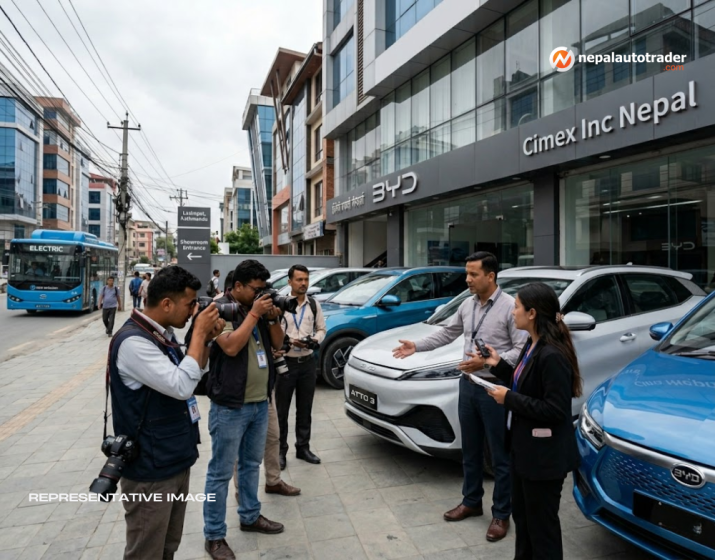
Nepal's electric vehicle market has become one of the most closely watched segments in the automotive business. Every shipment, every customs declaration and every pricing move is now examined with unusual intensity.
Against that backdrop, Cimex Inc., the authorized distributor of BYD vehicles in Nepal, has issued a clarification addressing concerns linked to an EV import controversy.
The company's response comes after allegations and public discussion surrounding vehicle imports generated widespread attention across the automotive industry. That matters.
When the country's best-selling EV brands become part of a public debate, dealers, buyers and competitors all pay attention.
At the center of the discussion are questions surrounding imported electric vehicles and the way import-related information has been interpreted.
Cimex maintains that several claims circulating in public discussions do not accurately reflect the company's position. According to the clarification, the company sought to provide additional context and explain the circumstances behind the issue.
Here's the thing. Nepal's EV market has evolved at extraordinary speed. Import volumes have climbed, new brands have entered the market and pricing pressure has intensified. In such an environment, even minor discrepancies can quickly become major talking points.
| Key Area | Focus Of Discussion | Why It Matters |
|---|---|---|
| Vehicle Imports | Import-related documentation and interpretation | Direct impact on compliance discussions |
| Market Competition | Rapid EV growth | Higher scrutiny across the industry |
| Consumer Confidence | Public perception | Influences purchasing decisions |
The timing is significant.
Nepal's electric vehicle sector is no longer a niche market. Brands are competing aggressively for market share, and distributors are operating under increasing public and regulatory scrutiny.
BYD has emerged as one of the strongest players in the segment, making any controversy involving its local distributor especially visible.
Not everyone will notice it immediately, but reputational issues can travel faster than sales figures.
That is one reason companies often move quickly when questions arise about imports, taxation or regulatory compliance.
This is bigger than a single distributor.
The controversy highlights how closely Nepal's EV ecosystem is now being monitored. As adoption accelerates, discussions about import procedures, valuation frameworks and regulatory oversight are becoming increasingly important.
Industry observers have repeatedly pointed to the need for clear communication between importers, authorities and consumers.
That transparency becomes even more important as new models arrive and competition intensifies.
| Stakeholder | Primary Concern | Expected Outcome |
|---|---|---|
| Consumers | Trust and transparency | Clear information |
| Importers | Regulatory certainty | Stable business environment |
| Authorities | Compliance and oversight | Consistent enforcement |
The clarification is unlikely to end the discussion overnight.
Questions surrounding EV imports often require detailed examination, and industry stakeholders will continue to follow developments closely.
Still, Cimex's response signals an effort to place its position on record and address concerns directly.
As Nepal's electric vehicle market grows larger and more competitive, similar debates may become increasingly common.
And that's important.
The future of the sector will depend not only on product quality and pricing, but also on trust, transparency and confidence in the systems that support vehicle imports.
The broader picture remains positive. Nepal continues to be one of the region's most active electric vehicle markets, attracting new products and growing consumer interest.
Yet rapid growth inevitably brings closer scrutiny.
The latest clarification from Cimex Inc. serves as a reminder that success in the EV era is no longer measured only by sales volumes. Regulatory credibility, public trust and transparent communication now carry equal weight.
For distributors, that may become just as important as the next vehicle launch.
Q: Why did Cimex issue a clarification?
A: Cimex issued a statement to address concerns and public discussion related to an EV import controversy. The company sought to explain its position and provide additional context.
Q: Does the controversy involve BYD vehicles?
A: Cimex is the authorized distributor of BYD vehicles in Nepal, which is why the discussion has attracted significant industry attention.
Q: Has any change in vehicle pricing been announced?
A: No pricing change was detailed as part of the clarification discussed in the report.
Q: Why is this issue important for EV buyers?
A: Buyers closely monitor transparency, compliance and importer credibility, particularly in a fast-growing EV market.
Q: Could the controversy affect Nepal's EV market?
A: The broader market is expected to continue growing, but such debates often increase scrutiny on import processes and regulatory practices.
Q: What should consumers watch next?
A: Future statements from stakeholders, regulatory developments and additional clarification from involved parties will be key areas to monitor.

Nepal Auto-Trader is one-stop platform for all automotive needs. We provide unbiased and unparalleled news/reviews of all auto-motives being launched in Nepalese Auto-Industry. Find recent updates and price of bikes/cars, compare and review recently launched bikes/cars, buy/sell/trade reconditioned cars/bikes and all government news about changing rules and regulation, road safety by subscribing us.

Subscribe to our Newsletter
© Copyright 2026, Nepal Autotrader



.png)
.png)