

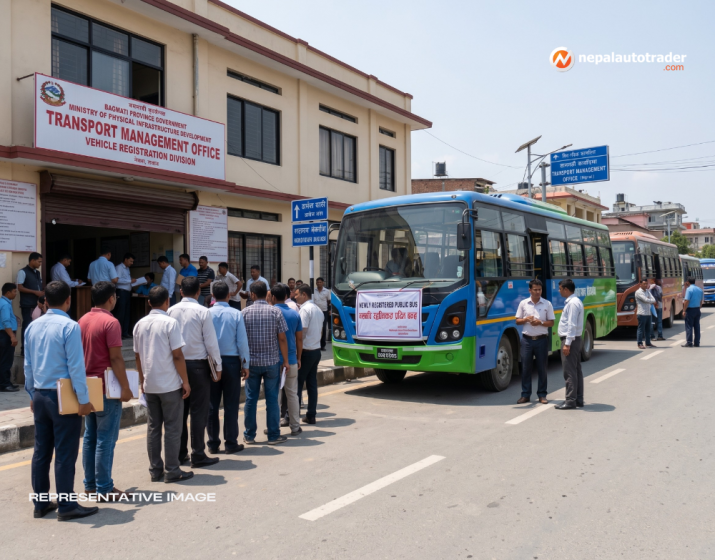
Just weeks after public vehicle registration was halted, Bagmati Province has reopened the process, bringing relief to transport operators who had found themselves trapped in regulatory limbo.
The decision was taken by the Ministry of Labour, Employment and Transport under Minister Jairam Thapa. Instructions have already been issued to transport offices across the province to resume registrations under the existing framework while authorities conduct additional studies and consultations with stakeholders.
For businesses that had already imported vehicles, completed financing arrangements and finalized documentation, the restart could not have come soon enough.
The story began on May 21, when the Department of Transport Management directed provincial governments and local authorities across Nepal to halt the registration of new public vehicles until further notice. The order applied not only to diesel and petrol-powered vehicles but also to electric public transport vehicles.
Authorities cited several challenges:
The suspension was implemented under Section 24(3) of the Vehicle and Transport Management Act, which allows authorities to restrict registrations in the public interest.
On paper, the reasoning appeared straightforward. In practice, it triggered significant disruption across Nepal's transport ecosystem.
Transport entrepreneurs were among the first to push back.
Operators argued that newly purchased vehicles were sitting idle despite having completed customs clearance, billing procedures and financing arrangements. Loan repayments continued. Interest payments accumulated daily. Employees still needed to be paid.
Here's the thing.
Vehicle registration is not merely an administrative formality. For commercial operators, registration is the final step that allows a vehicle to generate revenue. Without it, a new bus, microbus or electric public vehicle becomes an expensive asset parked in a yard.
The pressure quickly built across industry associations and transport groups.
Following consultations and growing concern from stakeholders, the provincial government ultimately chose to restore the registration process while broader policy discussions continue.
| Event | Date | Status |
|---|---|---|
| National suspension directive | May 21, 2026 | Implemented |
| Public vehicle registration halted | May 2026 | Province-wide impact |
| Bagmati reopening decision | June 3, 2026 | Registration resumed |
| Further policy review | Ongoing | Under study |
The reopening carries significance beyond Bagmati alone.
The province remains Nepal's largest vehicle market and transportation hub. It has also been at the center of several modernization initiatives, including digital vehicle documentation, QR-based blue books and online transport services.
Recent efforts have included:
Those projects signal a province attempting to modernize transportation management while also responding to mounting urban mobility challenges.
Not everyone will notice it immediately.
But the registration dispute highlights a deeper tension between controlling vehicle growth and maintaining a healthy transport industry.
The temporary suspension sparked debate throughout Nepal's transport sector.
Supporters argued that unchecked vehicle growth contributes to congestion and environmental pressures, particularly in urban areas. Critics countered that limiting public transport registrations could reduce fleet renewal and slow the adoption of newer, cleaner vehicles, including electric models.
The inclusion of electric public vehicles in the original suspension drew particular attention because Nepal has spent years encouraging EV adoption through supportive policies and fiscal incentives.
That debate is unlikely to disappear simply because registrations have resumed in Bagmati.
Questions around route management, fleet modernization, congestion control and sustainable urban mobility remain very much alive.
For now, registrations continue under the previous system while Bagmati Province studies potential policy adjustments and coordinates with relevant stakeholders.
Whether the province eventually adopts new registration controls, revised public transport rules or additional regulatory measures remains unclear.
What is clear is that the past two weeks exposed how interconnected Nepal's transport ecosystem has become. A single administrative decision can affect vehicle importers, financiers, transport operators, drivers and passengers almost immediately.
And that's important.
The reopening provides short-term stability. The longer-term conversation about how Nepal manages public transportation growth is only getting started.
Q: Has Bagmati Province officially reopened public vehicle registration?
A: Yes. The provincial government has instructed transport offices to resume registration of public vehicles under the previous system while further studies and consultations continue.
Q: When was public vehicle registration originally suspended?
A: The nationwide suspension directive was issued on May 21, 2026, by the Department of Transport Management.
Q: Did the suspension affect electric public vehicles?
A: Yes. The original directive covered both conventional and electric public transport vehicles.
Q: Why did authorities suspend registrations?
A: Officials cited traffic congestion, air pollution, road pressure and broader public transport management challenges.
Q: Are there any new registration rules in place now?
A: No new framework has been announced yet. Registrations are currently proceeding under the previous system while policy reviews continue.
Q: Why is this decision significant for transport operators?
A: It allows newly purchased vehicles to complete registration and begin operations, helping operators avoid ongoing financing and operational costs tied to idle vehicles.

Nepal Auto-Trader is one-stop platform for all automotive needs. We provide unbiased and unparalleled news/reviews of all auto-motives being launched in Nepalese Auto-Industry. Find recent updates and price of bikes/cars, compare and review recently launched bikes/cars, buy/sell/trade reconditioned cars/bikes and all government news about changing rules and regulation, road safety by subscribing us.

Subscribe to our Newsletter
© Copyright 2026, Nepal Autotrader



.png)
.png)