

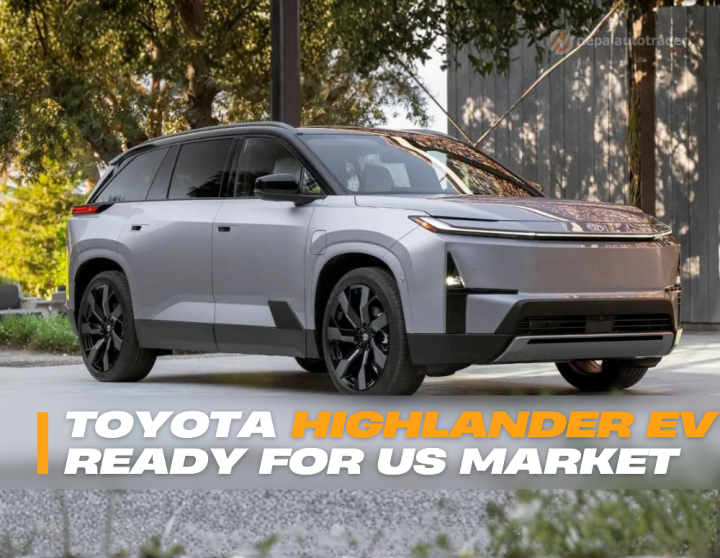
Toyota’s Nepali‑language release confirms that the Highlander EV will launch in the United States as a fully electric, seven‑seat SUV. The move is a direct response to the rapid growth of the EV segment in the premium crossover space. The company is not merely adding a badge‑engineered version; it is building a dedicated battery pack in North Carolina, meaning the vehicle will be produced and sold domestically. That matters because local production reduces tariffs, shortens supply chains, and signals confidence in the North American market.
Toyota is offering two configurations. Both share a front‑wheel‑drive motor rated at 165 kW, but the all‑wheel‑drive version adds a rear motor that pushes the combined output to 250 kW. The battery sizes differ, directly affecting range.
| Variant | Battery Capacity | Estimated Range (WLTP) | Combined Power |
|---|---|---|---|
| FWD | 77 kWh | 460 km | 165 kW |
| AWD | 95.8 kWh | 515 km | 250 kW |
Both versions support an 11 kW AC charger, which is modest compared with fast‑charging networks but aligns with Toyota’s strategy of using existing home‑charging infrastructure. The decision to limit fast‑charging capability may keep costs down, yet it could be a pain point for long‑distance travelers.
Inside, the new Highlander EV gets a modern cockpit. A 14‑inch touchscreen handles infotainment, while a 12.3‑inch digital instrument cluster delivers real‑time energy data. The vehicle retains a 3051 mm wheelbase, giving ample legroom for three rows of seats. Other design cues include a sleek closed‑off grille, slim daytime running lights, and flush‑type door handles that reinforce the electric aesthetic.
These touches aim to position the Highlander EV as a tech‑forward family mover, not just an eco‑friendly alternative.
The Highlander EV will sit opposite the Ford Explorer Hybrid, the Hyundai Palisade PHEV, and the upcoming Kia Sorento EV. All three competitors offer similar seating capacity, but Toyota’s edge lies in brand loyalty and a proven SUV pedigree. The claimed 515 km range exceeds the Explorer Hybrid’s 400 km electric‑only capability, while the price point—still unannounced—will be critical. If Toyota can price the AWD variant under $55,000, it could undercut the Palisade PHEV, which starts around $58,000.
Toyota has laid out a clear rollout plan. Production will begin at the North Carolina battery plant later in 2026, with the first deliveries slated for early 2027. Pre‑orders are expected to open in the fourth quarter of 2026, and the company will likely offer a limited‑edition launch package that includes free home‑charging equipment.
| Phase | Date | Status |
|---|---|---|
| Battery plant construction | 2025‑2026 | On schedule |
| Production start | Late 2026 | Planned |
| Consumer pre‑orders | Q4 2026 | Pending |
| First deliveries | Early 2027 | Target |
The rollout aligns with Toyota’s broader electrification roadmap, which targets a fully electric lineup in the United States by the early 2030s. The Highlander EV will be a cornerstone of that plan, giving families a familiar shape with zero tailpipe emissions.
Analysts expect the Highlander EV to boost overall EV adoption in the three‑row SUV segment, a niche that has lagged behind sedans and compact crossovers. If the vehicle meets its range claims and arrives at a competitive price, it could push the segment’s average range above 500 km, forcing rivals to accelerate their own battery upgrades. Moreover, local production may inspire other manufacturers to set up North Carolina facilities, creating a regional EV hub.
The upcoming launch also raises questions about infrastructure. An 11 kW AC charger is adequate for overnight home charging, but public fast‑charging networks will need to adapt if the Highlander EV gains traction. Toyota’s decision to keep fast‑charging modest could be a catalyst for broader network upgrades.
**Q: When will the *Toyota Highlander EV* be available in the United States?** A: Production is slated for late 2026, with the first deliveries expected in early 2027. Pre‑orders should open in the fourth quarter of 2026.
Q: What are the two battery sizes and their respective ranges? A: The front‑wheel‑drive model uses a 77 kWh pack and is rated for 460 km. The all‑wheel‑drive version carries a 95.8 kWh pack and claims 515 km on a full charge.
Q: How much power does the all‑wheel‑drive system produce? A: The AWD setup combines a front motor of 165 kW with a rear motor to reach a total output of 250 kW.
Q: Will the Highlander EV support fast charging? A: Both variants are limited to an 11 kW AC charger. No DC fast‑charging capability has been announced.
Q: How does the Highlander EV compare to the Ford Explorer Hybrid? A: The Highlander EV offers a longer electric‑only range (515 km vs. about 400 km for the Explorer Hybrid) and a larger battery, but pricing and fast‑charging options will determine the final value proposition.
Q: Where will the vehicle be built? A: Toyota is constructing a dedicated battery plant in North Carolina, and the Highlander EV will be assembled in the United States.

Nepal Auto-Trader is one-stop platform for all automotive needs. We provide unbiased and unparalleled news/reviews of all auto-motives being launched in Nepalese Auto-Industry. Find recent updates and price of bikes/cars, compare and review recently launched bikes/cars, buy/sell/trade reconditioned cars/bikes and all government news about changing rules and regulation, road safety by subscribing us.

Subscribe to our Newsletter
© Copyright 2026, Nepal Autotrader



.png)
.png)