

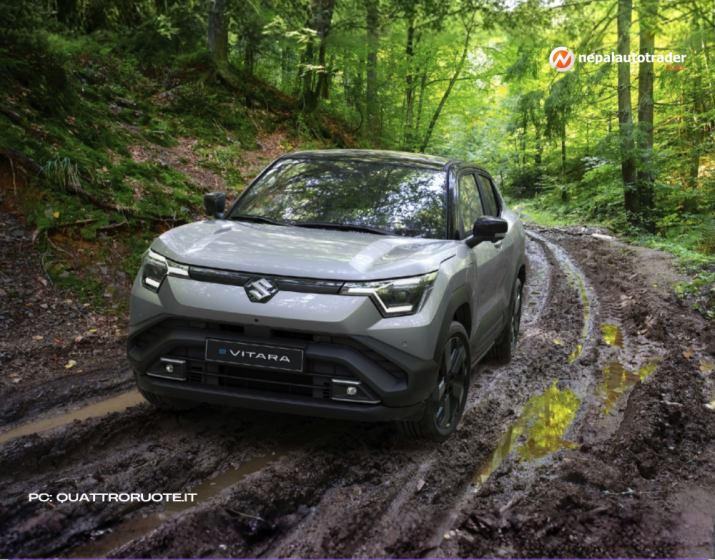
CG Motocorp, the official distributor of Suzuki vehicles in Nepal, has reduced the price of the Suzuki e Vitara by Rs 100,000 across all variants.
The decision comes shortly after the government introduced changes to customs duty and tax rates on battery electric vehicles through the recently announced national budget.
For buyers, the impact is immediate. For Suzuki, it is a strategic move that allows the brand to pass on tax benefits directly to customers rather than absorbing them internally.
That matters.
In a market where pricing often determines purchase decisions, a six-figure reduction can significantly improve a model's competitiveness, especially in the fast-growing electric SUV segment.
The biggest headline is the revised starting price.
When the Suzuki e Vitara was officially launched during the WADA Auto Show in Pokhara earlier this year, the entry-level Delta variant carried a price tag of Rs 4.999 million.
Following the adjustment, the same variant is now available for Rs 4.899 million.
The reduction extends across the entire lineup.
| Variant | Previous Price | New Price |
|---|---|---|
| Delta | Rs 4.999 million | Rs 4.899 million |
| Zeta | Rs 5.399 million | Rs 5.299 million |
| Alpha | Rs 5.999 million | Rs 5.899 million |
| Alpha DT | Rs 6.049 million | Rs 5.949 million |
Every variant receives an identical Rs 100,000 reduction, creating a cleaner and more consistent pricing structure across the range.
Importantly, the lower prices do not come with any specification changes.
The e Vitara continues to be offered with two battery configurations and two power outputs.
| Specification | Option 1 | Option 2 |
|---|---|---|
| Battery Capacity | 49 kWh | 61 kWh |
| Motor Output | 106 kW | 128 kW |
| Powertrain | Battery Electric Vehicle | Battery Electric Vehicle |
The SUV also introduces Suzuki's latest dedicated EV architecture and a design language that clearly separates it from the brand's traditional internal combustion models.
At the front and rear, distinctive tri-slash LED DRLs give the SUV a modern identity, while the charging port is conveniently positioned at the front.
Not everyone will notice it immediately, but details like that can make everyday ownership noticeably easier.
Inside, Suzuki has equipped the e Vitara with a cabin that feels considerably more premium than many buyers might expect from the brand.
Key features include:
This extensive equipment list places the e Vitara in direct contention with several emerging electric SUVs that have entered Nepal over the last two years.
Beyond pricing, practicality remains a core selling point.
The Maruti Suzuki e Vitara measures 4,275 mm in length, 1,800 mm in width and 1,635 mm in height. A generous 2,700 mm wheelbase provides the foundation for a spacious cabin and improved passenger comfort.
| Dimension | Measurement |
|---|---|
| Length | 4,275 mm |
| Width | 1,800 mm |
| Height | 1,635 mm |
| Wheelbase | 2,700 mm |
For family buyers transitioning from conventional compact SUVs, those dimensions should translate into a familiar level of usability.
The reduction may appear modest on paper, but its significance extends beyond the e Vitara itself.
Government tax adjustments are intended to encourage EV adoption, and Suzuki's decision to immediately reflect those benefits in retail pricing sends a strong signal to the market.
Other brands will be watching closely.
If additional manufacturers follow the same path, buyers could see a fresh round of pricing revisions across several EV categories in the coming months.
For now, the biggest winner is the customer. The Suzuki e Vitara was already positioned as one of the more accessible Japanese electric SUVs in Nepal. With prices now starting at Rs 4.899 million, that position has become even stronger.
Q: How much has the Suzuki e Vitara price been reduced in Nepal?
A: Suzuki has reduced the price of every e Vitara variant by Rs 100,000 following changes to BEV customs duty and tax rates announced in the national budget.
Q: What is the new starting price of the Suzuki e Vitara?
A: The entry-level e Vitara Delta now starts at Rs 4.899 million, down from Rs 4.999 million.
Q: How many variants of the e Vitara are available in Nepal?
A: The SUV is currently available in four variants: Delta, Zeta, Alpha and Alpha DT.
Q: What battery options are offered with the e Vitara?
A: Buyers can choose between a 49 kWh battery paired with a 106 kW motor and a 61 kWh battery paired with a 128 kW motor.
Q: What are the standout features of the Suzuki e Vitara?
A: Key highlights include ADAS, a panoramic sunroof, dual digital displays, 360-degree camera, wireless charging, electronic parking brake with auto hold and automatic climate control.
Q: Why were e Vitara prices reduced?
A: According to CG Motocorp, the reduction is a direct result of changes to customs duty and taxation on battery electric vehicles introduced through the latest government budget.

Nepal Auto-Trader is one-stop platform for all automotive needs. We provide unbiased and unparalleled news/reviews of all auto-motives being launched in Nepalese Auto-Industry. Find recent updates and price of bikes/cars, compare and review recently launched bikes/cars, buy/sell/trade reconditioned cars/bikes and all government news about changing rules and regulation, road safety by subscribing us.

Subscribe to our Newsletter
© Copyright 2026, Nepal Autotrader



.png)
.png)