

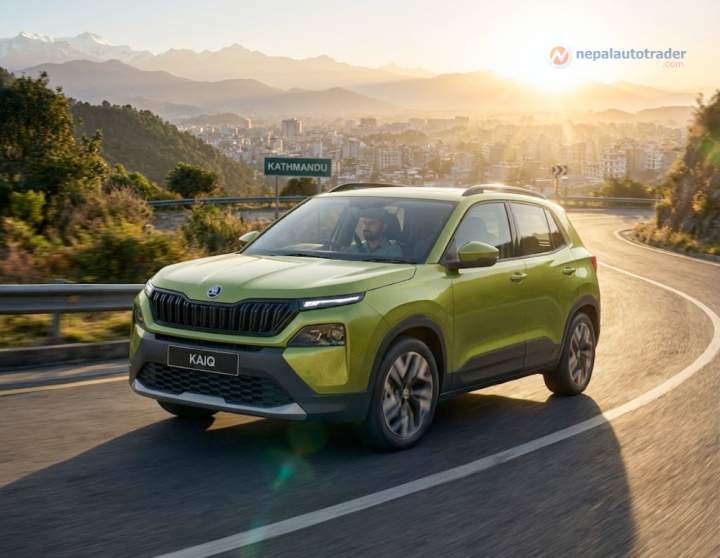
The long‑awaited Skoda KAIQ rolled out of the press bay at Chandragiri Hills Resort, flanked by Bollywood legend Rajesh Hamal and senior executives of MWA Expands. The crowd got a first glimpse of the SUV’s bold front grille, 17‑inch alloy wheels and a silhouette that mirrors the earlier Skoda Kushaq but with a fresher, more urban stance. That matters because Skoda has been quiet on the Nepalese scene since the Kushaq’s debut, and the KAIQ is the brand’s answer to a market hungry for affordable yet premium‑feeling crossovers.
These appointments push the KAIQ well beyond the entry‑level price point. A buyer who once settled for a basic hatchback now sees a cabin that feels like a compact premium sedan. This changes things for Skoda’s brand perception in Nepal.
The heart of the KAIQ is a 1.0 L TSI three‑cylinder petrol unit. It churns out 114 bhp at 5,500 rpm and 178 Nm of torque at 1,600 rpm. The engine is paired with either a 6‑speed manual gearbox or a 7‑speed DSG‑type automatic (marketed locally as a 6‑speed AT). Both setups promise smooth city cruising and enough pull for the winding roads of the Kathmandu Valley.
Key performance figures:
That matters because fuel cost remains a top concern for Nepalese buyers; the KAIQ offers a balance of power and efficiency rarely seen in this segment.
| Specification | Value |
|---|---|
| Engine | 1.0 L TSI, 3‑cylinder |
| Power | 114 bhp @ 5,500 rpm |
| Torque | 178 Nm @ 1,600 rpm |
| Transmission | 6‑speed MT / 6‑speed AT |
| Length | 3.95 m |
| Wheelbase | 2.56 m |
| Ground clearance | 189 mm |
| Boot capacity | 446 L (up to 1,265 L with rear seats folded) |
Skoda has kept the pricing structure simple: two trims – Manual and Automatic. Both receive the full safety suite and interior tech list.
| Trim | Price (NPR) | Key Features |
|---|---|---|
| KAIQ Manual | 45,90,000 | 6‑airbag, ABS, EBD, Traction Control, ISOFIX, dual digital screens |
| KAIQ Automatic | 52,90,000 | All Manual features + 7‑speed DSG‑type AT, paddle shifters |
The price sits comfortably between the Hyundai Venue (≈ 44 lakh) and the Kia Sonet (≈ 55 lakh), giving Skoda a sweet spot for budget‑conscious buyers who still crave premium touches.
| Competitor | Price (NPR) | Engine | Power | Key Advantage |
| Hyundai Venue | 44,00,000 | 1.2 L MPI | 83 bhp | Proven reliability |
| Kia Sonet | 55,00,000 | 1.0 L Turbo | 118 bhp | Sporty design |
| Mahindra XUV300 | 48,50,000 | 1.2 L Turbo | 110 bhp | Strong after‑sales network |
| Maruti Suzuki Fronx | 46,00,000 | 1.0 L Turbo | 100 bhp | Low running cost |
| Tata Nexon | 49,00,000 | 1.2 L Turbo | 120 bhp | Robust build |
The KAIQ’s 114 bhp places it ahead of most rivals except the Nexon, while its interior tech outpaces the Venue and Fronx. Safety is another differentiator: six airbags and a full suite of electronic aids are standard, a rarity in the sub‑₹55 lakh bracket.
Skoda’s re‑entry with the KAIQ signals a broader strategy: expand the SUV lineup, tighten dealer networks, and push digital‑first sales channels. MWA Expands has hinted at a 2026‑2027 rollout of a hybrid‑ready model, likely based on the upcoming Skoda Enyaq platform. If the KAIQ can capture even a modest 2‑3 % of Nepal’s SUV market, it will justify further investment and perhaps bring a plug‑in hybrid version to Kathmandu by 2028.
The launch also nudges competitors to upgrade safety and infotainment across their line‑ups. Expect a wave of OTA updates, higher‑grade upholstery options, and more aggressive pricing in the next twelve months.
Q: What is the exact launch date for the Skoda KAIQ in Nepal? A: The KAIQ was officially unveiled on 27 Magh 2082 (February 10 2026) and will be available for delivery from March 2026.
Q: Are there any financing schemes for the KAIQ? A: MWA Expands is offering up to 70 % financing on both trims, with down‑payment options starting at 10 % of the ex‑showroom price.
Q: How does the KAIQ’s safety equipment compare to the Hyundai Venue? A: The KAIQ comes with six airbags, ABS, EBD, Traction Control and ISOFIX as standard. The Venue offers two airbags and ABS only, making the KAIQ a clear safety leader in its price segment.
Q: Will the KAIQ be available with a diesel engine? A: No. Skoda is launching the KAIQ in Nepal exclusively with the 1.0 L TSI petrol engine, aligning with the market’s shift toward cleaner powertrains.
Q: Where can I book a test‑drive? A: Test‑drives can be booked through the official Skoda Nepal portal or any authorized MWA Expands showroom in Kathmandu, Pokhara and Biratnagar.
Q: Is the KAIQ eligible for any government tax rebates? A: Currently, Nepal’s tax structure does not provide specific rebates for petrol‑powered SUVs; however, the vehicle qualifies for the standard import duty schedule.

Nepal Auto-Trader is one-stop platform for all automotive needs. We provide unbiased and unparalleled news/reviews of all auto-motives being launched in Nepalese Auto-Industry. Find recent updates and price of bikes/cars, compare and review recently launched bikes/cars, buy/sell/trade reconditioned cars/bikes and all government news about changing rules and regulation, road safety by subscribing us.

Subscribe to our Newsletter
© Copyright 2026, Nepal Autotrader



.png)
.png)