

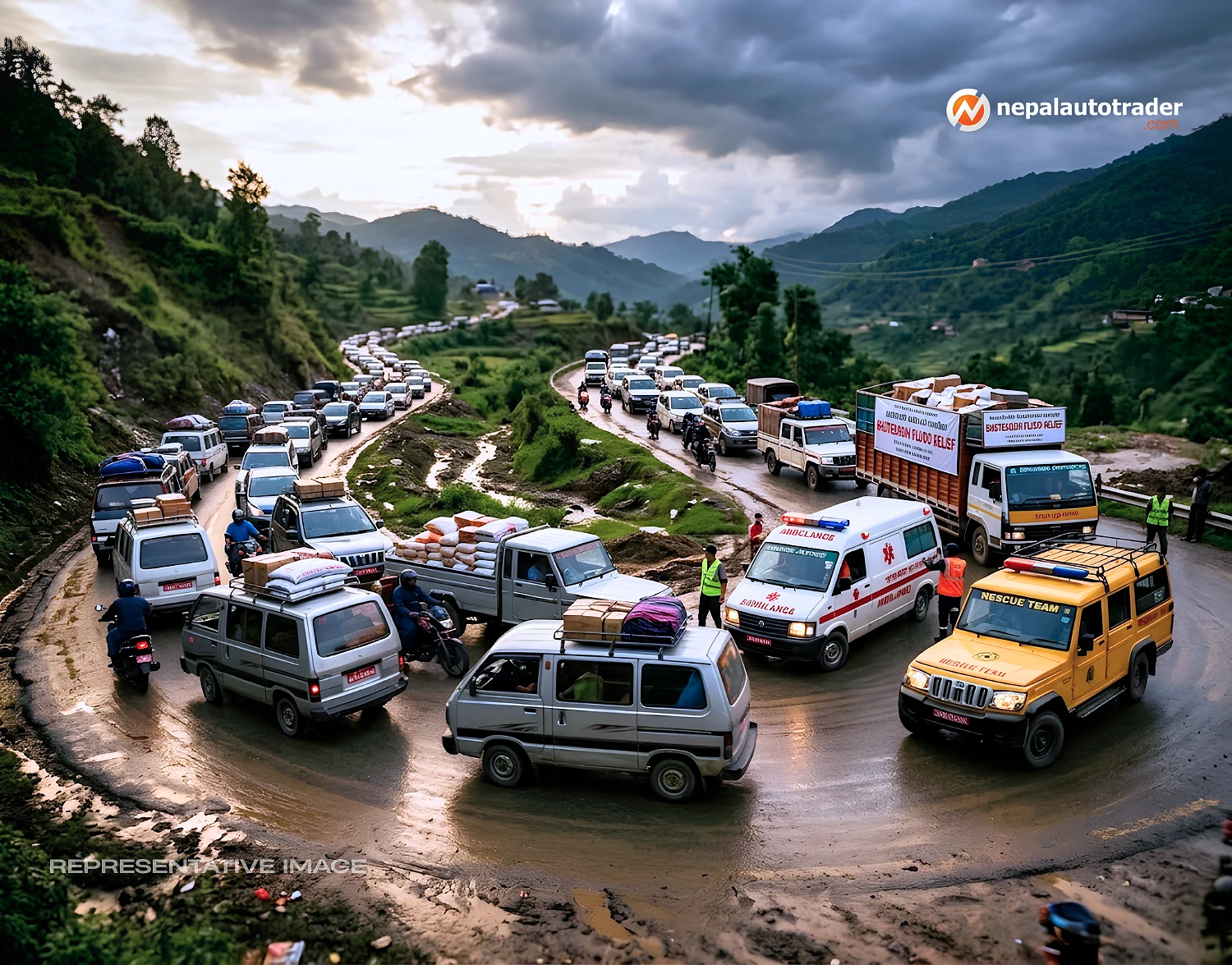
There is a difficult contradiction unfolding on the road toward the flood affected areas. People are trying to help, but too many separate relief trips are now making the journey harder for the teams already responsible for emergency response.
According to MeroAuto, traffic congestion has increased sharply on the Tokha Chhahare Trishuli road as more individuals leave Kathmandu in small private vehicles, each carrying relatively small quantities of relief materials. The effort is well intentioned. The road, however, is becoming crowded enough to interfere with urgent movement.
That distinction matters. In a disaster zone, the ability to move an ambulance, rescue crew or priority relief vehicle can be more important than the number of individual vehicles carrying supplies.
The problem is therefore not simply a traffic issue. It is becoming part of the wider logistics challenge surrounding the response.
The immediate concern is access. Heavy congestion on the route means ambulances carrying emergency patients are finding it difficult to pass easily. Government rescue teams and priority relief carriers are also facing difficulty reaching their destinations on time.
For drivers, this is the sort of congestion that can quickly become more serious than an ordinary Kathmandu traffic jam. There is no convenient alternative when the vehicle behind you may be carrying a patient, rescue equipment or essential supplies.
The situation also creates another risk. The government says people entering difficult and potentially hazardous areas without preparation can put their own safety at risk. That means the traffic problem is tied directly to the safety of the people attempting to provide assistance.
| Road impact | Reported consequence |
|---|---|
| Heavy private-vehicle traffic | Increased congestion on the Tokha Chhahare Trishuli road |
| Ambulance movement | Emergency patient transport is becoming more difficult |
| Rescue operations | Government rescue teams face delays reaching affected areas |
| Relief transportation | Priority relief carriers are finding it harder to reach destinations on time |
| Individual volunteers | Uncoordinated travel can expose relief providers to additional safety risks |
The Prime Minister's Secretariat has asked individuals to stop independently traveling toward the affected areas and instead coordinate their assistance through the government system. The request is aimed at reducing congestion and preventing rescue and relief operations from becoming more disorganized and risky.
People who want to distribute relief materials or support rescue work have been asked to contact the District Administration Office in their respective district before traveling. The stated intention is not to discourage public support, but to make sure that assistance reaches communities without overwhelming already strained roads.
That is an important distinction. Disaster response works best when supplies, people and vehicles move according to need rather than simply availability.
The traffic problem comes during an active flood response. The source report was published at 2:43 pm on Friday, Bhadra 12, 2083, as the Bhotekoshi flood response was unfolding.
The broader situation is putting pressure on transport infrastructure as authorities work to restore damaged roads and infrastructure. Prime Minister Balendra Shah has also directed local administration and relevant agencies to speed up the reopening of flood affected roads and infrastructure and accelerate long term restoration work.
That means the road network is doing two jobs at once. It must carry ordinary movement where possible while also serving as a critical channel for emergency response.
In that environment, even well meaning additional traffic can have an outsized effect.
The significance of the route extends beyond the current congestion. Tokha Chhahare is already recognized as an important connection out of Kathmandu toward northern routes, and recent road planning has given the corridor wider strategic importance.
Previous infrastructure discussions have focused on a proposed Tokha Chhahare road and tunnel connection, including its potential role in improving access toward the China border. The government has also identified Tokha Chhahare among the projects for feasibility study in its infrastructure planning.
For now, though, the immediate issue is much simpler. The road needs to remain usable for the vehicles that matter most during the emergency.
The consequences are already being felt across the response effort.
| Priority | Reason for priority |
|---|---|
| Emergency ambulances | Need unrestricted access for patients requiring urgent medical transport |
| Government rescue teams | Must reach affected communities and carry out emergency operations |
| Priority relief carriers | Transport organized assistance to areas affected by the flood |
| Coordinated volunteers | Can contribute assistance without adding unnecessary road pressure |
The immediate solution is unlikely to come from adding more vehicles to the road. It will come from better coordination of the vehicles already trying to help.
The government has made its position clear. Citizens and social organizations are encouraged to support affected communities, but they are being asked to coordinate before traveling. That approach could reduce unnecessary congestion while keeping the road open for emergency traffic.
The wider response is also continuing. Authorities are working to restore infrastructure damaged by the flood, while rescue and relief operations remain active. In a crisis, road capacity is a resource just like food, medicine or fuel. Once it becomes blocked, everything behind it slows down.
For motorists considering a trip toward the affected areas, the message is straightforward. Helping does not always mean driving there yourself. Sometimes the most useful contribution is coordinating first, then allowing the emergency system to move what is needed through the road network.
That may feel slower. In practice, it can be much faster for the people who urgently need help.
Q: Why is there heavy traffic on the Tokha Chhahare Trishuli road?
A: Traffic has increased as individuals travel from Kathmandu toward Bhotekoshi flood affected areas in small private vehicles carrying relief materials. The additional traffic is affecting the movement of ambulances, government rescue teams and priority relief vehicles.
Q: Can individuals still provide flood relief?
A: Yes. The Prime Minister's Secretariat has asked people and organizations willing to help to coordinate through their respective District Administration Office before traveling or delivering relief materials.
Q: Why is independent relief travel considered a problem?
A: Multiple small private vehicles can increase congestion and make it harder for emergency and priority relief vehicles to pass. Unprepared travel into difficult and risky areas can also create additional safety concerns.
Q: Which vehicles are being affected by the congestion?
A: The reported congestion is making movement difficult for ambulances, government rescue teams and priority relief carriers using the Tokha Chhahare Trishuli road.
Q: Is the Tokha Chhahare route strategically important beyond the current flood response?
A: Yes. The corridor has been associated with plans for improved road and tunnel connectivity toward Chhahare and northern Nepal, including links relevant to access toward the China border.
Q: What should people do before traveling to help flood affected communities?
A: The government's current request is to contact the relevant District Administration Office first and coordinate relief or rescue assistance rather than traveling independently. This is intended to keep roads clear for emergency operations while ensuring assistance is organized effectively.

Nepal Auto-Trader is one-stop platform for all automotive needs. We provide unbiased and unparalleled news/reviews of all auto-motives being launched in Nepalese Auto-Industry. Find recent updates and price of bikes/cars, compare and review recently launched bikes/cars, buy/sell/trade reconditioned cars/bikes and all government news about changing rules and regulation, road safety by subscribing us.

Subscribe to our Newsletter
© Copyright 2026, Nepal Autotrader



.png)
.png)