

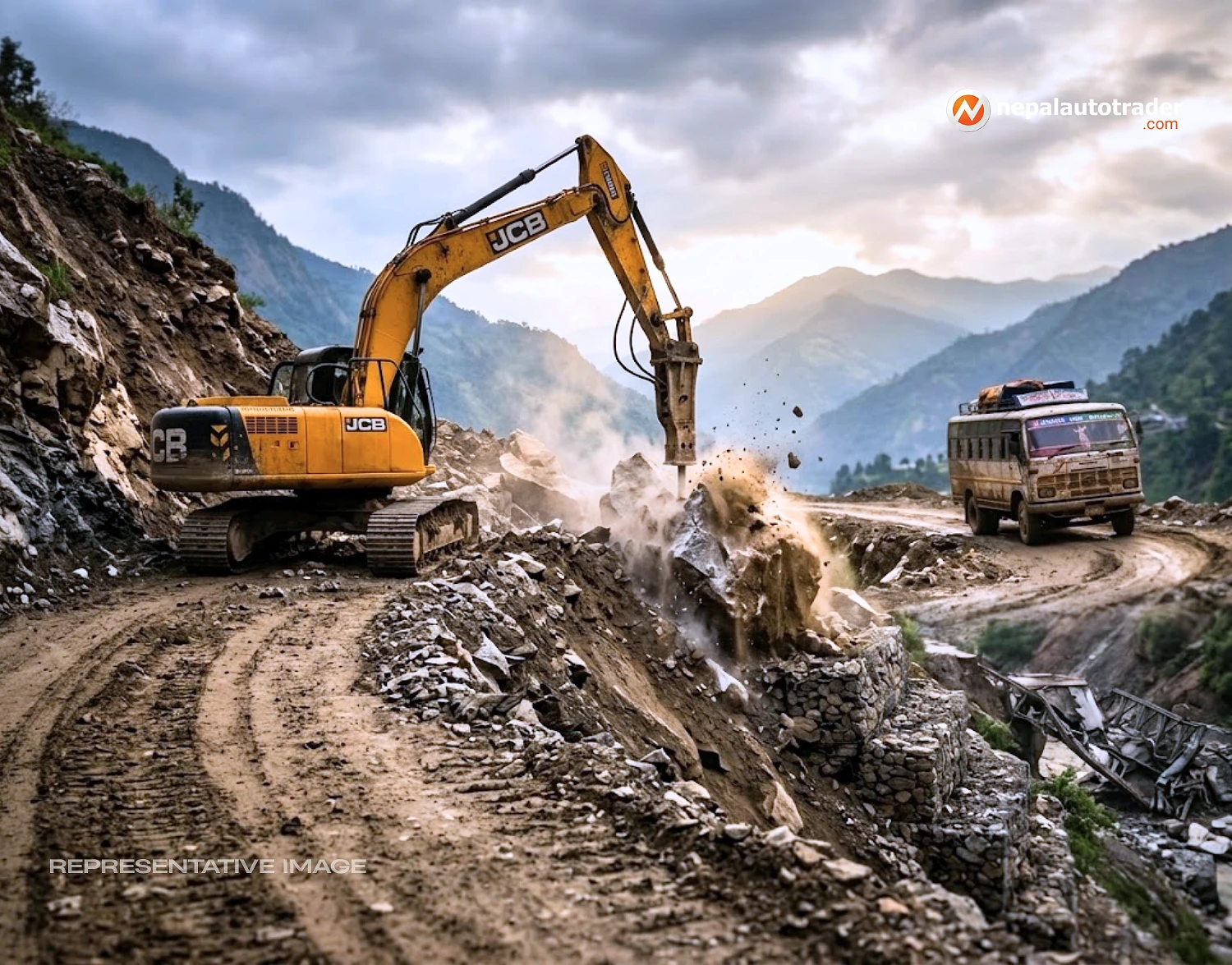
Rasuwa is back on Nepal's road network, at least partially. After Wednesday's flooding severed the district's main road connection, authorities have repaired an alternative rural route that can now accommodate small vehicles.
The change is significant because the disruption was not a routine road closure. The flood swept away the Betravati bridge, cutting the established connection into Rasuwa and leaving the district without its normal road access. The alternative route provides a way through, but it is best understood as an emergency lifeline rather than a replacement highway.
According to the Infrastructure Development Ministry, motorists can now travel from Kathmandu through Tokha, Chhahare, Gadkharpul, Aapre, Narja, Lachyang, Sarmathali and Patikharka before reaching Bogatitaar and continuing toward Kalikasthan and Dhunche.
The route was not normally used for regular vehicle traffic. It has been repaired specifically to restore limited connectivity following the disaster. That distinction matters. Rasuwa is connected again, but normal road operations have not returned.
For drivers, the new connection comes with a very different experience from the regular road. The alternative is a narrow rural road, and parts of it remain unpaved. Authorities say only small four-wheeled vehicles can use the route.
That immediately limits its role in the wider transport network. Heavy trucks, buses and other large vehicles cannot simply divert onto the road and continue toward Rasuwa.
For residents and essential travellers, even an imperfect road is a major improvement over complete isolation. Yet the physical condition of the detour means authorities will need to manage traffic carefully, particularly if demand increases.
The regular route from Kathmandu to Rasuwa remains unavailable because the flood destroyed the concrete bridge at Betravati. A Bailey bridge is now being prepared at the location, but installation will take time.
| Road connection | Current condition | Vehicle access |
|---|---|---|
| Alternative route to Dhunche | Repaired and opened | Small four-wheeled vehicles |
| Kathmandu-Trishuli-Betravati route | Main bridge destroyed | Large vehicles unable to pass |
| Betravati-Mailung-Syafrubesi-Rasuwagadhi road | Severely damaged | Normal traffic disrupted |
The government is preparing to install a Bailey bridge at Betravati because restoring that crossing is essential for bringing the regular route back into operation. Until then, the detour remains the only newly restored road option for small vehicles.
The significance extends beyond convenience. A functioning main road is critical for the movement of goods, larger vehicles, construction equipment and emergency supplies. A narrow rural detour cannot perform all of those jobs.
The scale of the infrastructure damage explains why authorities are not treating the reopening as a quick fix. Around 40 kilometres of roads across Rasuwa have been damaged by the flood, while the Betravati-Mailung-Syafrubesi-Rasuwagadhi road has been described as completely washed away.
Earlier assessments from the Department of Roads reported at least 19 bridges and approximately 40 kilometres of roads damaged in the affected areas. The department said the full extent of the damage had not yet been determined when the initial assessment was made.
| Infrastructure | Reported impact | Immediate response |
|---|---|---|
| Roads in Rasuwa | Approximately 40 kilometres damaged | Repair and reconstruction underway |
| Betravati bridge | Concrete bridge swept away | Bailey bridge preparation |
| Betravati-Mailung-Syafrubesi-Rasuwagadhi road | Completely damaged | Restoration required |
| Bridges in affected areas | At least 19 damaged in initial assessment | Heavy machinery and technical teams deployed |
The government has also been moving equipment into affected areas to clear debris and begin restoration work. A separate ministry update said 20 pieces of equipment, including 10 government machines and 10 supplied by the private sector, had been mobilized for road and bridge recovery.
Seven Bailey bridges, each available for immediate deployment at lengths of up to 50 metres, were also identified for damaged crossings. India and China have reportedly committed to providing additional Bailey bridges when required.
The immediate priority is clear: keep the emergency connection functioning while rebuilding the normal corridor. That will not happen overnight.
The regular road network is particularly important for Rasuwa because the district's main corridors connect communities with larger transport routes and the Rasuwagadhi border area. Until the main road is repaired, freight and heavy transport will remain constrained.
Recent flooding has also disrupted several other major roads in Nepal, including the Nagdhunga-Muglin corridor and the Trishuli-Mailung-Syafrubesi road. The wider disruption shows how quickly damage to bridges and river corridors can affect vehicle movement far beyond a single district.
For now, the message for motorists is simple. Rasuwa is accessible again, but only in a limited sense. The alternative road restores movement for small vehicles, while the main connection still waits for a bridge and much larger reconstruction effort.
There is an understandable temptation to describe the reopening as a return to normal. It is not.
The repaired rural route gives Rasuwa an essential lifeline after a devastating flood, and that alone matters. But with roughly 40 kilometres of road damage, a destroyed Betravati bridge and major sections of the main corridor washed away, the real infrastructure challenge is still ahead.
The Bailey bridge at Betravati will be the next critical milestone. Once that crossing is restored, attention can turn toward rebuilding the damaged road network and bringing larger vehicles back into the district.
For motorists, the current detour is useful. For Nepal's transport system, it is a reminder of something less comfortable: when a major river crossing fails, connectivity can disappear in hours, while rebuilding it can take considerably longer.
Q: Can vehicles now travel from Kathmandu to Rasuwa?
A: Yes, an alternative route has been repaired and opened for small four-wheeled vehicles. The route passes through several rural roads before reaching Kalikasthan and Dhunche.
Q: Can buses and large trucks use the new alternative route?
A: No. The alternative road is narrow and suitable only for small four-wheeled vehicles. Larger vehicles remain unable to reach Rasuwa through the normal route.
Q: Why is the regular Kathmandu-Trishuli-Betravati route still closed?
A: Flooding swept away the concrete bridge at Betravati. Authorities are preparing to install a Bailey bridge, but the normal connection cannot reopen for larger traffic until the crossing is restored.
Q: How much road infrastructure has been damaged in Rasuwa?
A: Approximately 40 kilometres of road have been damaged across Rasuwa. The Betravati-Mailung-Syafrubesi-Rasuwagadhi road has been reported as completely damaged.
Q: When will the normal road connection to Rasuwa reopen?
A: The source does not provide a specific reopening date. Authorities are preparing a Bailey bridge at Betravati, while larger-scale road restoration will still be required.
Q: Is the alternative route suitable for regular long-distance travel?
A: It provides an important emergency connection, but it is a narrow and partly unpaved rural road. Travel can be difficult, and access remains restricted to small vehicles.

Nepal Auto-Trader is one-stop platform for all automotive needs. We provide unbiased and unparalleled news/reviews of all auto-motives being launched in Nepalese Auto-Industry. Find recent updates and price of bikes/cars, compare and review recently launched bikes/cars, buy/sell/trade reconditioned cars/bikes and all government news about changing rules and regulation, road safety by subscribing us.

Subscribe to our Newsletter
© Copyright 2026, Nepal Autotrader



.png)
.png)