

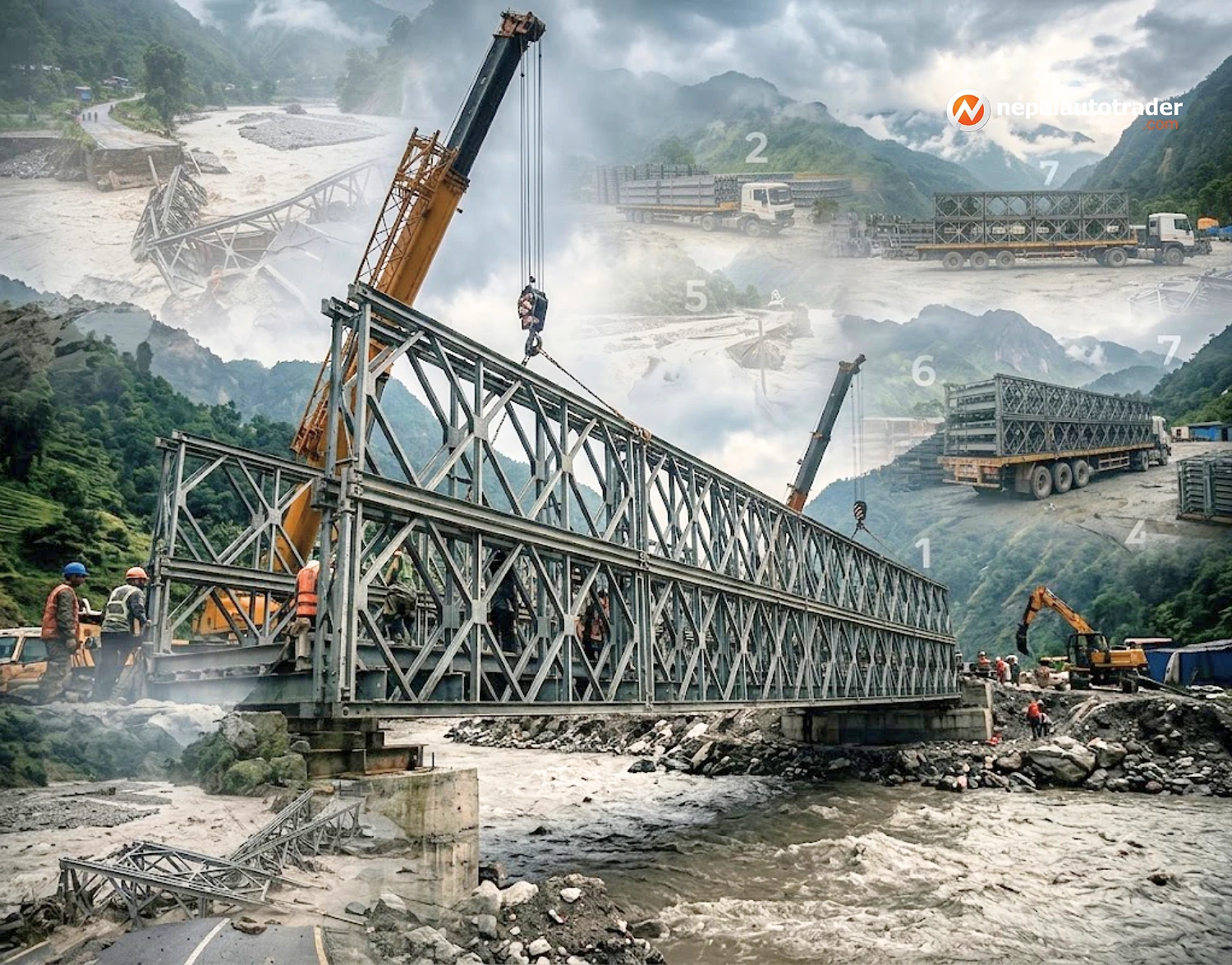
The scale of the damage explains why the Bailey bridge response is being treated as an urgent transport operation rather than a routine infrastructure repair. A flood in the Bhotekoshi River has left bridges destroyed and long stretches of road either washed away or blocked.
According to the Ministry of Physical Infrastructure Development, 41 bridges were completely damaged by the flood. The same ministry says around 40 kilometres of road in Rasuwa was also completely damaged.
That combination matters. Replacing one bridge does not restore a route if the road leading to it is still unusable. In this case, the authorities are working on both fronts, clearing damaged roads while preparing temporary bridge structures.
The immediate objective is straightforward, reconnect the areas that have been cut off and restore vehicle movement as quickly as conditions allow.
The ministry says seven Bailey bridges are available for immediate installation at locations where bridges have been washed away. These structures can be installed at sites requiring spans of up to 50 metres, subject to an assessment of need and feasibility.
| Infrastructure item | Reported figure | Status or purpose |
|---|---|---|
| Bailey bridges | 7 | Available for immediate installation |
| Maximum bridge length | 50 metres | Maximum span stated by the ministry |
| Completely damaged bridges | 41 | Damage reported following the flood |
| Road damage in Rasuwa | About 40 kilometres | Road network substantially disrupted |
Betravati has been selected for the first installation. The decision reflects its importance in restoring access toward Rasuwa. The ministry says that until the road to Betravati is reopened, reaching Dhunchhe and then Syafrubesi is not possible by the affected route.
It is a temporary bridge strategy, but there is nothing temporary about its importance. When a permanent structure is gone, a Bailey bridge can become the difference between an isolated corridor and a functioning one.
The bridge installations are only one part of the response. Authorities are also trying to remove mud and debris from damaged roads, with the Prithvi Highway receiving first priority.
The ministry reports that approximately 13 kilometres of the Prithvi Highway has been covered with mud. Work is under way to remove the material and restore vehicle movement. Separately, around 10 kilometres between Galchhi and Trishuli remains closed.
The wider Rasuwa corridor has suffered especially severe disruption. The road from Betravati through Mailung, Syafrubesi and Rasuwagadhi has been described as completely damaged.
This is where the response becomes a race against the condition of the network itself. A bridge may be ready, but it cannot carry traffic until the approach roads can carry traffic too.
To accelerate the reopening effort, 20 pieces of equipment have been mobilised. The government has supplied 10, while the private sector has supplied another 10.
| Resource | Quantity | Role described in the source |
|---|---|---|
| Government-supplied equipment | 10 | Road-opening and infrastructure response |
| Private-sector equipment | 10 | Supporting road clearance and recovery |
| Total equipment | 20 | Mobilised for the response |
The source does not identify the individual equipment models, capacities or contractors operating them, so those details cannot yet be established from the available information. It also does not provide a total construction cost for the seven Bailey bridges or a final budget for the recovery work.
That absence of a published cost figure is significant for anyone trying to assess the full financial scale of the disaster response. At this stage, the clearest measure is operational, how quickly roads can be cleared and temporary crossings restored.
Nepal is not relying only on the seven Bailey bridges already available. The ministry says both the Government of India and the Government of China have committed to making necessary Bailey bridges available immediately.
The additional support could become important if the number of damaged crossings exceeds the country's immediately available temporary bridge stock. The source does not specify how many additional bridges either country will provide, nor does it give a delivery schedule.
That distinction matters. The commitment is clear, but the operational details remain open.
The wider infrastructure damage also shows why the response cannot be measured solely by the number of bridges installed. A temporary crossing restores a physical link, but the surrounding road has to be accessible, stable and safe enough for traffic.
For motorists, freight operators and communities in the affected corridor, the real milestone will therefore be movement, not the installation ceremony.
The immediate sequence is already taking shape. Authorities are prioritising the Prithvi Highway, while simultaneously working to reconnect Rasuwa to the national road network.
The ministry has not provided a final completion date for all seven bridge installations. That makes the current operation less about a single deadline and more about restoring the network in stages.
The significance extends beyond one road corridor. Nepal's mountainous transport system depends heavily on bridges, and when floods remove several crossings at once, the consequences spread rapidly across road access, local movement and regional connectivity.
For now, Betravati is the critical starting point. If the first Bailey bridge can be installed and the connecting road reopened, it will provide an early indication that the damaged corridor is beginning to move again.
Q: How many Bailey bridges are being prepared for installation?
A: The Ministry of Physical Infrastructure Development says seven Bailey bridges are available for immediate installation at locations where they are needed and feasible.
Q: Where will the first Bailey bridge be installed?
A: The first installation is being prepared at Betravati. The ministry has identified restoring road access to Rasuwa as a priority.
Q: How long can the available Bailey bridges be?
A: The source says the available Bailey bridges can be installed for spans of up to 50 metres. The exact length required at each location will depend on the site.
Q: How badly has the road network been damaged?
A: Around 40 kilometres of road in Rasuwa has been completely damaged. The source also reports approximately 13 kilometres of the Prithvi Highway covered in mud and around 10 kilometres of the Galchhi to Trishuli road closed.
Q: How many machines are being used for the recovery effort?
A: A total of 20 pieces of equipment are being deployed, including 10 supplied by the government and 10 from the private sector.
Q: Are India and China also providing Bailey bridges?
A: Yes. The ministry says the Government of India and Government of China have committed to providing necessary Bailey bridges immediately. The source does not specify the number or delivery timeline.

Nepal Auto-Trader is one-stop platform for all automotive needs. We provide unbiased and unparalleled news/reviews of all auto-motives being launched in Nepalese Auto-Industry. Find recent updates and price of bikes/cars, compare and review recently launched bikes/cars, buy/sell/trade reconditioned cars/bikes and all government news about changing rules and regulation, road safety by subscribing us.

Subscribe to our Newsletter
© Copyright 2026, Nepal Autotrader



.png)
.png)