

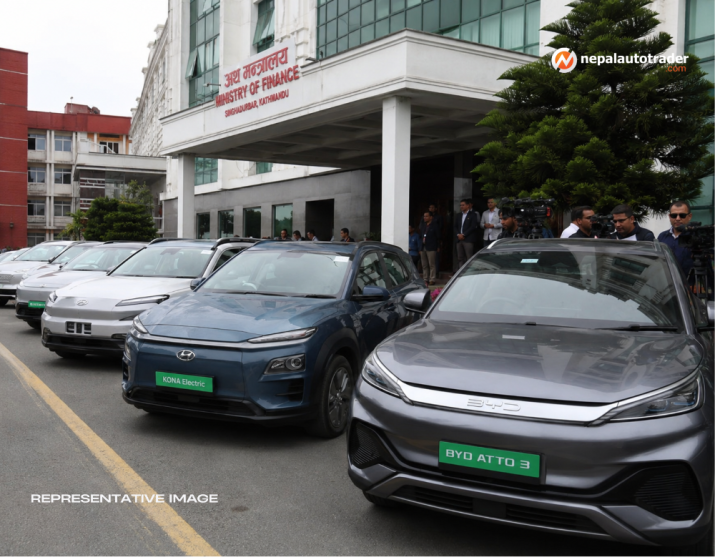
Nepal’s electric vehicle market just hit a turning point. A real one.
In the national budget for Fiscal Year 2026/27, the government confirmed that electric vehicles will no longer be taxed according to peak motor power. Instead, duties will now be tied directly to a vehicle’s declared value. That sounds technical on paper. In reality, it changes the entire conversation around how EVs are imported, priced and sold in Nepal.
For years, Nepal used a tiered tax structure based on kilowatt output. Higher power figures meant steeper customs and excise duties. The setup pushed several automakers and importers toward detuned versions of global EVs just to fit into lower tax brackets. Buyers often ended up with compromised specifications.
Now, the government says that era is over.
And honestly, this was coming.
According to the budget statement presented by Finance Minister Dr. Swarnim Wagle, the previous structure created market distortions because expensive EVs with artificially lower power ratings could still qualify for lower taxes.
That mattered more than many people realized.
The old system looked like this:
| Motor Power Category | Customs Duty | Excise Duty |
|---|---|---|
| Up to 50 kW | 15% | 5% |
| 51 kW to 100 kW | 20% | 15% |
| 101 kW to 200 kW | 30% | 20% |
| 201 kW to 300 kW | 60% | 35% |
Those slabs shaped Nepal’s EV market for years. Carmakers adapted. Dealers adapted. Customers adapted too.
But there was a growing problem underneath the surface. Some EVs with premium pricing and sophisticated hardware were entering Nepal with lower motor output figures simply to avoid higher taxation. Industry stakeholders had repeatedly questioned whether motor power alone should determine taxation in a country where terrain and road conditions often demand stronger drivetrains.
Here’s the thing.
Once taxation shifts toward declared vehicle value, the government gains a more predictable revenue model. But premium EV buyers are likely going to feel the hit first.
The immediate concern across the industry revolves around pricing.
Luxury and high-end EVs that previously benefited from lower kW classifications could now face significantly higher effective taxation if their import value becomes the main benchmark. That could reshape pricing strategies for several brands operating in Nepal.
Not everyone will notice it immediately. Entry-level EVs may remain relatively stable if their invoice values stay competitive. But imported premium models, especially fully loaded variants, are entering uncertain territory.
Industry conversations around this had already intensified before the budget announcement. Reports suggested several alternative taxation proposals were under discussion, including battery-capacity taxation and simplified kW slabs. Ultimately, the government chose value-based taxation instead.
Potential market effects include:
That final point is important.
Nepal’s EV market has grown aggressively over the last few years because buyers saw electric mobility as both aspirational and financially sensible. If premium EV pricing climbs sharply, value-focused brands could gain even more ground.
Brands already competing aggressively in the mainstream segment may benefit from the transition. Readers tracking Nepal’s EV market may also want to explore our coverage of the latest EV market growth trends and this breakdown of the BYD Dolphin’s real-world ownership appeal.
The government did not stop with customs reform.
A new Clean Infrastructure Investment Fee will now be collected at customs. According to the budget announcement, the money will support:
At the same time, several older charges, including infrastructure development tax and road maintenance fees, have been merged into a single Green Tax.
| Policy Change | Previous System | New System |
|---|---|---|
| EV Tax Basis | Motor power (kW) | Vehicle value |
| Infrastructure Charges | Separate taxes and fees | Single Green Tax |
| EV Ecosystem Funding | Limited targeted mechanism | Dedicated infrastructure fee |
The simplification could help reduce administrative complexity at customs. Buyers probably will not celebrate another fee entering the equation, but the government clearly wants to connect taxation directly with EV ecosystem development.
Whether that money actually translates into faster charger deployment and better public infrastructure is the bigger question.
Nepal’s charging network is improving, but outside major urban corridors, range anxiety remains very real.
The budget also introduced a Smart Urban Mobility program for Kathmandu. And this part deserves attention beyond the EV industry itself.
The government says the initiative will include:
Pokhara is also expected to gradually transition toward electric public transport services. Petrol stations are being encouraged to install EV charging stations with minimum infrastructure requirements.
That broadens the story beyond private car ownership.
For a country heavily dependent on imported fossil fuels, electrified public transport changes the economics of mobility at scale. Some industry observers have argued for years that reducing petroleum dependence matters more than maximizing short-term customs revenue.
And frankly, they have a point.
Readers interested in Nepal’s broader infrastructure shift can also check our feature on how Nepal’s charging network is evolving and this analysis of electric public transport expansion plans.
The biggest challenge now is implementation.
Value-based taxation sounds straightforward until valuation disputes begin. Governments worldwide struggle with invoice manipulation, under-declaration concerns and valuation benchmarking when taxes depend heavily on declared import values.
Nepal will need tighter customs oversight if the new framework is going to function smoothly.
Still, this policy marks a philosophical shift.
The government appears less interested in discouraging power output and more focused on taxing vehicle value directly while accelerating EV infrastructure investment. That changes how automakers will approach Nepal going forward.
Some premium models may become harder sells. Mid-market EV competition could intensify. Global-spec vehicles might finally arrive without artificial detuning compromises.
And consumers? They’re about to discover whether this new system rewards transparency or simply makes electric cars more expensive.
The answer probably arrives faster than anyone expects.
Q: When will Nepal’s new value-based EV tax system take effect?
A:
The new policy was announced in the Fiscal Year 2026/27 national
budget. Implementation is expected to begin under the new fiscal
framework introduced by the government.
Q: How were EVs taxed in Nepal before this change?
A:
EV taxes were previously calculated according to motor power output
measured in kilowatts. Vehicles were grouped into different duty slabs
depending on their peak power figures.
Q: Will EV prices increase in Nepal after the new tax rule?
A:
Premium EVs with higher declared import values could become more
expensive under the revised structure. Entry-level models may see less
dramatic pricing changes depending on their invoice values.
Q: What is the new Green Tax announced in Nepal?
A:
The government merged several customs-related charges, including
infrastructure and road maintenance fees, into a single Green Tax to
simplify the taxation system.
Q: What is the Clean Infrastructure Investment Fee?
A:
It is a newly introduced customs fee intended to support EV charging
infrastructure, domestic EV assembly and battery recycling initiatives
across Nepal.
Q: Will Kathmandu get more electric public transport under the new budget?
A:
Yes. The government announced a Smart Urban Mobility program that
includes electric public buses, charging infrastructure, smart bus parks
and vehicle tracking systems in Kathmandu.

Nepal Auto-Trader is one-stop platform for all automotive needs. We provide unbiased and unparalleled news/reviews of all auto-motives being launched in Nepalese Auto-Industry. Find recent updates and price of bikes/cars, compare and review recently launched bikes/cars, buy/sell/trade reconditioned cars/bikes and all government news about changing rules and regulation, road safety by subscribing us.

Subscribe to our Newsletter
© Copyright 2026, Nepal Autotrader



.png)
.png)