

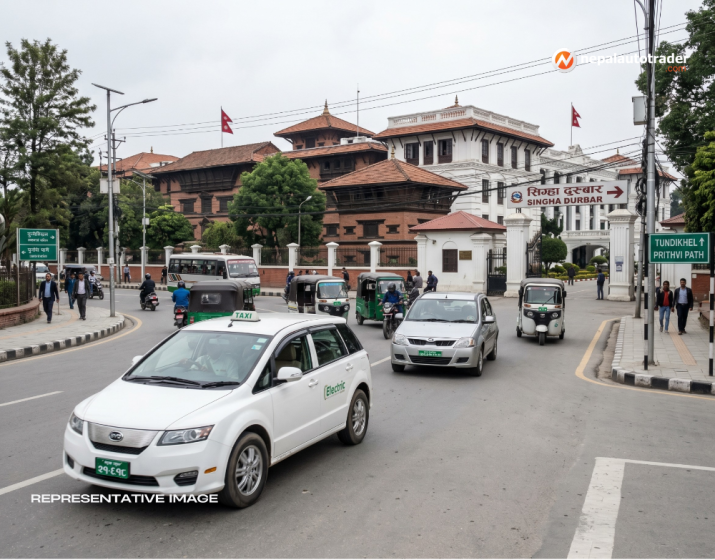
Electric vehicles have spent the last few years riding a wave of momentum in Nepal. Walk through Kathmandu today and the shift is impossible to miss. BYD crossovers, MG hatchbacks, Tata EVs, premium Chinese SUVs, they are everywhere.
Now the government has complicated that momentum.
Nepal has increased the road construction and maintenance tax burden on electric vehicles, adding fresh pressure to a market that had become one of South Asia’s most aggressive EV growth stories. The revision arrives at a sensitive moment, just as financing rules tightened and consumers started questioning how affordable electric mobility will remain over the next few years.
That matters.
The country has aggressively promoted EV adoption through lower customs and excise duties compared to internal combustion vehicles. But policymakers also face another reality, roads need funding, infrastructure expansion is expensive, and fuel tax revenue naturally drops as EV penetration rises.
Here’s the thing. Governments eventually try to recover that gap somewhere.
On paper, Nepal still looks EV-friendly. Customs and excise duties on electric vehicles remain significantly lower than taxes imposed on petrol and diesel models.
But ownership costs are no longer moving in just one direction.
Over the past year, buyers have already faced:
The new road construction tax increase adds another layer.
Industry insiders say the timing is particularly difficult because Nepal’s EV boom has been strongest in the affordable and mid-range segments. Buyers moving from motorcycles or compact petrol hatchbacks into their first electric car are extremely price sensitive.
Not everyone will notice it immediately. But cumulative costs change buying behavior faster than headlines do.
According to published tax structures currently applicable in Nepal, EVs already face customs duty, excise duty, VAT and road development fees depending on motor power categories.
| EV Motor Power Category | Customs Duty | Excise Duty | Road Development Fee |
|---|---|---|---|
| Up to 50 kW | 15% | 5% | 5% |
| 51 kW to 100 kW | 20% | 15% | 5% |
| 101 kW to 200 kW | 30% | 20% | 5% |
| 201 kW to 300 kW | 60% | 35% | 5% |
| Above 300 kW | 80% | 50% | 5% |
The result is obvious. Smaller EVs remain relatively protected, but every policy revision chips away at the affordability advantage that pushed EV adoption into the mainstream.
The government is trying to balance two competing realities.
First, Nepal wants EV adoption to accelerate. The country imports expensive fossil fuels while generating domestic hydropower. Electrification helps reduce fuel imports and supports energy self-reliance.
Second, road infrastructure spending cannot rely forever on taxes collected from petrol and diesel consumption.
That transition creates tension.
Officials continue promoting charging infrastructure, EV assembly and clean mobility investment. The government has also maintained incentives for charging equipment and related industries.
At the same time, policymakers increasingly appear reluctant to let EVs remain a lightly taxed category forever.
This is where the market gets nervous.
Frequent policy shifts have historically disrupted Nepal’s automobile sector. Dealers import vehicles months before sales begin. Banks structure financing around expected tax rates. Consumers delay purchases when rumors of tax changes spread through the market.
The EV market analysis published earlier this year already highlighted how sensitive showroom traffic becomes whenever budget discussions begin.
And yes, buyers are paying attention.
Talk to importers privately and a consistent theme appears. Most are not demanding zero taxes. What they want is predictability.
That distinction matters.
Several distributors spent the last two years aggressively expanding EV inventory, charging partnerships and service infrastructure. Brands including BYD, MG, Tata Motors and Dongfeng pushed deeper into Nepal’s growing electric market.
But repeated policy speculation has made inventory planning difficult.
Some dealers reportedly accelerated imports before fiscal policy revisions took effect. Others delayed launches entirely while waiting for budget clarity.
The situation becomes even more complicated after the central bank reduced the loan-to-value ratio for EV financing from 80% to 60%.
| Market Pressure | Impact on EV Buyers | Industry Effect |
|---|---|---|
| Road tax increase | Higher ownership cost | Reduced entry-level demand |
| Lower financing limits | Bigger down payment required | Slower showroom conversion |
| Policy uncertainty | Purchase delays | Inventory risk increases |
| Import duty revisions | Higher retail prices | Margin pressure for dealers |
The broader concern is psychological. EVs succeeded partly because consumers believed the government fully backed electrification.
Mixed signals weaken confidence.
The recent BYD Dolphin review and MG4 comparison test both reflected how rapidly consumer interest has expanded beyond early adopters.
Now the market enters a more cautious phase.
Even with rising taxes, EVs in Nepal still carry major advantages over petrol and diesel vehicles.
Operating costs remain dramatically lower. Electricity prices are relatively stable. Maintenance requirements are simpler. Urban commuting favors regenerative braking and stop-start efficiency.
And frankly, Kathmandu traffic makes electric driving feel natural.
There’s another important factor. Nepal’s public charging network continues expanding at a meaningful pace.
That underlying momentum will not disappear overnight because of a tax increase.
Still, the affordability conversation is changing.
Earlier, buyers mainly asked whether EVs could handle long-distance driving in Nepal. Now they increasingly ask whether policy stability can be trusted long term.
The country remains one of the most fascinating EV markets in the region.
Adoption has moved far faster than many analysts expected. Chinese brands established serious market presence. Consumers embraced EVs quicker than traditional automakers anticipated.
But maturing markets become more politically complicated.
Road construction taxes on EVs signal that Nepal is entering a new phase of electric mobility policy. One where governments support electrification while simultaneously searching for sustainable revenue models.
That balancing act will define the next chapter.
For buyers, the immediate takeaway is simple. EV ownership still makes financial sense for many urban users, especially compared to heavily taxed petrol SUVs and rising fuel costs.
For the industry, the message is less comfortable.
Policy stability may now matter more than tax incentives themselves.
And that conversation is only getting started.
Q: Has Nepal increased taxes on electric vehicles?
A: Yes. Nepal has increased road construction and maintenance related taxation on EVs, adding to existing customs duties, excise duties and VAT structures applied according to motor power categories.
Q: Will EV prices increase after the new tax revision?
A: Higher taxation generally increases overall ownership costs. Entry-level and mid-range EV segments are expected to feel the strongest pressure because those buyers are highly price sensitive.
Q: Are EVs still cheaper to own than petrol cars in Nepal?
A: In many cases, yes. Electricity remains cheaper than petrol, and EV maintenance costs are typically lower. The long-term ownership equation still favors EVs for many urban users.
Q: Which EV brands are most active in Nepal right now?
A: Brands such as BYD, MG, Tata Motors and several Chinese manufacturers continue expanding aggressively in Nepal’s fast-growing electric vehicle market.
Q: Has EV financing changed in Nepal?
A: Yes. Nepal Rastra Bank reduced the loan-to-value ratio for EV financing from 80% to 60%, requiring buyers to arrange larger down payments.
Q: Is Nepal still supporting EV infrastructure development?
A: Yes. The government continues supporting charging infrastructure, EV-related industries and charging equipment imports through targeted incentives and policy support.

Nepal Auto-Trader is one-stop platform for all automotive needs. We provide unbiased and unparalleled news/reviews of all auto-motives being launched in Nepalese Auto-Industry. Find recent updates and price of bikes/cars, compare and review recently launched bikes/cars, buy/sell/trade reconditioned cars/bikes and all government news about changing rules and regulation, road safety by subscribing us.

Subscribe to our Newsletter
© Copyright 2026, Nepal Autotrader


.png)
.png)