

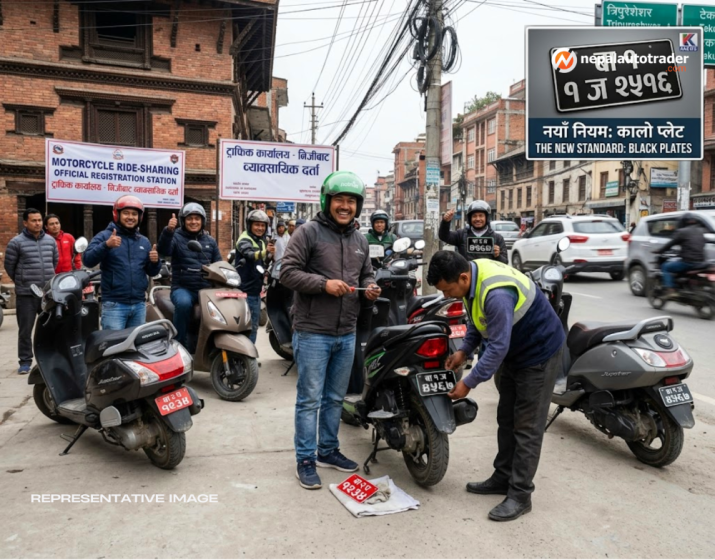
Nepal's ride-sharing sector has just entered a new phase.
The government has introduced fresh rules requiring motorcycles and scooters used for ride-sharing services to be registered as commercial vehicles with black number plates. Alongside that change comes a new annual income tax of NPR 3,000 and a 5 percent tax on every ride-sharing transaction.
For thousands of riders using platforms such as Pathao, InDrive and similar services, the announcement represents the most significant regulatory shift the sector has seen in years. And it arrives at a time when policymakers are still debating how ride-sharing should fit within Nepal's broader transport framework.
Until now, most ride-sharing services in Nepal operated using privately registered motorcycles and scooters carrying red number plates.
The new economic act changes that arrangement. Vehicles carrying paying passengers through ride-sharing platforms must now be registered as hired or commercial vehicles. Under the provisions of the Transport Act 2049, those vehicles are required to use black number plates.
That may sound like a simple administrative update. It isn't.
For many riders, particularly part-time operators, the requirement creates a new compliance process and potentially changes how they participate in the ride-sharing economy.
The government's new framework introduces several direct obligations for ride-sharing operators.
| Requirement | Previous Situation | New Rule |
|---|---|---|
| Number Plate | Red private plate commonly used | Black commercial plate required |
| Vehicle Registration | Private registration | Commercial or hired vehicle registration |
| Annual Tax | Not specified for ride-sharing two-wheelers | NPR 3,000 annually |
| Ride Transactions | No new levy under this framework | 5% tax on each transaction |
The combination of registration requirements and taxation signals a clear attempt by the government to formally regulate a sector that has expanded rapidly through smartphone-based platforms.
One of the biggest takeaways from the announcement is the government's decision to create a dedicated tax mechanism for ride-sharing.
Key elements include:
Officials appear to be moving toward a model where ride-sharing is treated less like informal transport and more like a recognized commercial mobility service.
Not everyone will notice it immediately. But platform operators, riders and passengers eventually will.
The timing of the announcement is significant because discussions around ride-sharing regulation have intensified across Nepal.
A separate dispute has already emerged between federal authorities and the Gandaki provincial government over how ride-sharing vehicles should be regulated. While federal rules now require black plates for fare-based two-wheelers, provincial regulations previously allowed certain ride-sharing operations using red-plated motorcycles.
The disagreement highlights a broader policy challenge.
How should governments balance safety, taxation and regulation without making participation too difficult for part-time riders?
Public reaction has been mixed. Some observers argue that clearer registration and taxation improve accountability. Others fear additional compliance costs could discourage students and part-time workers who rely on ride-sharing income. Discussions across Nepal's online communities reflect both perspectives.
Ride-sharing has become an important part of urban transportation in cities such as Kathmandu and Pokhara.
The government's latest move effectively acknowledges that reality.
Rather than banning the activity outright, policymakers are creating a framework that treats ride-sharing as a taxable commercial transport service. That distinction is important because it gives the sector a more formal legal identity while also expanding government oversight.
Here's the thing.
The success of the policy may ultimately depend on implementation. If registration processes remain straightforward and affordable, compliance could increase. If administrative hurdles grow, some riders may reconsider participation.
For now, one fact is clear. Nepal's ride-sharing industry is no longer operating in the grey area it once occupied.
The era of the red plate ride-sharing motorcycle is coming to an end.
Q: Can motorcycles with red number plates still provide ride-sharing services?
A: No. Under the new economic act, motorcycles and scooters used for ride-sharing must be registered as hired vehicles and carry black number plates.
Q: How much annual tax must ride-sharing two-wheelers pay?
A: The government has fixed the annual income tax at NPR 3,000 for two-wheelers registered under the new ride-sharing framework.
Q: Is there a tax on every ride-sharing booking?
A: Yes. The government has introduced a 5 percent tax on each ride-sharing transaction.
Q: When do black number plates become necessary?
A: The requirement applies under the new economic legislation that now recognizes ride-sharing two-wheelers as hired vehicles.
Q: Why is Nepal introducing these changes?
A: The measures formalize ride-sharing operations, bring them under commercial registration rules and create a taxation structure for the growing sector.

Nepal Auto-Trader is one-stop platform for all automotive needs. We provide unbiased and unparalleled news/reviews of all auto-motives being launched in Nepalese Auto-Industry. Find recent updates and price of bikes/cars, compare and review recently launched bikes/cars, buy/sell/trade reconditioned cars/bikes and all government news about changing rules and regulation, road safety by subscribing us.

Subscribe to our Newsletter
© Copyright 2026, Nepal Autotrader



.png)
.png)