

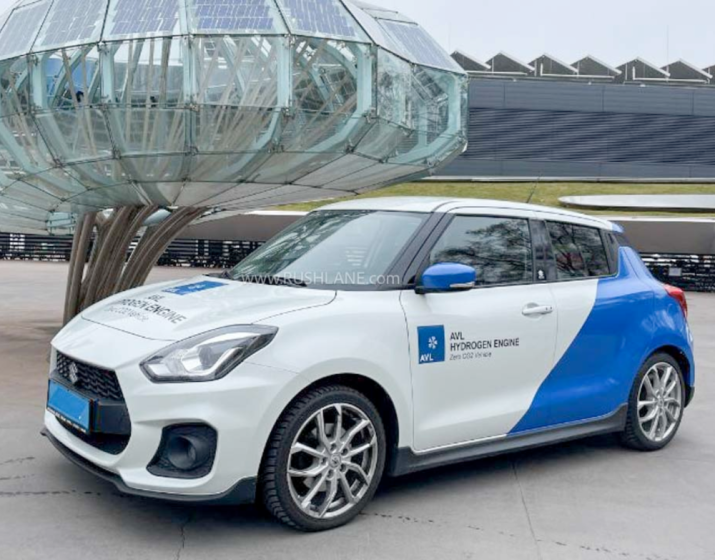
Suzuki has revealed a hydrogen-powered version of the Swift at the 47th International Vienna Motor Symposium, showing a different path for zero-emission mobility. This is not a fuel-cell electric vehicle. Instead, Suzuki and Austrian engineering company AVL have developed a hydrogen-burning internal combustion engine based on the familiar compact hatchback.
That detail matters. A lot.
Most hydrogen vehicles on the road today rely on fuel-cell systems that convert hydrogen into electricity. Suzuki has gone another way. The company is burning hydrogen directly inside a modified combustion engine, preserving the feel and mechanical structure of a traditional ICE powertrain while cutting tailpipe emissions to water vapor.
The choice of the Swift was deliberate. Suzuki did not use a luxury sedan or a commercial truck to present this technology. It used one of its most recognizable global hatchbacks.
That changes the conversation around hydrogen.
Hydrogen mobility projects are often associated with expensive flagship vehicles or large transport fleets. Suzuki’s prototype sends a different message, compact and affordable cars can also adopt hydrogen combustion technology.
The company says the prototype is based on a modified 1.4-litre four-cylinder engine equipped with direct-injection hydrogen technology developed alongside AVL. The setup allows the engine to burn hydrogen directly in the combustion chamber instead of using hydrogen to create electricity through a chemical process.
According to details shared around the project, the engine can operate in both lean combustion and stoichiometric combustion modes using a cooled EGR system.
| Component | Specification |
|---|---|
| Vehicle | Suzuki Swift Hydrogen Prototype |
| Engine | 1.4-litre 4-cylinder hydrogen ICE |
| Technology Partner | AVL |
| Power Output | 100 kW |
| Torque | 220 Nm |
| Fuel Type | Hydrogen |
| Emission Output | Primarily water vapor |
Suzuki says the setup delivers improved performance while maintaining combustion stability. Reports surrounding the unveiling mention gains of around 10 kW and 20 Nm in stoichiometric mode.
This is still experimental technology, but it feels less distant than many hydrogen concepts shown over the last decade.
There is an important distinction here. The Swift Hydrogen is not comparable to vehicles like the Toyota Mirai, which uses a hydrogen fuel-cell system.
Instead, Suzuki is exploring what many engineers now call Hydrogen ICE, essentially a combustion engine redesigned to run on hydrogen.
The benefit is familiarity. Existing engine architecture, manufacturing systems, servicing infrastructure, and supplier networks can potentially remain relevant. Carmakers do not need to completely reinvent vehicle platforms to explore hydrogen mobility.
That could become critical for markets where affordability still dictates buying decisions.
| Technology Type | Hydrogen ICE | Hydrogen Fuel Cell |
|---|---|---|
| Power Generation | Burns hydrogen directly | Creates electricity chemically |
| Power Delivery | Mechanical combustion | Electric motor driven |
| Complexity | Uses modified ICE architecture | Requires fuel-cell stack and battery |
| Tailpipe Emissions | Mainly water vapor | Water vapor |
| Potential Advantage | Lower adaptation cost | High efficiency |
Hydrogen combustion also preserves familiar driving characteristics. The sound, mechanical feel, and response remain closer to conventional ICE vehicles compared to battery EVs.
For enthusiasts, that matters. For manufacturers, it could matter even more.
Suzuki’s announcement arrives at a time when hydrogen infrastructure discussions are accelerating globally. Governments and automakers are investing heavily in alternative fuel technologies as pressure grows to reduce emissions without relying solely on battery-electric vehicles.
India, one of Suzuki’s biggest markets through Maruti Suzuki, has already begun building a hydrogen mobility framework under the National Green Hydrogen Mission.
Recent developments highlighted in regional reports include:
That wider ecosystem is important because hydrogen vehicles are only as viable as the infrastructure supporting them. Without refueling stations, the technology struggles to scale.
Still, Suzuki’s approach may offer a more adaptable solution for emerging markets where cost sensitivity remains high.
The company has not confirmed production plans for the hydrogen-powered Swift. No launch timeline, pricing details, or commercialization roadmap were announced during the symposium.
But the signal is clear. Hydrogen is no longer being explored only for buses, trucks, or premium showcase vehicles.
That question surfaced almost immediately after the unveiling.
Maruti Suzuki remains India’s largest carmaker by volume, and the Swift continues to be one of its most recognizable hatchbacks. Suzuki Motor Corporation’s technology roadmap often shapes what eventually appears in India.
There is no official confirmation of an India launch. None.
Still, the existence of a functioning hydrogen-powered compact hatchback adds a new dimension to future mobility discussions in the region. Battery EVs currently dominate zero-emission headlines, while hybrids and CNG vehicles continue expanding rapidly. Hydrogen ICE now enters that conversation with a more accessible face.
The compact hatchback segment has rarely been associated with hydrogen technology. Suzuki may have changed that perception overnight.
And this is where the story becomes bigger than one prototype.
The automotive industry is increasingly moving toward a multi-energy future. EVs, hybrids, hydrogen, biofuels, and synthetic fuels are all competing for relevance. Suzuki’s hydrogen-powered Swift suggests the company does not believe there will be a single universal answer.
That perspective feels pragmatic. Especially in markets where infrastructure, affordability, and energy access vary dramatically.
For now, the Suzuki Swift Hydrogen remains a technology demonstrator. But it is also a reminder that the internal combustion engine may not disappear as quickly as many predicted. It may simply evolve.
Quietly. Rapidly. And perhaps with hydrogen flowing through it instead of petrol.
Q: Is the Suzuki Swift Hydrogen an electric vehicle?
A:
No. The hydrogen-powered Swift is not a fuel-cell EV. It uses a
modified internal combustion engine that burns hydrogen directly inside
the cylinders.
Q: What engine does the Suzuki Swift Hydrogen use?
A: The prototype uses a modified 1.4-litre four-cylinder engine developed with AVL and adapted to run on hydrogen fuel.
Q: How much power does the hydrogen Swift produce?
A: Reports surrounding the unveiling mention output figures of 100 kW and 220 Nm from the hydrogen combustion setup.
Q: Has Suzuki confirmed production plans for the hydrogen Swift?
A:
No production timeline or launch announcement has been made. The
vehicle was presented as a technology demonstrator at the Vienna Motor
Symposium.
Q: How is this different from the Toyota Mirai?
A:
The Toyota Mirai uses hydrogen fuel-cell technology to generate
electricity, while the Swift prototype burns hydrogen directly in a
combustion engine.
Q: Could this technology come to India through Maruti Suzuki?
A:
Suzuki has not confirmed any India launch plans. However, the unveiling
has sparked discussion because Maruti Suzuki closely follows Suzuki
Motor Corporation’s broader technology direction.

Nepal Auto-Trader is one-stop platform for all automotive needs. We provide unbiased and unparalleled news/reviews of all auto-motives being launched in Nepalese Auto-Industry. Find recent updates and price of bikes/cars, compare and review recently launched bikes/cars, buy/sell/trade reconditioned cars/bikes and all government news about changing rules and regulation, road safety by subscribing us.

Subscribe to our Newsletter
© Copyright 2026, Nepal Autotrader



.png)
.png)