

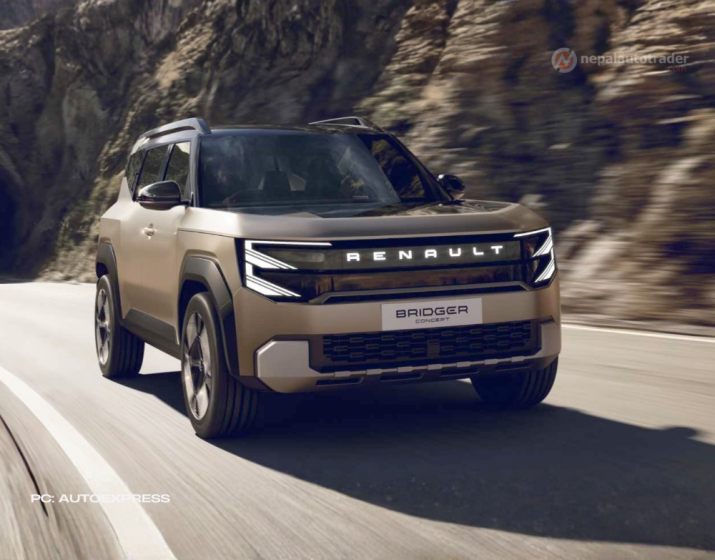
Renault is pushing deeper into the compact SUV battle, and this time the focus is not just design or pricing. It is efficiency. The upcoming Renault Bridger, the sub-4 metre SUV expected to arrive by the end of 2027, will reportedly receive a brand-new 1.2-litre hybrid powertrain developed with support from Horse Powertrain, the UK-based powertrain specialist jointly owned by Renault, Geely, and Saudi Aramco. That matters.
The development comes at a critical moment for Renault India. The French brand is rebuilding its portfolio with products like the new Duster and the upcoming Bridger, both expected to play a central role in reviving volumes in one of the world’s most competitive SUV markets.
Unlike the regular petrol version already reported earlier, the new hybrid setup is expected to use a 3-cylinder Miller cycle engine, engineered primarily for fuel efficiency rather than outright performance. Renault is also said to be exploring technology from AVL’s H12 concept showcased at the Vienna Motor Symposium.
The biggest talking point here is the engine architecture. Renault is reportedly moving toward a Miller cycle combustion setup for the hybrid Bridger. In simple terms, the Miller cycle prioritises thermal efficiency by altering valve timing and reducing pumping losses inside the engine.
Hybrid systems compensate for the lower peak combustion output using electric assistance. The result can be impressive fuel economy without sacrificing urban drivability.
According to reports, Renault could borrow several technologies from AVL’s H12 high-efficiency demonstrator, which claimed fuel consumption figures of just 3.3 litres per 100km on a modified Dacia Duster test vehicle.
| Hybrid Engine Detail | Expected Specification |
|---|---|
| Engine Layout | 3-cylinder petrol |
| Displacement | Below 1200cc |
| Combustion Cycle | Miller Cycle |
| Powertrain Type | Strong Hybrid |
| Efficiency Target | Approx. 30kpl |
| Development Partner | Horse Powertrain |
The sub-1200cc displacement is not accidental. Renault wants the Bridger to qualify for India’s lower small-car tax bracket. This changes things. Smaller displacement, lower taxes, better efficiency, and hybrid assistance could allow Renault to aggressively position the SUV on pricing.
The strategy mirrors what several automakers are now attempting in India, balancing stricter emissions regulations with growing demand for fuel-efficient SUVs.
The Bridger is shaping up to be one of Renault’s most flexible products globally. Reports suggest the SUV will not rely on a single fuel strategy. Instead, Renault plans to offer multiple configurations depending on customer demand and market trends.
The expected line-up includes:
That spread is unusually wide for the compact SUV segment. Especially for Renault.
The company is clearly trying to cover multiple buyer categories at once, buyers looking for affordable petrol SUVs, fleet-oriented CNG users, efficiency-focused hybrid customers, and future EV adopters.
The upcoming Bridger will be underpinned by the RGMP platform, Renault’s modular architecture capable of supporting internal combustion, hybrid, and electric powertrains. The platform is also expected to use the company’s newer electronic architecture co-developed with Google.
The Bridger will enter one of the most crowded and aggressive vehicle segments in India. Rivals will include the Tata Nexon, Hyundai Venue, Kia Sonet, Mahindra XUV 3XO, and Maruti Suzuki Brezza.
Most of those rivals already offer turbo-petrol engines. Some offer diesel. Tata now fields petrol, diesel, CNG, and EV variants under the Nexon umbrella.
Renault appears determined not to enter this fight with limited options.
| Model | Powertrain Diversity | Hybrid Option |
|---|---|---|
| Renault Bridger | Petrol, CNG, Hybrid, EV | Expected |
| Tata Nexon | Petrol, Diesel, CNG, EV | No |
| Hyundai Venue | Petrol, Diesel | No |
| Kia Sonet | Petrol, Diesel | No |
| Mahindra XUV 3XO | Petrol, Diesel | No |
This is where Renault sees an opportunity. Hybrid technology still remains rare in the compact SUV category because of cost challenges. If Renault manages to keep pricing competitive while delivering strong fuel economy figures, the Bridger could carve out a unique position.
And there is another layer here. Diesel demand continues to shrink in smaller SUVs due to tightening emissions norms and rising compliance costs. Renault reportedly sees the hybrid Bridger as a potential diesel replacement. That is a major strategic shift.
The involvement of Horse Powertrain is significant beyond just the Bridger project. The company was created as a joint venture involving Renault Group, Geely, and Saudi Aramco to develop next-generation combustion and hybrid technologies.
Renault is increasingly leaning on this partnership to keep combustion engines relevant in markets where EV adoption remains uneven.
The Bridger’s hybrid system is expected to use an evolved version of the HR12 engine family. Reports suggest Renault may integrate some technologies from AVL’s H12 demonstrator while still keeping displacement below the tax-sensitive 1200cc threshold.
That balancing act will define the project.
Achieving all of that in a mass-market SUV is difficult. But Renault clearly believes the payoff is worth chasing.
Renault has already confirmed that India will play a major role in the Bridger project. The SUV is expected to be manufactured locally at the company’s Chennai facility, not just for domestic sales but potentially for export markets as well.
That matters because Renault is no longer treating India as a side market. The Bridger and the new Duster are part of a broader reset strategy after years of declining momentum.
The company now appears focused on SUVs, scalable platforms, flexible powertrains, and higher localisation.
There is still time before launch. Specifications, pricing, and final hybrid architecture remain under development. But the direction is now becoming clearer.
Renault is not trying to win the compact SUV war with a single engine or a single technology. It is trying to out-cover the market itself.
Q: When will the Renault Bridger hybrid launch in India?
A: The Renault Bridger is expected to go on sale by the end of 2027. Renault has not yet announced an official launch date for the hybrid variant.
Q: What engine will the Renault Bridger hybrid use?
A: Reports suggest the Bridger hybrid will use a new 1.2-litre 3-cylinder petrol engine running on the Miller cycle, paired with hybrid technology for higher efficiency.
Q: Will the Renault Bridger also get petrol and CNG versions?
A: Yes. Renault is expected to offer naturally aspirated petrol, turbo-petrol, factory-fitted CNG, hybrid, and fully electric versions of the Bridger.
Q: What vehicles will compete with the Renault Bridger?
A: The Bridger will compete against compact SUVs including the Tata Nexon, Hyundai Venue, Kia Sonet, Mahindra XUV 3XO, and Maruti Suzuki Brezza.
Q: Why is Renault keeping the engine below 1200cc?
A: Keeping displacement below 1200cc allows the Bridger to qualify for India’s lower small-car tax structure, helping Renault maintain competitive pricing.
Q: Will there be an electric Renault Bridger?
A: Yes. Renault has already confirmed that the RGMP platform used by the Bridger can support a fully electric powertrain, and an EV version is expected later.

Nepal Auto-Trader is one-stop platform for all automotive needs. We provide unbiased and unparalleled news/reviews of all auto-motives being launched in Nepalese Auto-Industry. Find recent updates and price of bikes/cars, compare and review recently launched bikes/cars, buy/sell/trade reconditioned cars/bikes and all government news about changing rules and regulation, road safety by subscribing us.

Subscribe to our Newsletter
© Copyright 2026, Nepal Autotrader



.png)
.png)