

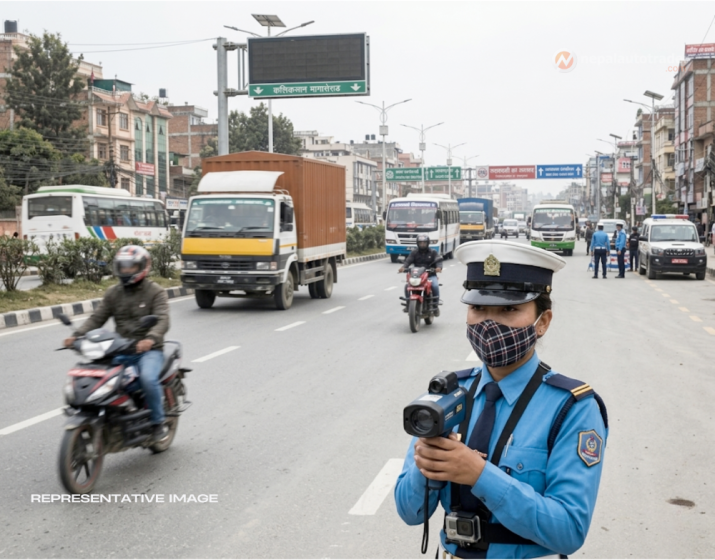
The Nepal Government has announced plans to tighten vehicle speed regulation, a move that immediately shifts attention toward road safety enforcement across the country. The announcement arrives at a time when accident rates on highways and urban corridors continue to raise concern among policymakers, transport authorities, and commuters alike.
Officials have indicated that stricter speed control measures will be implemented to improve road discipline and reduce crash severity. While the government has not publicly detailed every enforcement mechanism yet, the direction is clear. Overspeeding is now firmly back under the spotlight.
That matters.
The discussion is not limited to private cars. Public transport fleets, cargo carriers, and long-distance commercial vehicles are expected to face heavier scrutiny under the revised enforcement framework. Nepal has seen repeated debates over highway safety in recent years, particularly after multiple fatal incidents involving buses and heavy vehicles.
Transport operators are already watching the development closely. Many fear stricter enforcement could increase operational delays, especially on long-distance routes where tight schedules dominate daily business.
This is more than a traffic management story. The government’s announcement touches multiple sectors at once.
Road safety remains one of Nepal’s biggest transportation challenges. Poor road conditions, aggressive overtaking, inconsistent enforcement, and overloaded vehicles continue to create dangerous conditions across several regions. Speed, however, remains one of the most visible and controllable factors.
| Key Area | Expected Impact | Who Gets Affected |
|---|---|---|
| Road Safety | Potential reduction in severe accidents | General public |
| Commercial Transport | Possible operational delays | Bus and cargo operators |
| Traffic Enforcement | Higher monitoring responsibility | Traffic police |
| Public Transport Sector | Pressure for compliance upgrades | Fleet owners |
The move also reflects a wider regional trend. Governments across South Asia are increasingly tightening transport safety policies as urban traffic density grows and highway usage expands.
Nepal’s automobile sector has changed rapidly in recent years. Larger SUVs, faster motorcycles, premium EVs, and more powerful commercial vehicles are entering the market at a pace the country’s road infrastructure often struggles to match. This changes things.
Among all vehicle categories, commercial transport operators are likely to feel the strongest impact from tighter speed enforcement.
Public buses and freight carriers operate under heavy scheduling pressure. Faster turnaround times often translate directly into higher earnings. That has historically created an environment where speeding becomes difficult to control consistently.
Industry insiders now expect authorities to increase monitoring across major highway sections.
Importers and dealership networks are also paying attention. Nepal’s vehicle market has become increasingly competitive, especially in the SUV and EV space. Brands continue to introduce vehicles with stronger acceleration, higher cruising capability, and advanced driving technology.
Yet road infrastructure development has not always kept pace.
One major question remains unanswered. How exactly will the government enforce tighter speed regulation?
There is growing discussion around modern traffic monitoring systems, digital surveillance, and stronger speed tracking technology. While no detailed rollout plan has been officially confirmed, the possibility of expanded electronic enforcement is already part of industry conversation.
| Potential Enforcement Tool | Purpose |
|---|---|
| Speed Monitoring Devices | Track overspeeding violations |
| Highway Surveillance | Improve enforcement coverage |
| Digital Record Systems | Strengthen penalty tracking |
| Commercial Fleet Monitoring | Improve operator accountability |
The shift could eventually push fleet operators toward more connected vehicle systems and monitoring solutions. That would align Nepal with broader global transport management trends, particularly in commercial logistics and passenger mobility.
There is another angle too. Stricter speed control may indirectly influence vehicle purchasing patterns, especially among fleet buyers prioritizing safety and operational compliance over outright performance.
Right now, the biggest uncertainty revolves around implementation.
The government has signaled intent, but transport companies, dealerships, fleet operators, and motorists are all waiting for specific rules, timelines, penalties, and technical standards. Enforcement consistency will be critical. Nepal has announced multiple road safety initiatives in the past, but implementation gaps have often weakened long-term effectiveness.
Still, this announcement lands at a sensitive moment for the transport sector.
Vehicle imports are evolving rapidly. Electric mobility is gaining momentum. Highway traffic continues to increase. And public attention toward road safety has become harder to ignore after repeated major accidents.
The government now faces pressure to ensure that stricter regulation translates into measurable safety improvement rather than short-term enforcement headlines.
The next phase will determine whether this becomes a genuine transport reform effort or simply another temporary crackdown. The industry is watching carefully. So are commuters.
Q: What did the Nepal Government announce regarding vehicle speed?
A: The government announced plans to tighten vehicle speed regulation as part of broader road safety efforts. Detailed implementation measures are still expected.
Q: Which vehicles are likely to face the strictest monitoring?
A: Commercial vehicles, including buses and cargo carriers, are expected to remain under major focus due to their involvement in long-distance transportation and public safety concerns.
Q: Will Nepal introduce new speed monitoring technology?
A: Authorities have not officially confirmed specific systems yet, but industry discussions suggest increased use of monitoring and digital enforcement tools could be considered.
Q: Why is the government tightening speed regulations now?
A: Rising road safety concerns, highway accidents, and increasing traffic density have intensified pressure for stronger enforcement measures.
Q: Could the new rules affect transport operators?
A: Yes. Transport companies and commercial fleet operators may face stricter compliance requirements and tighter operational monitoring once enforcement begins.

Nepal Auto-Trader is one-stop platform for all automotive needs. We provide unbiased and unparalleled news/reviews of all auto-motives being launched in Nepalese Auto-Industry. Find recent updates and price of bikes/cars, compare and review recently launched bikes/cars, buy/sell/trade reconditioned cars/bikes and all government news about changing rules and regulation, road safety by subscribing us.

Subscribe to our Newsletter
© Copyright 2026, Nepal Autotrader



.png)
.png)