

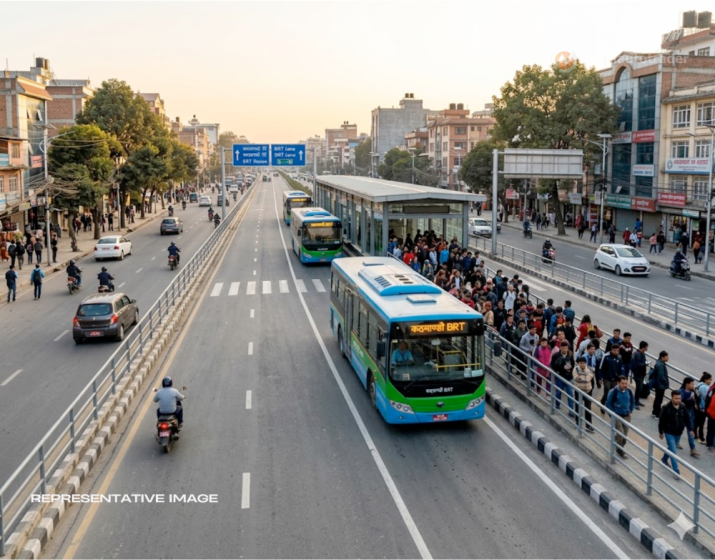
Kathmandu’s public transport problem is no longer just an inconvenience. It is now an urban crisis. Packed microbuses, slow-moving traffic, unmanaged stops and inconsistent service have pushed authorities back toward a solution that has been discussed for years, Bus Rapid Transit, better known as BRT.
According to the announcement published by MeroAuto, the government is preparing to operate a dedicated Bus Rapid Transit system on Kathmandu’s Ring Road section. The plan aims to reorganize how public transportation works inside the valley while reducing pressure created by unmanaged smaller vehicles.
That matters. Because Kathmandu’s transport conversation has been stuck in the same loop for years.
The latest announcement signals that authorities are again prioritizing a structured mass transit model instead of fragmented transport operations. The proposed BRT corridor is expected to introduce dedicated lanes for buses, allowing them to move separately from mixed traffic.
While full technical specifications were not disclosed in the source, the direction is clear. Kathmandu wants faster buses, more predictable travel times and a reduction in transport chaos.
| Project Element | Current Status | Key Details |
|---|---|---|
| Bus Rapid Transit | Announced | Focused on Kathmandu Ring Road corridor |
| Dedicated Bus Lane | Planned | Separate movement for public buses |
| Public Transport Reform | Ongoing | Aims to improve urban mobility and reduce congestion |
| Large Bus Prioritization | Expected | Shift away from smaller unmanaged vehicles |
The announcement also arrives after previous rapid bus trials between Ratnapark and Suryabinayak. That service introduced dedicated operational windows and attempted to reduce commuting time on one of the valley’s heavily congested stretches.
Officials had previously stated that buses on the rapid corridor could complete the journey in roughly 45 minutes, significantly lower than conventional public transport timing. The experiment faced interruptions, but it showed one thing clearly. Dedicated lanes change traffic flow dramatically.
Kathmandu Valley’s transport system still depends heavily on fragmented private operators, microbuses and route competition. Passengers often face:
The proposed BRT model attempts to tackle several of these issues simultaneously. By introducing larger buses and controlled stops, authorities are trying to create a system that functions more like organized urban transit rather than a collection of competing vehicles.
Public frustration around Kathmandu’s transportation system has also become increasingly visible online and in policy discussions. Conversations surrounding overcrowded microvans, unsafe bus operations and the absence of disciplined public transport continue to grow louder.
At the same time, the valley has started experimenting with other mobility reforms. Kathmandu Metropolitan City, in collaboration with Sajha Yatayat, recently launched night electric bus services on major routes inside the valley. The move highlighted a wider shift toward structured and publicly managed transport systems.
For Kathmandu, the BRT discussion is no longer theoretical. It is slowly becoming unavoidable.
The earlier rapid bus initiative between Ratnapark and Suryabinayak became an important test case for Kathmandu Valley.
| Rapid Bus Route | Operational Detail | Key Information |
|---|---|---|
| Ratnapark - Suryabinayak | Dedicated service | 13.4 km route |
| Initial Fleet | 25 buses | 40-seat buses allocated |
| Operational Window | Peak-hour focused | Morning and evening schedules |
| Expanded Operation | Later increased | 36 buses operated at intervals |
The service initially struggled with operational consistency and enforcement. Dedicated lanes require strict traffic management, especially inside Kathmandu where private vehicles frequently occupy bus corridors.
Still, the experiment provided a foundation. Authorities now have operational data, commuter feedback and traffic behavior observations from a real-world rapid transit trial.
That experience could influence how the larger Ring Road BRT system is eventually designed.
One of the most important aspects of the BRT conversation is what it indirectly targets, Kathmandu’s long-standing dependence on smaller public vehicles.
Several urban transport projects in the valley have already explored replacing microbuses and tempos with larger buses. Earlier initiatives linked with sustainable urban transport programs attempted to reorganize operators into larger transport companies capable of operating high-capacity buses.
The BRT system naturally favors this model.
But infrastructure alone will not solve everything. Enforcement, operator management and commuter behavior will decide whether Kathmandu’s BRT becomes transformative or symbolic.
The valley has seen ambitious transport announcements before. Some faded quickly under operational pressure.
This one feels different because congestion itself is forcing the issue.
The latest announcement does not provide a full implementation timeline, investment figure or construction schedule. Those details remain unclear for now. Still, the intent from authorities is becoming increasingly visible, Kathmandu Valley is moving toward structured mass transit.
There is also a wider regional context behind this shift.
Cities across South Asia are investing heavily in dedicated bus corridors because rail-based systems remain financially difficult and time consuming. For Kathmandu, with its dense urban layout and complicated terrain, BRT offers a more achievable transition path.
The challenge now is execution.
If dedicated lanes are properly enforced, if larger buses are prioritized and if route discipline is maintained, the BRT system could become one of the biggest transport reforms Kathmandu has seen in years.
If not, it risks becoming another short-lived experiment swallowed by the valley’s traffic reality.
Right now, Kathmandu stands somewhere between those two futures.
Q: What is Kathmandu planning to introduce on the Ring Road?
A: Kathmandu authorities are planning to introduce a Bus Rapid Transit system with dedicated lanes aimed at improving public transportation and reducing congestion across the valley.
Q: Has Kathmandu already tested rapid bus operations before?
A: Yes. Authorities previously operated a rapid bus service between Ratnapark and Suryabinayak using dedicated operational arrangements during peak traffic hours.
Q: Will the BRT system replace microbuses in Kathmandu?
A: The announcement does not explicitly confirm replacement plans. However, the BRT model generally prioritizes larger buses and more organized public transport operations.
Q: Who is involved in Kathmandu’s transport reform efforts?
A: Agencies including the Ministry of Physical Infrastructure and Transport, transport departments and operators such as Sajha Yatayat are involved in various public transport modernization efforts.
Q: Why is Bus Rapid Transit important for Kathmandu?
A: BRT systems can reduce travel time, improve passenger capacity and create more reliable public transportation through dedicated bus corridors and controlled operations.
Q: Has the government announced a completion date for the BRT project?
A: No official completion timeline or investment figure was provided in the announcement referenced by the source.

Nepal Auto-Trader is one-stop platform for all automotive needs. We provide unbiased and unparalleled news/reviews of all auto-motives being launched in Nepalese Auto-Industry. Find recent updates and price of bikes/cars, compare and review recently launched bikes/cars, buy/sell/trade reconditioned cars/bikes and all government news about changing rules and regulation, road safety by subscribing us.

Subscribe to our Newsletter
© Copyright 2026, Nepal Autotrader



.png)
.png)