

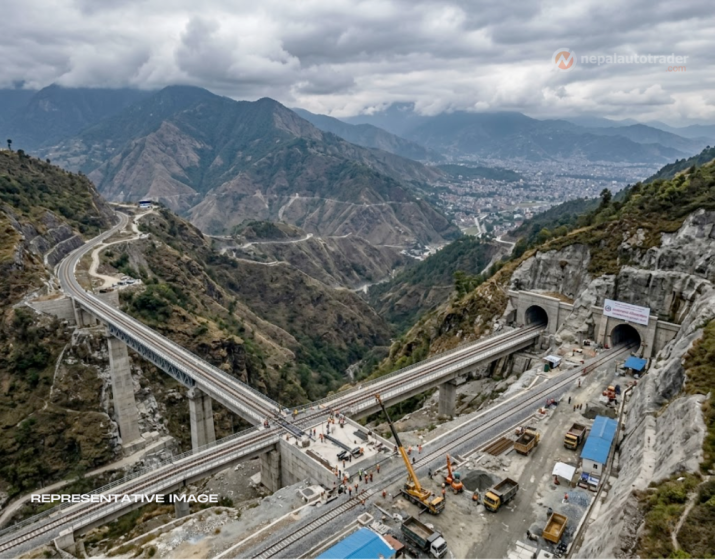
For more than a decade, Nepal’s ambition to connect Kathmandu with both China and India through railways has remained trapped between political declarations, technical studies and difficult Himalayan geography. Now, both projects are moving again.
The study process for the Kerung-Kathmandu railway has entered a new phase, while the Raxaul-Kathmandu railway is nearing completion of its detailed survey process. The developments signal a fresh push toward cross-border rail connectivity, one that could reshape cargo movement, tourism and regional trade around Nepal’s capital.
The projects are not just transport corridors. They sit at the intersection of economics, infrastructure strategy and geopolitics, with China and India both deeply involved in separate railway links into Kathmandu.
The Department of Railways confirmed that the preliminary phase of the Kerung-Kathmandu railway study has been completed. Chinese technical teams carried out field inspections across Kathmandu, Nuwakot and Rasuwa before temporarily returning to China during the New Year period.
According to officials, the next stage will focus on geological studies, including soil testing and ground boring across the proposed alignment.
This changes things.
Preliminary studies typically establish broad alignment possibilities. Geological testing is where railway projects in Himalayan terrain become real engineering exercises. Tunnel feasibility, bridge foundation stability and mountain composition all begin to shape actual construction viability.
| Kerung-Kathmandu Railway Study Status | Current Detail |
|---|---|
| Study Phase | Second phase preparation underway |
| Areas Surveyed | Kathmandu, Nuwakot, Rasuwa |
| Current Activity | Geological and soil investigation preparation |
| Technical Method | Drone mapping and field-level study |
| Partner Country | China |
The Kerung railway project first gained momentum after agreements between Nepal and China during the visit of Chinese President Xi Jinping to Nepal. Later memorandums expanded cooperation for feasibility studies and technical assessments.
Officials say the ongoing work will determine:
The scale of the challenge remains enormous. Large sections of the proposed line would need tunnels through unstable Himalayan geology. Even preliminary engineering work has taken years.
And still, Nepal is pushing ahead.
While the northern railway continues feasibility work, the southern Raxaul-Kathmandu railway has progressed further.
India’s Konkan Railway Corporation has already completed the field survey and submitted technical findings to Nepal’s Ministry of Physical Infrastructure and Transport. The survey process reportedly took around 22 months.
The final alignment paints a picture of just how technically demanding the project will be.
| Raxaul-Kathmandu Railway Key Details | Figure |
|---|---|
| Total Length | 140.79 km |
| Tunnels | 32 |
| Total Tunnel Length | 42 km |
| Major Bridges | 124 |
| Stations | 12 |
| Estimated Cost | Rs 400 billion |
| Additional Compensation Estimate | Rs 70 billion |
The proposed line would begin around Raxaul on the Indian side before entering Nepal and passing through:
Officials say discussions are ongoing regarding the final Kathmandu endpoint, with debate around extending the line toward the Chobhar dry port from Khokna.
The route will reportedly require around 1,500 hectares of land acquisition.
That alone signals the scale of what Nepal is attempting.
Nepal has long depended heavily on road transport for both cargo and passenger movement. Rail connectivity with both India and China would significantly alter logistics patterns, especially for imports entering Kathmandu Valley.
The proposed rail corridors could eventually:
The rapid growth of Nepal’s transport sector and increasing pressure on existing highways have added urgency to discussions around rail infrastructure.
At the same time, these projects arrive amid wider regional competition. India and China are both expanding infrastructure influence in Nepal through transport, trade and connectivity projects.
The railway debate has therefore become bigger than transportation alone.
It now sits inside Nepal’s broader economic future.
Despite progress in studies and surveys, experts continue to warn that both railways face difficult terrain and extremely high construction costs.
Much of the proposed infrastructure will require tunnels, elevated bridges and complex mountain engineering. Officials and former bureaucrats have also questioned long-term financial viability.
| Major Challenges | Impact On Project |
|---|---|
| Mountain Geology | Extensive tunneling and stabilization required |
| Land Acquisition | High compensation costs |
| Bridge Construction | Large-scale engineering complexity |
| Project Financing | Multi-billion rupee investment requirement |
| Environmental Sensitivity | Potential ecological and terrain impact |
Some infrastructure experts have also argued that Nepal’s ongoing expressway construction projects could reduce the urgency for rail connectivity in the short term.
Still, railway planners believe long-term strategic benefits justify continued studies.
The reality is clear. Nepal’s terrain makes railway construction expensive. Very expensive. But the same geography also makes dependable transport links critically important.
That contradiction continues to define these projects.
For the Kerung-Kathmandu railway, the immediate next step is geological and technical feasibility work. Chinese technical teams are expected to resume field operations after returning to Nepal.
For the Raxaul-Kathmandu railway, authorities are moving toward finalization of the detailed project report level studies. Discussions around financing, final alignment approval and implementation models are expected to follow.
Neither project is close to construction yet.
But after years of slow movement, both corridors are now advancing at the same time. That alone marks a significant shift in Nepal’s long-running railway ambitions.
The bigger question is no longer whether Kathmandu wants rail connectivity.
It is whether Nepal can eventually build it through some of the most difficult terrain in the region.
For now, the studies continue.
And the stakes keep rising.
Related reading: Kathmandu Fast Track construction progress, How cross-border railway infrastructure transforms trade, Nepal logistics sector transformation.
Q: How long will the Raxaul-Kathmandu railway be?
A: According to the final location survey, the proposed Raxaul-Kathmandu railway will span approximately 140.79 km. The route will connect Kathmandu with the Indian railway network through Raxaul.
Q: How many tunnels and bridges are planned for the railway?
A: The Raxaul-Kathmandu railway is expected to include 32 tunnels covering around 42 km and 124 major bridges. The difficult terrain is one of the biggest engineering challenges for the project.
Q: What is the estimated cost of the Raxaul-Kathmandu railway?
A: The construction estimate stands at around Rs 400 billion, excluding compensation costs. Additional land compensation expenses are estimated at around Rs 70 billion.
Q: What stage is the Kerung-Kathmandu railway currently in?
A: The project has completed preliminary studies and is preparing for geological investigation work. Chinese technical teams have already conducted drone mapping and field inspections in several districts.
Q: Which districts will the Raxaul-Kathmandu railway pass through?
A: The railway alignment is expected to pass through Parsa, Bara, Rautahat, Makwanpur, Lalitpur and Kathmandu before reaching the capital region.
Q: Why are these railway projects important for Nepal?
A: The rail projects are expected to improve cargo movement, strengthen regional connectivity, support trade and reduce long-term dependence on road-based transportation for goods entering Kathmandu Valley.

Nepal Auto-Trader is one-stop platform for all automotive needs. We provide unbiased and unparalleled news/reviews of all auto-motives being launched in Nepalese Auto-Industry. Find recent updates and price of bikes/cars, compare and review recently launched bikes/cars, buy/sell/trade reconditioned cars/bikes and all government news about changing rules and regulation, road safety by subscribing us.

Subscribe to our Newsletter
© Copyright 2026, Nepal Autotrader



.png)
.png)