

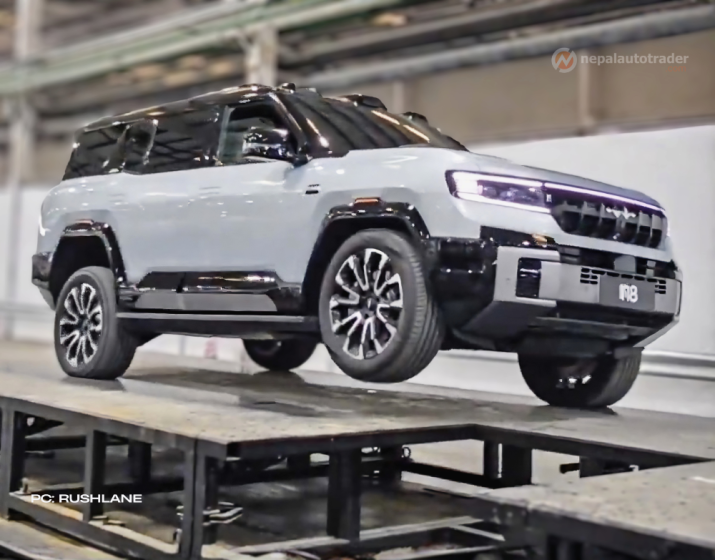
BYD has expanded its fast-charging offensive in China with the launch of the 2026 Bao 5 Flash Charging Edition and 2026 Bao 8 Flash Charging Edition under its Fang Cheng Bao lifestyle SUV brand. The two electrified off-road SUVs arrive with the company’s latest DiSus-P Ultra intelligent hydraulic suspension system, second-generation Blade Battery technology and upgraded ultra-fast charging capability. This is not a mild update. It is a direct statement from BYD that hardcore SUVs no longer need to compromise on charging speed, comfort or long-distance usability.
The launch took place in China on May 13, with both SUVs positioned as premium electrified off-roaders built for long-range travel and rapid energy replenishment. Fang Cheng Bao, the personalised sub-brand owned by BYD, has been steadily expanding its rugged SUV portfolio, and this update pushes the lineup deeper into the high-tech terrain war currently unfolding in China.
That matters.
BYD says all products under the Fang Cheng Bao umbrella have now entered the “flash charging era”. Earlier models such as the BYD Ti3 Flash Charging Edition already introduced the company’s new charging architecture, but the Bao 5 and Bao 8 take that technology into heavier, more capability-focused SUVs.
Consumers placing orders within the initial launch phase can also access limited-time discounted pricing. Overseas, these SUVs are expected to carry the Denza B5 and Denza B8 names in some export markets.
| Model | Official Price | Key Highlight |
|---|---|---|
| 2026 Bao 5 Flash Charging Edition | 305,800 yuan | 1,310 km combined CLTC range |
| 2026 Bao 8 Flash Charging Edition | 419,800 yuan | 1,380 km combined CLTC range |
| Bao 5 210 km Tianshen Max | 259,800 yuan | New trim addition |
While the charging headlines grab attention, the real engineering centerpiece is the debut of the DiSus-P Ultra intelligent hydraulic body control system. BYD describes it as an all-scenario intelligent suspension setup combining adaptive dampers, electronic control, hydraulic suspension hardware, ride-height adjustment and body stabilization software.
This changes things.
The updated system replaces the earlier single-valve damping structure with a dual-valve layout and introduces three-level stiffness adjustment with road preview capability. According to technical information released during the launch event, the system can independently raise a wheel by up to 300 mm, while suspension travel adjustment reaches 200 mm.
BYD also demonstrated three-wheel driving capability during the Bao 8 presentation, reinforcing the SUV’s off-road positioning.
For a brand trying to redefine electrified off-roading, suspension sophistication is becoming just as important as battery size or charging speed.
Both SUVs sit on BYD’s DMO electric off-road platform and use a plug-in hybrid powertrain setup. Reports surrounding the launch detail a 2.0-litre turbocharged hybrid system paired with dual electric motors.
| Specification | Bao 5 / Bao 8 Flash Charging Editions |
|---|---|
| Platform | DMO electric off-road platform |
| Engine | 2.0T plug-in hybrid |
| Front Motor | 200 kW |
| Rear Motor | 300 kW |
| Total Output | 550 kW |
| Peak Torque | 760 Nm |
| 0-100 km/h | 4.8 seconds |
| Battery Tech | Second-generation Blade Battery |
The new second-generation Blade Battery and flash charging architecture are central to BYD’s current technology push. The company claims its latest charging ecosystem can dramatically reduce charging time while improving usability in extreme weather conditions.
China’s EV market has shifted rapidly toward ultra-fast charging infrastructure over the past year, and BYD is moving aggressively to defend its dominance against rivals investing heavily in 800V and 1000V systems. The company recently outlined plans for large-scale deployment of its “Flash Charging China” network.
That larger context is impossible to ignore.
The Bao 5 and Bao 8 are entering one of the fastest-moving categories in the Chinese market. Electrified off-road SUVs have become a major battleground, with established names and newer tech-heavy entrants chasing buyers who want rugged styling without traditional fuel consumption penalties.
Primary competitors highlighted around the launch include:
Unlike many conventional ladder-frame SUVs, BYD’s approach leans heavily into software, battery technology and electronic chassis systems. Fang Cheng Bao is effectively trying to create a new category where off-road capability, luxury comfort and ultra-fast charging coexist.
The strategy appears to be working. Fang Cheng Bao recorded domestic sales of 21,138 units in April 2026, representing a year-on-year increase of 110.6%. March sales reached 21,120 units, while February deliveries stood at 14,491 units.
There is momentum here. Real momentum.
BYD confirmed during the launch event that its Shark pickup series will also be integrated into the Fang Cheng Bao lineup in China, broadening the brand’s reach beyond SUVs. At the same time, the company continues rolling out flash charging compatibility across multiple vehicle categories, from sedans to lifestyle SUVs.
The Bao 5 and Bao 8 Flash Charging Editions are not simply updated models with faster charging. They represent BYD’s broader attempt to control the next phase of the electrified vehicle market, where charging convenience becomes just as important as outright range figures.
And in China’s brutally competitive EV market, convenience sells fast.
Q: What is the price of the 2026 Bao 5 Flash Charging Edition?
A: The 2026 Bao 5 Flash Charging Edition starts at 305,800 yuan in China. BYD also introduced the Bao 5 210 km Tianshen Max trim priced at 259,800 yuan.
Q: How much does the Bao 8 Flash Charging Edition cost?
A: The larger Bao 8 Flash Charging Edition starts at 419,800 yuan in the Chinese market. Limited-time discounted pricing is also available during the launch phase.
Q: What is special about the DiSus-P Ultra suspension system?
A: DiSus-P Ultra is BYD’s latest intelligent hydraulic body control system. It supports adaptive damping, ride-height adjustment, wheel lifting and three-wheel driving capability for improved off-road performance.
Q: What range do the new Bao SUVs offer?
A: The Bao 5 Flash Charging Edition claims up to 1,310 km combined CLTC range, while the Bao 8 reaches up to 1,380 km combined CLTC range.
Q: Which vehicles compete with the Bao 5 and Bao 8?
A: Key rivals include the Tank 400 Hi4-T, Deepal G318 and Toyota Land Cruiser Prado in China’s electrified off-road SUV segment.
Q: Will these SUVs be sold outside China?
A: Reports indicate the Bao 5 and Bao 8 may be marketed internationally as the Denza B5 and Denza B8 in selected export markets, although BYD has not confirmed a detailed global rollout timeline.

Nepal Auto-Trader is one-stop platform for all automotive needs. We provide unbiased and unparalleled news/reviews of all auto-motives being launched in Nepalese Auto-Industry. Find recent updates and price of bikes/cars, compare and review recently launched bikes/cars, buy/sell/trade reconditioned cars/bikes and all government news about changing rules and regulation, road safety by subscribing us.

Subscribe to our Newsletter
© Copyright 2026, Nepal Autotrader



.png)
.png)