

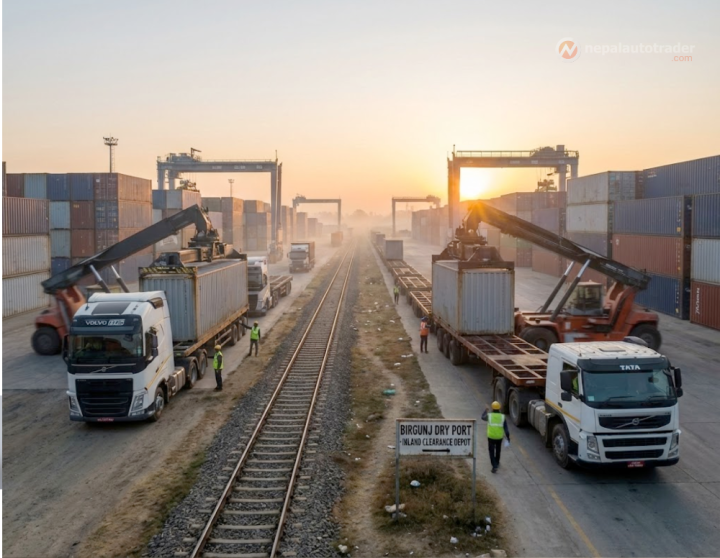
Kathmandu – In the six‑month window that ends with Pus 2082, Birgunj’s Sukkhaban‑dar‑gah handled 572 railway racks of freight. The figure is a clear step down from the 588 racks that crossed the border in the same stretch a year earlier. The drop is modest in raw numbers but sharp enough to raise eyebrows among logistics planners.
The decline isn’t a mystery. Komal Gyanwali, head of the Nepal Inter‑modal Transport Development Committee’s Birgunj office, told reporters that a halt in Indian Rail services throttled the flow. “When the Indian side experiences a ‘halt‑age’, the racks simply stop arriving,” he explained. That matters because Birgunj is the gateway for goods from Kolkata, Haldia and Vishakhapatnam – three ports that together supply a swath of Nepal’s industrial heartland.
A 2‑3 % reduction may look trivial on paper, but the ripple effect spreads far beyond the dry port’s perimeter. Importers of sponge iron and chemical fertilizers rely on tight schedules to keep factories humming. A shortfall of even a handful of racks can translate into delayed production, higher inventory costs and a scramble for alternative routes.
Moreover, the rail‑rack system is Nepal’s most cost‑effective bulk‑move method. Trucks can cost up to 30 % more per tonne‑kilometre, especially on the hilly corridors that link Birgunj to Kathmandu. When rail capacity shrinks, freight rates inch upward, and the price tag on everyday commodities – from cement to steel – subtly climbs.
Below is the month‑by‑month tally Gyanwali supplied for the current fiscal half. The numbers illustrate a dip in Saun followed by a slow climb toward Pus.
| Month (B.S.) | Racks Received | Key Notes |
|---|---|---|
| Saun | 94 | Start of fiscal, minor service hiccup |
| Bhadau | 90 | Continued slowdown, election impact in India |
| Asoj | 101 | Partial service restoration |
| Kartik | 91 | Seasonal dip, lower agricultural imports |
| Mangsir | 92 | Steady flow, no major disruptions |
| Pus | 104 | Service back to near‑normal, higher demand |
A single 20‑ft railway rack can accommodate 90 standard containers. The larger 40‑ft rack holds 45 containers. Using those ratios, the six‑month total translates to roughly 51,480 twenty‑foot‑equivalent slots or 25,740 forty‑foot‑equivalent slots.
The cargo mix is heavily weighted toward raw materials that feed Nepal’s construction and energy sectors:
These items travel from Indian ports with a transit time of 8 days from Kolkata and 10 days from Vishakhapatnam. The delay in rail services adds a day or two, which compounds when supply chains are already tight.
Gyanwali is cautiously optimistic. He notes that the political calendar in India – the state elections in West Bengal and local polls in Odisha – has begun to settle, and the rail network is clearing backlogs. “We expect a gradual return to pre‑halt levels by the end of the fiscal year,” he said. That matters for anyone watching Nepal’s trade balance, because a smoother rail flow can shave up to 5 % off logistics costs for bulk imports.
Stakeholders are also exploring multimodal alternatives. A pilot program to shift a portion of fertilizer cargo onto river barges along the Gandaki is under discussion, though the infrastructure is still nascent. If successful, it could provide a buffer against future rail hiccups.
In short, the current dip is a warning flag, not a permanent shift. The rail corridor remains the most efficient conduit for the bulk commodities that keep Nepal’s factories, farms and power plants running. As the Indian rail network steadies, Birgunj’s rack numbers should climb back, restoring the flow that the country’s economy depends on.
Q: How many railway racks did Birgunj handle in the first half of FY 2082/83? A: Birgunj processed 572 railway racks between Saun and Pus 2082.
Q: What caused the reduction compared to the previous year? A: A temporary service halt on Indian Railways slowed the arrival of racks from Kolkata, Haldia and Vishakhapatnam.
Q: Which commodities are most affected by the rack slowdown? A: The primary imports are sponge iron, chemical fertilizer, gypsum, iron ore and coal.
Q: How many containers can a single 20‑ft rack carry? A: One 20‑ft rack can hold 90 standard containers; a 40‑ft rack holds 45 containers.
Q: When is the rail flow expected to recover? A: Officials anticipate a return to near‑normal levels by the end of FY 2082/83, assuming Indian rail disruptions subside.
Q: Are there any alternatives being explored to mitigate future rail issues? A: A river‑barging pilot on the Gandaki is being studied as a supplementary route for fertilizer shipments.
PREVIOUS NEWS

Nepal Auto-Trader is one-stop platform for all automotive needs. We provide unbiased and unparalleled news/reviews of all auto-motives being launched in Nepalese Auto-Industry. Find recent updates and price of bikes/cars, compare and review recently launched bikes/cars, buy/sell/trade reconditioned cars/bikes and all government news about changing rules and regulation, road safety by subscribing us.

Subscribe to our Newsletter
© Copyright 2026, Nepal Autotrader



.png)
.png)