

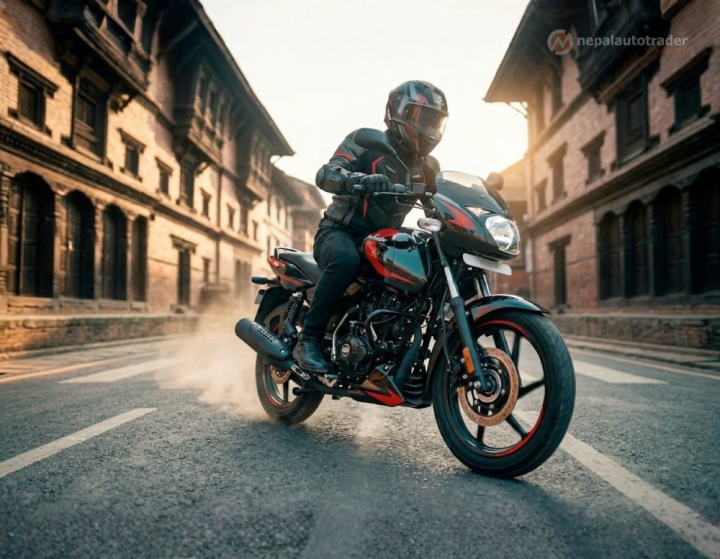
The launch event in Kathmandu felt less like a product rollout and more like a statement. Bajaj’s local partner, Hansa Hulashchand & Co, rolled out a bike that looks like a younger sibling of the 200 cc family, yet carries the DNA of the classic Pulsar line.
Visually, the bike sports a fresh graphics suite – matte‑black tail, aggressive twin‑pipe exhaust, and a slimmer fuel tank that reduces the overall silhouette. The LED headlamp replaces the old halogen unit, cutting power draw and adding a crisp look at night.
Under the skin, the heart of the machine is the F.I.B.S 6V (Fuel Injection, 6‑Valve) engine. It replaces the carburetor, promising better fuel economy, smoother throttle response, and lower emissions. That matters for riders who log long commutes on Kathmandu’s winding streets.
Safety gets a boost with Single Channel ABS on the front wheel, a first for Bajaj’s 150 cc range. The bike also ships with a Bluetooth‑enabled digital console that pairs to a smartphone for navigation prompts, service alerts, and ride statistics. In a market where most 150 cc bikes still rely on analog gauges, this feels like a genuine step forward.
| Specification | Detail |
|---|---|
| Engine | F.I.B.S 6V, 149.5 cc, single‑cylinder, air‑cooled |
| Power | 13.8 kW (18.5 hp) @ 8,500 rpm |
| Torque | 13.8 Nm @ 7,000 rpm |
| Transmission | 5‑speed constant‑mesh |
| Brakes | Front: 300 mm disc with **Single Channel ABS**; Rear: 130 mm drum |
| Lighting | Full‑width **LED headlamp**, LED tail‑lamp |
| Instrument Cluster | Full‑color **Bluetooth digital console** with speed, fuel, gear indicator |
| Fuel System | Electronic **Fuel Injection** (FI) with 6‑valve architecture |
| Dimensions | Length 2,050 mm, Width 785 mm, Height 1,110 mm, Wheelbase 1,320 mm |
| Weight | 138 kg (kerb) |
| Variant | Price (NPR) | Key Features |
|---|---|---|
| Pulsar 150 Standard | 3,55,900 | LED headlamp, **Single Channel ABS**, Bluetooth console |
| Pulsar 150 Premium | 3,85,900 | All Standard features + alloy wheels, rear disc brake |
Financing has been stripped down to a single document – the Nepali citizenship certificate. No utility bills, no property papers, no income statements. The dealer network advertises zero service charge and a simple instalment plan that can be completed “on‑the‑spot”. This could lower the entry barrier for first‑time buyers and for riders upgrading from older 125 cc machines.
Bajaj isn’t launching this bike in a vacuum. The 150 cc segment in Nepal is dominated by the Hero Splendor Plus (price around 2,95,000 NPR) and the TVS Apache RTR 160 (price near 3,30,000 NPR). Both offer reliable performance but lack the integrated digital console and front‑ABS.
| Feature | Bajaj Pulsar 150 | Hero Splendor Plus | TVS Apache RTR 160 |
|---|---|---|---|
| Engine | 149.5 cc FI, 13.8 kW | 124.7 cc carb, 8.9 kW | 159.7 cc carb, 12.5 kW |
| ABS | Front Single Channel | No ABS | No ABS |
| Digital Console | Bluetooth‑enabled | Analog speedometer | Analog speedometer |
| LED Headlamp | Yes | No | No |
| Starting Price | 3,55,900 NPR | 2,95,000 NPR | 3,30,000 NPR |
The Pulsar’s price sits between the two, but the tech advantage is clear. Riders who value safety and connectivity will likely tip the scale toward Bajaj, especially when the finance scheme removes paperwork friction.
The launch isn’t an isolated event. Bajaj Auto’s roadmap for Nepal includes a electric two‑wheel concept slated for late‑2026, and a 200 cc sport‑tourer expected in early‑2027. By establishing a tech‑forward image with the Pulsar 150, Bajaj is laying groundwork for those future releases.
From a market perspective, the two‑wheel segment in Nepal grew 7 % year‑on‑year in 2025, driven by rising disposable income and expanding credit options. A model that blends performance, safety, and digital convenience is positioned to capture a sizeable share of that growth.
Dealerships have already reported a surge in test‑drive bookings within the first 48 hours of the announcement. If the early interest translates into sales, Bajaj could see a double‑digit increase in its Nepalese market share by the end of 2026.
That matters because a stronger foothold gives Bajaj leverage when negotiating supply chain terms with its Indian manufacturing hub, potentially lowering costs for future models.
Q: What is the exact launch date for the new Pulsar 150 in Nepal? A: The bike was officially unveiled on 25 Falgun 2082 (8 February 2026) and is available for purchase from that day onward at all authorized Bajaj Auto showrooms.
Q: Are there any colour options for the Pulsar 150? A: Yes, the launch includes three factory colours – Matte Black, Pearl Red, and Metallic Blue. Custom graphics can be added at dealer‑installed accessory shops.
Q: How does the fuel‑injection system improve mileage?** A: FI meters exact fuel per throttle input, reducing wastage. Early owners report 30‑35 km/l on mixed city‑highway riding, a modest gain over the carbureted predecessor.
Q: Can I finance the bike with only my citizenship ID? A: Absolutely. The new finance scheme accepts the Nepali citizenship certificate as the sole document, eliminating the need for utility bills or income proof.
Q: Does the bike come with a warranty? A: Bajaj offers a 12‑month/12,000 km warranty covering engine and transmission, plus a 6‑month/6,000 km warranty on the electrical system.
Q: How does the Pulsar 150 compare to the TVS Apache 160 in terms of power? A: The Pulsar 150 delivers 13.8 kW (18.5 hp) while the Apache 160 produces 12.5 kW (16.8 hp). The Pulsar also adds front‑ABS and a digital console, giving it a technology edge.

Nepal Auto-Trader is one-stop platform for all automotive needs. We provide unbiased and unparalleled news/reviews of all auto-motives being launched in Nepalese Auto-Industry. Find recent updates and price of bikes/cars, compare and review recently launched bikes/cars, buy/sell/trade reconditioned cars/bikes and all government news about changing rules and regulation, road safety by subscribing us.

Subscribe to our Newsletter
© Copyright 2026, Nepal Autotrader



.png)
.png)