

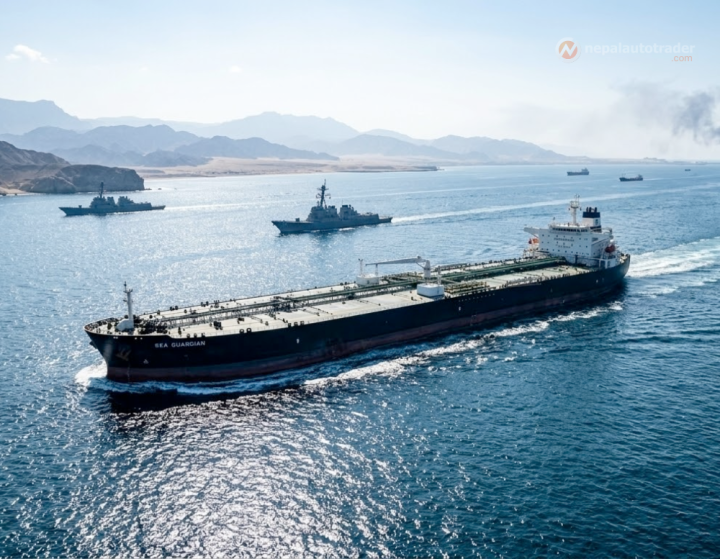
The war that erupted between Israel, the United States, and Iran has sent shockwaves through every oil‑laden pipeline and tanker route. A key flashpoint is the Strait of Hormuz, the narrow waterway through which about a fifth of the world’s petroleum flows. When Iranian air strikes targeted oil platforms last week, the risk of a prolonged choke‑point became palpable. That matters because any bottleneck there instantly inflates the price of every barrel that manages to slip through.
The conflict also pulled in China, the biggest buyer of Iranian crude. Tehran ships roughly 1.6 million barrels each day to Chinese refineries, and any interruption forces China to scramble for alternative supplies at higher costs. The ripple effect reaches every corner of the global market, from the Gulf to Kathmandu. This changes things for anyone whose wallet touches fuel.
On 25 Falgun 2082 (mid‑February 2026), the benchmark WTI contract closed at $100.12 per barrel, a level not seen since early 2022. The move was not a sudden jump but the culmination of three weeks of incremental gains, each driven by a fresh headline:
| Date | Price (USD) | Trigger |
|---|---|---|
| 10 Falgun | 92.45 | Escalating Israel‑Iran rhetoric |
| 18 Falgun | 96.78 | U.S. naval presence near Hormuz |
| 25 Falgun | 100.12 | Iranian platform attacks |
Al Jazeera’s energy desk ran a model that pegs a sustained supply squeeze at $150 per barrel within two months if the conflict persists. The projection is not a guess; it is based on historic price elasticity when the Strait of Hormuz has been partially blocked. That matters for exporters, importers, and every commuter.
The price breakout is already reshaping three core areas:
These threads intertwine, creating a feedback loop that magnifies the original shock. This changes things for policy makers who must balance fiscal stability with public discontent.
Energy strategists at Morgan Stanley stress that the current rally is “a symptom of geopolitical risk, not a structural demand surge.” Their note highlights two scenarios:
Both paths underscore the fragility of today’s supply chain. The takeaway? Volatility is here to stay, and stakeholders must hedge aggressively.
For Nepal, the immediate concern is the fuel price impact on public transport and agriculture. The National Transport Authority has already warned of a potential 5 % rise in bus fares if oil prices breach $120 per barrel. Meanwhile, the Ministry of Finance is reviewing subsidies for essential goods to cushion the blow.
The broader lesson is that a regional conflict can reverberate across the Himalayas, turning a distant war into a local economic headache. That matters for anyone watching the country’s inflation trajectory.
The bottom line: the crude oil market is now a barometer of geopolitical tension, and the next headline could push the price to $150. Stakeholders should monitor the Strait of Hormuz closely, because every ship that stalls there adds a dollar to the pump.
| Region | Current Price Impact | Projected Change |
|---|---|---|
| South Asia | Petrol + Rs 1 per litre | + Rs 2–3 if $130 breached |
| Middle East | Export revenue up 8 % | Stabilises if conflict ends |
| Europe | Diesel freight + €0.12 per litre | Potential 15 % rise by Q3 |
Q: When did crude oil first cross the $100 threshold? A: The benchmark WTI contract closed above $100 on 25 Falgun 2082, marking the first breach since early 2022.
Q: What could push the price to $150 per barrel? A: Continued disruptions in the Strait of Hormuz, prolonged Israel‑Iran hostilities, and limited spare capacity in global refineries are the primary drivers.
Q: How will Nepal’s fuel prices change if oil reaches $130? A: The National Transport Authority projects a further Rs 2–3 per litre increase for petrol and diesel, with possible fare hikes for public transport.
Q: Are there any strategic reserves Nepal can tap? A: Nepal currently relies on imported fuel and does not maintain large strategic oil reserves; the government may negotiate temporary subsidies instead.
Q: Which countries are most exposed to the current price spike? A: Import‑dependent economies such as India, Bangladesh, and Nepal face the steepest cost increases, while exporters like Iran and Saudi Arabia see higher revenues.
Q: What should businesses do to mitigate the risk? A: Hedge fuel contracts, explore alternative logistics routes, and consider energy‑efficiency upgrades to blunt the impact of higher oil prices.

Nepal Auto-Trader is one-stop platform for all automotive needs. We provide unbiased and unparalleled news/reviews of all auto-motives being launched in Nepalese Auto-Industry. Find recent updates and price of bikes/cars, compare and review recently launched bikes/cars, buy/sell/trade reconditioned cars/bikes and all government news about changing rules and regulation, road safety by subscribing us.

Subscribe to our Newsletter
© Copyright 2026, Nepal Autotrader



.png)
.png)