

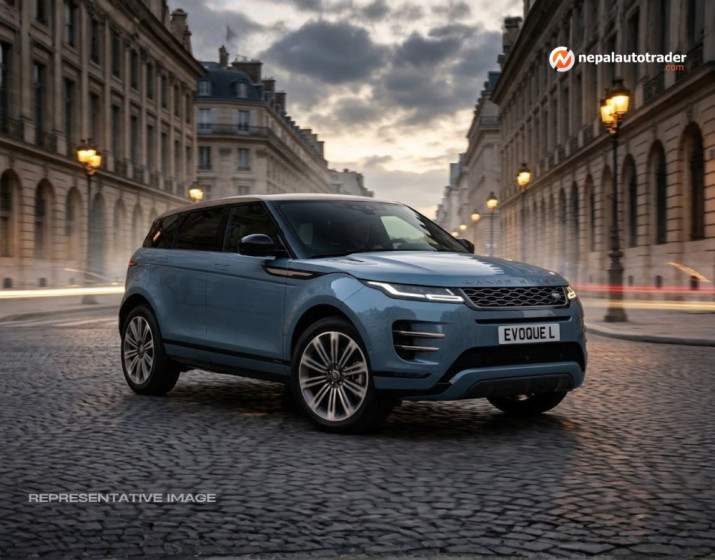
A 54 percent price drop does not quietly enter the room. It lands with weight, and in the case of the Range Rover Evoque L, it immediately reframes how the vehicle is positioned in its segment. This is not a subtle adjustment or seasonal incentive. It reads like a correction, the kind that forces buyers, dealers, and competitors to reassess assumptions in real time.
As Reported, the shift is tied to its local market conditions. And while the exact pricing structure before and after the adjustment is not detailed, the magnitude alone tells its own story. Something in the demand equation has changed. Or perhaps the pricing simply drifted too far from what buyers were willing to absorb.
Here’s the thing. Luxury SUVs rarely move like this unless pressure builds beneath the surface.
The Range Rover Evoque L sits in a space where brand equity usually carries a significant portion of the value. Land Rover has long relied on design presence, badge prestige, and urban luxury appeal to justify positioning. But pricing, especially in emerging or tightly contested markets, has become increasingly sensitive.
This reported adjustment suggests a recalibration rather than a reinvention. The vehicle itself remains anchored in its established identity. What has shifted is the price-to-perception balance.
Not everyone will notice it immediately, but pricing moves like this often ripple outward. Competitors quietly take notes. Dealers adjust tone. Buyers start reconsidering what “premium” feels like in practical terms.
The Range Rover Evoque L has always leaned into compact luxury with urban usability. It is not the largest SUV in the lineup, but it carries enough brand weight to sit above mainstream rivals. That balance is delicate.
When pricing shifts by something as steep as 54 percent, the positioning question becomes unavoidable. Is this now a more accessible entry into Land Rover ownership, or a correction back to realistic market expectations?
To understand the impact, it helps to view how it typically sits against its peers.
| Model | Positioning | Market Role |
|---|---|---|
| Range Rover Evoque L | Compact luxury SUV | Urban premium entry point |
| BMW X3 | Mid-size premium SUV | Balanced performance and practicality |
| Audi Q5 | Premium crossover | Tech-focused luxury daily driver |
The comparison is not about direct equivalence. It is about psychological positioning. And that is where pricing shifts matter most. They change how people imagine the vehicle before they even step inside.
A number like 54 percent does not simply adjust affordability. It reshapes perception layers that are hard to rebuild once altered. Luxury branding depends on controlled exclusivity, and pricing is one of its strongest signals.
But markets do not operate on branding alone. They respond to reality. Demand, inventory flow, and buyer resistance all feed into decisions like this. And when they align, the outcome can look dramatic from the outside.
In practical terms, this kind of shift can lead to:
And that’s important. Because once a vehicle enters a new price reality, it rarely returns to the old one without consequence.
For Land Rover, the broader question is not about a single model. It is about sustaining balance across a lineup that stretches from urban crossovers to full-size luxury SUVs. The Range Rover Evoque L sits at the accessible end of that spectrum, which makes it particularly sensitive to pricing strategy.
If this adjustment holds, the ripple effect could influence how other models are positioned regionally. Manufacturers tend to avoid isolated pricing anomalies unless they serve a larger strategy. That suggests either a demand correction or a competitive response is in play.
Either way, buyers benefit in the short term. But the segment itself becomes more volatile. Pricing stability is often the invisible foundation of luxury automotive confidence. When it shifts, everything else follows cautiously.
The story of the Range Rover Evoque L right now is not about engineering changes or design updates. It is about alignment. Alignment between what manufacturers believe a vehicle is worth, and what the market is willing to sustain.
A 54 percent price adjustment is not subtle messaging. It is a correction that speaks louder than brochures or campaigns. Buyers will interpret it in different ways. Some will see opportunity. Others will see instability. Both reactions are valid.
But the larger truth sits somewhere in the middle. Luxury mobility is becoming more price-aware, more competitive, and less forgiving of overreach. And this SUV is simply the latest to reflect that shift.
Quietly, the segment is being rewritten. One price adjustment at a time.

Nepal Auto-Trader is one-stop platform for all automotive needs. We provide unbiased and unparalleled news/reviews of all auto-motives being launched in Nepalese Auto-Industry. Find recent updates and price of bikes/cars, compare and review recently launched bikes/cars, buy/sell/trade reconditioned cars/bikes and all government news about changing rules and regulation, road safety by subscribing us.

Subscribe to our Newsletter
© Copyright 2026, Nepal Autotrader



.png)
.png)