

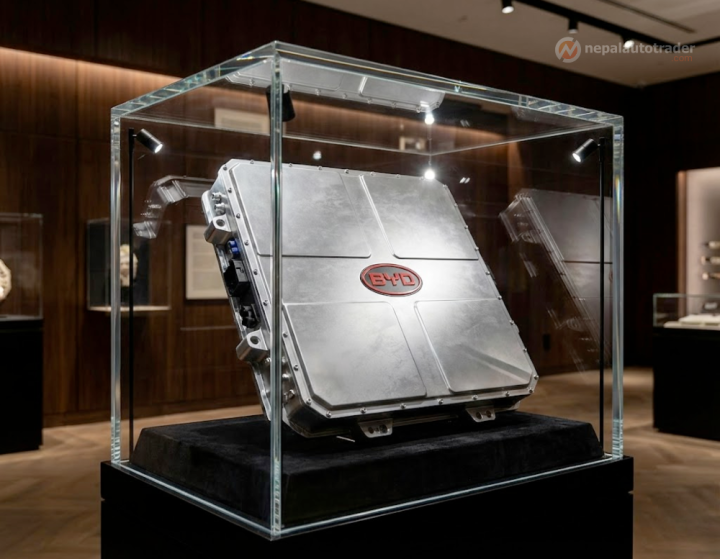
The Chinese giant BYD released a technical brief on its latest sulfide solid‑state battery. The document, dated 26 Magh 2082, says the cell can endure 10 000 charge‑discharge cycles while delivering higher energy density than its liquid‑electrolyte cousins. The company also highlighted a fast‑charge capability that trims charging time to a fraction of today’s standards. That matters for commuters who spend hours on a single charge.
Sulfide electrolytes replace the flammable liquid found in conventional lithium‑ion packs. They enable a higher voltage window, which translates into more kilowatt‑hours per kilogram. In practice, a rider could travel farther on the same weight, and the battery would stay stable even under rapid charge pulses. This changes things for Nepal’s hilly terrain where reliability is non‑negotiable.
Key benefits outlined by BYD:
| Parameter | Value | Notes |
|---|---|---|
| Electrolyte type | Sulfide solid‑state | Non‑flammable, high ionic conductivity |
| Cycle life | 10 000 cycles | Measured at 80 % depth of discharge |
| Energy density | ≈ 500 Wh/kg | Target figure, industry‑leading |
| Fast‑charge time | ≈ 15 min to 80 % | Under 1 C charge rate |
| Operating temperature | ‑20 °C to +60 °C | No active cooling required |
BYD’s rollout plan is aggressive. The first solid‑state‑enabled model is expected in 2027, with a limited production run to validate real‑world durability. Full‑scale manufacturing is slated for 2030, when the company aims to equip a broad swath of its electric two‑wheelers with the new cell.
| Phase | Date | Status |
|---|---|---|
| Prototype validation | 2025 Q3 | In‑house testing |
| Limited launch | 2027 Q1 | Target model: e‑bike A1 |
| Mass production | 2030 Q2 | Factory upgrades across China |
The Nepalese market has embraced electric scooters and motorcycles, but high replacement costs and charging infrastructure gaps remain. A battery that lasts 10 000 cycles could stretch a rider’s ownership horizon to a decade without a full pack swap. Faster charging would also ease pressure on the still‑sparse fast‑charge network.
If BYD’s claim holds, dealers could offer lower upfront prices because the amortized cost of the battery drops dramatically. That could push the average e‑bike price closer to the range of conventional petrol scooters, accelerating adoption.
For fleet operators—delivery services, ride‑hailing platforms—the durability promise means reduced downtime and predictable maintenance budgets. This changes the economics of operating electric two‑wheelers in Kathmandu’s congested streets.
Competitors are racing to catch up. Toyota, Honda, and Samsung SDI have all hinted at solid‑state projects, but none have publicly committed to a 10 000‑cycle figure. BYD’s head start could force a technology race that benefits consumers worldwide.
In Nepal, regulators may need to revise safety standards to accommodate the new chemistry, and charging‑station providers will have to adapt to higher power draws. The next few years will likely see a cascade of policy updates, pilot programmes, and consumer education campaigns.
That matters because the speed of adoption hinges on how quickly the ecosystem aligns with the new battery’s capabilities.
Q: When will the first BYD model with the 10 000‑cycle solid‑state battery be available in Nepal? A: BYD plans a limited launch in 2027. Exact arrival dates for Nepal will depend on local import schedules, but pre‑orders are expected to open a year before deliveries begin.
Q: How does the charging time compare to today’s lithium‑ion e‑bikes? A: The new cell can reach 80 % state‑of‑charge in about 15 minutes, roughly half the time required by most current lithium‑ion packs under similar power levels.
Q: Will the battery work in Nepal’s winter temperatures? A: The operating range of ‑20 °C to +60 °C covers typical Nepali winter lows, so thermal performance should remain stable without additional heating.
Q: How much more will a BYD e‑bike cost with this battery? A: BYD has not disclosed pricing yet. However, the extended cycle life is expected to lower total‑cost‑of‑ownership, which could offset a modest premium at purchase.
Q: Are there any safety concerns with sulfide electrolytes? A: Sulfide solid‑state electrolytes are non‑flammable, reducing fire risk compared with liquid electrolytes. BYD’s internal tests show stable behaviour even under rapid charging.
Q: How does this technology compare with Toyota’s solid‑state roadmap? A: Toyota targets solid‑state cells for passenger cars by the early 2020s, but has not announced a specific cycle‑life figure. BYD’s 10 000‑cycle claim is currently the most aggressive publicly disclosed target for two‑wheelers.

Nepal Auto-Trader is one-stop platform for all automotive needs. We provide unbiased and unparalleled news/reviews of all auto-motives being launched in Nepalese Auto-Industry. Find recent updates and price of bikes/cars, compare and review recently launched bikes/cars, buy/sell/trade reconditioned cars/bikes and all government news about changing rules and regulation, road safety by subscribing us.

Subscribe to our Newsletter
© Copyright 2026, Nepal Autotrader



.png)
.png)