

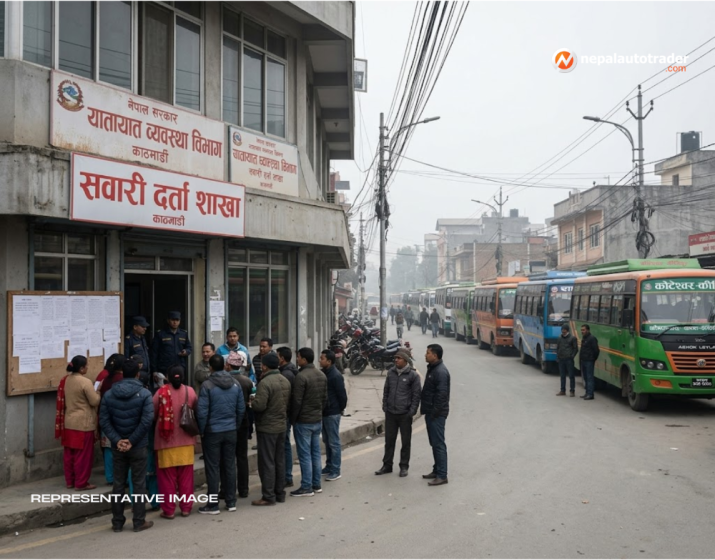
The Government of Nepal has suspended the registration of all new public transport vehicles across the country, including electric public vehicles, in one of the most significant transport policy interventions seen in recent years. The decision came through a circular issued by the Department of Transport Management, which directed all seven provincial governments and local bodies to immediately stop processing new registrations until further notice.
That matters. Because this is not limited to diesel buses or older commercial fleets. The freeze also covers new electric public vehicles, a move that has already triggered debate across Nepal’s transport and EV sectors.
According to the Department of Transport Management, the decision was taken because Nepal’s public transportation system lacks what officials described as “scientific management.” Authorities linked the rapid increase in public vehicles to worsening urban air quality, growing road congestion and mounting traffic jams, especially in and around Kathmandu Valley.
The department also said rising fuel prices have intensified operational pressure on transport businesses and commuters alike. Officials argue that continuing to add more public vehicles without restructuring the transport ecosystem would only deepen the crisis.
| Key Issue | Government Position | Impact |
|---|---|---|
| Air Pollution | Increasing emissions in urban regions | Pressure on environmental management |
| Traffic Congestion | Too many vehicles entering the system | Longer commute times and gridlock |
| Fuel Prices | Higher operational costs for transport operators | Financial strain on public mobility sector |
| Transport Planning | Lack of scientific route management | Inefficient public transport network |
The order was reportedly signed by department director Maniram Bhusal and distributed to provincial ministries responsible for physical infrastructure, labor and transport management.
This changes things. Particularly for importers and dealers who had already lined up inventory for Nepal’s expanding electric mobility market.
One of the biggest talking points surrounding the decision is the inclusion of electric buses, electric microbuses and commercial EV vans within the suspension order. Nepal has spent the past few years aggressively promoting electric mobility through tax incentives and import policy advantages. Public EV operators were increasingly viewed as part of the solution to Kathmandu’s pollution crisis.
Now, those same operators are unable to register new fleets.
Industry stakeholders say the move could disrupt several ongoing expansion plans involving:
No timeline has been provided for when registrations may reopen. Officials have instead emphasized that the suspension will remain active until authorities determine how many public vehicles are actually required in specific regions.
That uncertainty now hangs over dealerships, fleet owners and transport entrepreneurs.
The Department of Transport Management cited Section 24, Sub-section (3) of the Vehicle and Transport Management Act, 1993 (2049 BS) as the legal basis for the suspension.
The provision allows the government to halt vehicle registration if conditions related to environmental pollution, traffic pressure, road infrastructure limitations or broader public interest make such action necessary.
| Legal Provision | Authority Granted | Current Use |
|---|---|---|
| Section 24 (3) | Allows suspension of vehicle registration | Applied nationwide for public vehicles |
| Environmental Grounds | Pollution and congestion management | Cited in official circular |
| Public Interest Clause | Government intervention powers | Used to justify temporary freeze |
Officials insist the move is temporary and designed to support long term restructuring of Nepal’s transport network. Still, no scientific study or implementation roadmap has been publicly released yet.
The absence of that detail is already drawing scrutiny.
Transport entrepreneurs have not fully opposed the government’s decision. Some operators believe the public transport sector requires tighter management, especially in densely populated urban areas where route overlap and unregulated expansion have become common.
However, concerns remain over whether halting new registrations alone can solve Nepal’s deeper transport challenges.
Several contradictions are now part of the discussion:
According to reports referenced by transport stakeholders, Nepal currently has around 250,000 public transport vehicles, while private vehicle numbers are estimated to exceed 5.6 million.
That comparison is impossible to ignore.
The suspension creates direct implications for Nepal’s transport import ecosystem. Public transport importers, commercial EV distributors and dealership networks now face uncertainty regarding incoming stock and pending registrations.
Many businesses had aligned operations around Nepal’s growing electric mobility push. Importers bringing in electric buses and commercial EVs expected increasing fleet demand from operators seeking lower running costs and favorable taxation structures.
Now the market has effectively paused overnight.
Related analysis on Nepal’s EV expansion can be found in Nepal EV market growth analysis. Readers can also explore electric bus adoption in Nepal, BYD EV review coverage and public transport reform updates.
The larger concern now centers on timing. If the freeze continues for an extended period, transport operators may delay expansion plans, financing approvals and fleet modernization projects.
And for Nepal’s electric mobility ambitions, this decision introduces a sharp pause at a critical moment.
The Department of Transport Management says registrations will resume only after authorities complete studies on regional transport demand and capacity. Officials argue the country needs a more structured transport framework before allowing additional public vehicles onto already strained roads.
For now, provincial transport offices and local governments have been instructed to stop all new public vehicle registrations immediately.
The coming weeks will determine whether this becomes a short term administrative correction or the beginning of a broader restructuring of Nepal’s public mobility strategy.
Either way, the impact is already spreading across transport operators, EV importers, dealerships and commuters.
And this debate is only getting started.
Q: Which vehicles are affected by Nepal’s registration suspension?
A: The suspension applies to all new public transport vehicles, including diesel, petrol and electric public vehicles such as buses, microbuses and commercial EV vans.
Q: Has Nepal stopped registration of private vehicles too?
A: No. The current suspension only affects new public transport vehicles. Private vehicle registrations continue as normal.
Q: Why did the government stop public vehicle registration?
A: Authorities cited worsening air pollution, increasing traffic congestion, road pressure and lack of scientific transport management as the main reasons behind the decision.
Q: Under which law was the suspension implemented?
A: The Department of Transport Management used powers granted under Section 24 (3) of the Vehicle and Transport Management Act, 1993 (2049 BS).
Q: Are electric buses and EV public vehicles included?
A: Yes. The restriction specifically includes electric public transport vehicles alongside conventional fuel-powered vehicles.
Q: When will registrations reopen in Nepal?
A: Officials have not announced a reopening date. The suspension will remain active until further notice while authorities study transport demand and management requirements.

Nepal Auto-Trader is one-stop platform for all automotive needs. We provide unbiased and unparalleled news/reviews of all auto-motives being launched in Nepalese Auto-Industry. Find recent updates and price of bikes/cars, compare and review recently launched bikes/cars, buy/sell/trade reconditioned cars/bikes and all government news about changing rules and regulation, road safety by subscribing us.

Subscribe to our Newsletter
© Copyright 2026, Nepal Autotrader



.png)
.png)