

Nepal’s annual monsoon chaos is no longer being treated as an unavoidable season of road disasters. Authorities in Kathmandu have now moved with a coordinated campaign targeting public transport operators, drivers and passengers as the country braces for another difficult rainy period. That matters.
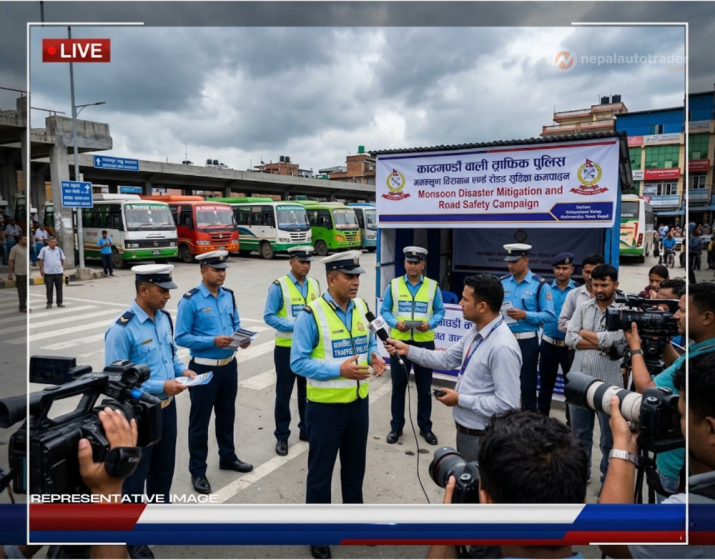
The Road and Vehicle Targeted Monsoon Disaster Mitigation Campaign-2083 was officially launched from Gongabu’s New Buspark under the leadership of the Kathmandu Valley Traffic Police Office, alongside the Federation of National Transport Entrepreneurs of Nepal and multiple transport labor organizations. The initiative comes at a time when landslides, road subsidence and flood-related disruptions continue to expose Nepal’s fragile transport infrastructure every monsoon season.Traffic Police Push Forecast-Based Driving Discipline
The campaign was inaugurated by Additional Inspector General of Police Ishwar Karki, who made it clear that the focus is no longer only on emergency response. Authorities now want prevention. Karki said improved forecasting from the Department of Hydrology and Meteorology gives transport operators enough warning to reduce risk if drivers and passengers actually follow alerts and advisories.
His comments reflected a growing concern inside Nepal’s traffic management agencies. Road accidents during monsoon are often linked not just to damaged highways, but to poor decision-making after weather warnings have already been issued.
| Campaign Focus Area | Implementation Detail | Expected Impact |
|---|---|---|
| Weather Forecast Compliance | Drivers and operators instructed to follow official warnings | Reduced accident risk during heavy rainfall |
| Passenger Assistance Desks | Deployment at major transport hubs | Improved public awareness and emergency readiness |
| CCTV And GPS Monitoring | Installation planned in public vehicles | Better operational oversight and accountability |
| Baggage Tag System | Mandatory identification for passenger luggage | Lower cases of lost and stolen baggage |
Karki also addressed another long-running issue in Kathmandu, public buses operating outside designated terminals despite the existence of the Gongabu New Buspark. He warned that action would now be taken against transport operators running services from unauthorized locations. This changes things.
The police official also confirmed that authorities are preparing an online ticketing system for all public transport vehicles, a move expected to improve passenger management and route transparency in the capital.
Punnya Prasad Sitoula, Chairman of the Federation of National Transport Entrepreneurs of Nepal, directly linked the campaign to previous transport disasters in places like Simaltal and Jhyaple Khola. Those incidents exposed severe gaps in disaster preparedness, route monitoring and passenger safety management.
Sitoula said transport entrepreneurs, workers and passengers all share responsibility in implementing the campaign effectively. He also reiterated support for government-led transport reforms aimed at improving road safety during the monsoon season.
The messaging was broader than simple traffic enforcement. Officials want operational discipline, cleaner passenger handling and centralized bus movement management before monsoon disruption intensifies across the country.
Authorities are now leaning heavily on technology as part of the safety push. Navraj Adhikari, Chief of Kathmandu Valley Traffic Police Office and Senior Superintendent of Police, confirmed that the campaign specifically aims to prevent public transport vehicles departing Kathmandu from being exposed to avoidable monsoon-related damage.
Passenger assistance desks will operate from major traffic and transport points including:
| Location | Operational Purpose | Campaign Role |
|---|---|---|
| Gongabu New Buspark | Main transport coordination hub | Passenger awareness and monitoring |
| Kalanki | Western traffic corridor | Safety information distribution |
| Nagdhunga | Major highway exit point | Monsoon travel guidance |
| Koteshwor | Eastern transport route | Passenger assistance operations |
| Balkhu And Jagaati | Regional traffic management zones | Disaster awareness outreach |
According to Adhikari, public awareness materials focused on monsoon disaster protection will be distributed directly to travelers. At the same time, authorities are preparing for CCTV camera and GPS system installations in public transport vehicles as quickly as possible.
GPS-based fleet monitoring systems are increasingly becoming part of Nepal’s wider transport modernization effort. For a country where highway conditions can change within hours during heavy rainfall, real-time vehicle tracking could become a major operational advantage.
One of the more immediate changes announced during the campaign launch involves luggage tracking. Authorities confirmed that baggage tags will become mandatory for passengers traveling on public transport vehicles due to rising complaints involving lost, exchanged and stolen bags.
A memorandum of understanding was signed between Senior Superintendent of Police Navraj Adhikari and Federation Chairman Punnya Prasad Sitoula regarding implementation of the baggage tag system.
Sitoula stated that preparations are underway to make the system compulsory from Jestha 15. It may sound minor, but Nepal’s long-distance bus network handles enormous passenger movement during festival and monsoon periods. Even small accountability systems can improve trust in public transport. That matters.
The program also honored Lok Bahadur Tandon, Chairman of Green City Hospital and senior social worker, along with Pandav Shrestha, Chairman of Samakhushi Town Planning Committee, for contributions linked to the Traffic Police Circle New Buspark building.
Nepal’s monsoon road crisis is deeply tied to geography, aging infrastructure and fragmented transport enforcement. Reports from previous monsoon seasons have repeatedly shown heavy damage to highways, bridges and public infrastructure across multiple provinces. Nepal’s highway repair and resilience challenge remains enormous.
The latest campaign attempts to connect multiple weak points at once:
Whether enforcement actually follows the announcements will determine the campaign’s success. Nepal has seen safety drives before. The difference this time is the sharper focus on coordination between police, operators and passengers before monsoon emergencies escalate.
For now, the government appears determined to push accountability into a transport system that has long struggled with fragmented oversight. With monsoon pressure building again across the country, authorities know the margin for error is extremely thin.
Q: What is the Road and Vehicle Targeted Monsoon Disaster Mitigation Campaign-2083?
A: It is a monsoon-focused road safety and disaster mitigation initiative launched by the Kathmandu Valley Traffic Police Office in coordination with transport entrepreneurs and labor organizations. The campaign focuses on reducing accidents, improving passenger safety and strengthening transport monitoring.
Q: Where was the campaign launched?
A: The campaign was officially launched from Gongabu’s New Buspark in Kathmandu. Authorities want the buspark to become the central operating point for public transport services inside the capital.
Q: When will baggage tags become mandatory for passengers?
A: According to transport entrepreneurs involved in the campaign, preparations are underway to make baggage tags mandatory from Jestha 15. The move is intended to reduce incidents involving lost and stolen luggage.
Q: Which locations will have passenger assistance desks?
A: Passenger assistance desks will operate at key transport hubs including Gongabu, Kalanki, Nagdhunga, Koteshwor, Balkhu and Jagaati. These desks will distribute monsoon safety awareness materials.
Q: What technology upgrades are planned for public vehicles?
A: Authorities plan to install CCTV cameras and GPS systems in public transport vehicles to improve monitoring and operational accountability during the monsoon season.
Q: Why was this campaign introduced now?
A: Officials said the initiative was influenced by lessons learned from accidents and monsoon-related incidents in places like Simaltal and Jhyaple Khola. Authorities want stronger preparedness before severe weather intensifies.

Nepal Auto-Trader is one-stop platform for all automotive needs. We provide unbiased and unparalleled news/reviews of all auto-motives being launched in Nepalese Auto-Industry. Find recent updates and price of bikes/cars, compare and review recently launched bikes/cars, buy/sell/trade reconditioned cars/bikes and all government news about changing rules and regulation, road safety by subscribing us.

Subscribe to our Newsletter
© Copyright 2026, Nepal Autotrader



.png)
.png)