

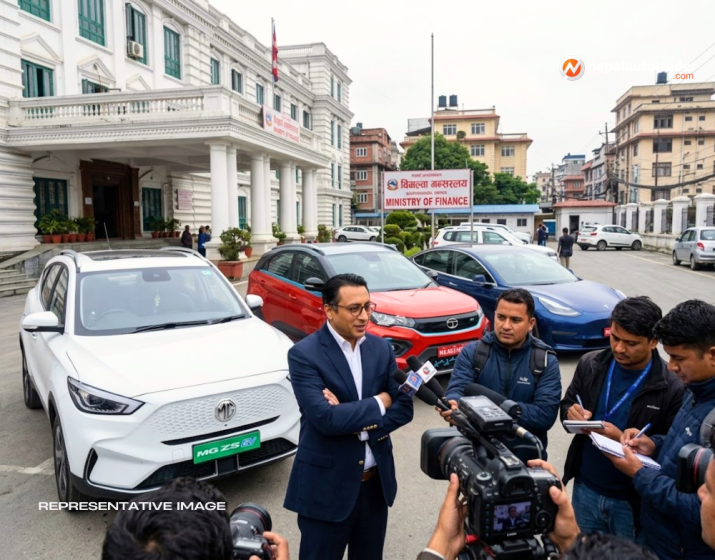
Nepal's electric vehicle market barely had time to digest the government's new taxation framework before officials were forced back into clarification mode.
The latest development centers on the Road Development Fee, a component of the tax package introduced through the budget for fiscal year 2026/27. What initially appeared to be a straightforward restructuring of EV taxation quickly became one of the most debated issues in the country's automotive sector.
According to Finance Minister Dr. Swarnim Wagle, the government will amend the provision after acknowledging that a higher-than-intended fee was included in the Economic Act.
That matters.
The minister has stated that EVs priced below Rs 5 million should face a 2.5 percent RDF rather than the currently stated 5 percent rate. Luxury EVs above that threshold will continue paying the higher charge.
For buyers waiting on showroom floors and dealers holding inventory, the distinction is significant.
The government has simultaneously introduced a broader overhaul of EV taxation.
Rather than calculating duties based on motor power output, Nepal has moved to a value-based taxation model. The previous excise duty structure has been scrapped and replaced by a new levy called the Clean Infrastructure Investment Fee.
Officials argue the new approach is easier to administer and creates a more transparent system for customs valuation.
| Tax Component | Current Structure | Status |
|---|---|---|
| Customs Duty | 20% | Continues |
| Road Development Fee | 2.5% proposed for EVs below Rs 5 million | Being corrected |
| VAT | 13% | Continues |
| Clean Infrastructure Investment Fee | Value-based | Newly introduced |
Here's the thing.
While policymakers describe the shift as a simplification exercise, the market's first reaction was concern that entry-level EVs could actually become more expensive despite the removal of excise duty.
That concern sparked a wave of criticism from industry stakeholders almost immediately after the budget announcement.
The newly introduced Clean Infrastructure Investment Fee applies according to vehicle value brackets.
Under the framework announced by the Ministry of Finance, the fee scales aggressively as vehicle values rise.
| Vehicle Value | Clean Infrastructure Investment Fee | Market Position |
|---|---|---|
| Up to Rs 2 million | 2.5% | Entry-level EVs |
| Rs 2 million to Rs 3 million | 20% | Mass market segment |
| Rs 3 million to Rs 4 million | 35% | Mid-range EVs |
| Rs 4 million to Rs 5 million | 90% | Premium mainstream |
| Above Rs 5 million | 130% | Luxury EVs |
The jump between brackets is dramatic. Not everyone will notice it immediately, but importers certainly have.
Vehicle valuation now carries even greater importance because taxation is linked directly to the customs value after applicable customs duties are added.
For some brands, a relatively small change in declared value could place a model into a substantially different tax category.
The government's message has become increasingly clear.
Officials want continued support for middle-class EV buyers while reducing incentives for higher-end electric vehicles.
During a post-budget discussion, Wagle argued that vehicles costing more than Rs 10 million should be viewed as luxury products rather than beneficiaries of broad-based incentives.
The philosophy marks an important shift from Nepal's earlier EV policy.
For years, policymakers focused primarily on accelerating adoption. Now the conversation includes revenue collection, foreign exchange management and taxation equity.
The balancing act is becoming harder as EV adoption grows.
And that's important.
For consumers shopping below the Rs 5 million mark, the proposed RDF correction could soften the impact of the broader tax overhaul.
Many mainstream electric crossovers and compact SUVs compete in precisely this territory.
If the amendment proceeds as indicated, pricing pressure on several high-volume models could ease compared with what dealers initially feared following the budget announcement.
Importers, meanwhile, gain something equally valuable, clarity.
The industry has repeatedly criticized frequent changes to EV policy. The issue extends beyond taxation. Nepal's Supreme Court recently called for a more stable long-term framework governing EV financing and adoption, highlighting concerns over recurring policy shifts.
Nepal remains one of South Asia's most closely watched EV markets. Adoption has accelerated rapidly, supported by lower operating costs and favorable electricity economics.
Yet the latest tax revisions show the market is entering a new phase.
The debate is no longer about whether EVs deserve support. It is about how much support is appropriate, which vehicles should receive it, and how the government balances environmental goals against fiscal realities.
The expected correction to the Road Development Fee suggests policymakers are still listening to industry feedback. Whether that restores confidence will depend on how quickly the amendment is implemented and whether the broader tax framework remains stable in the months ahead.
For now, buyers considering an EV purchase may be watching just as closely as the importers.
In Nepal's fast-moving electric vehicle market, tax policy has become almost as important as the cars themselves.
Q: What change is the government making to EV taxation?
A: The government plans to reduce the Road Development Fee for EVs priced below Rs 5 million from 5% to 2.5%, correcting what Finance Minister Swarnim Wagle described as an error in the Economic Act.
Q: What replaced the previous EV excise duty?
A: Nepal has replaced EV excise duty with the new Clean Infrastructure Investment Fee, which is calculated according to vehicle value.
Q: Will EV prices fall after the correction?
A: The finance minister has indicated that EVs priced below Rs 5 million should become cheaper once the RDF correction is formally implemented.
Q: How are EVs taxed under the new system?
A: EVs are now taxed through a combination of customs duty, VAT, Road Development Fee and the Clean Infrastructure Investment Fee.
Q: Why did Nepal move to value-based taxation?
A: The government says a value-based system simplifies customs administration and creates a clearer taxation structure compared with motor-power-based classification.
Q: Are luxury EVs receiving the same relief?
A: No. Vehicles above Rs 5 million will continue to face a higher RDF rate and significantly higher taxation under the new value-based fee structure.

Nepal Auto-Trader is one-stop platform for all automotive needs. We provide unbiased and unparalleled news/reviews of all auto-motives being launched in Nepalese Auto-Industry. Find recent updates and price of bikes/cars, compare and review recently launched bikes/cars, buy/sell/trade reconditioned cars/bikes and all government news about changing rules and regulation, road safety by subscribing us.

Subscribe to our Newsletter
© Copyright 2026, Nepal Autotrader



.png)
.png)