

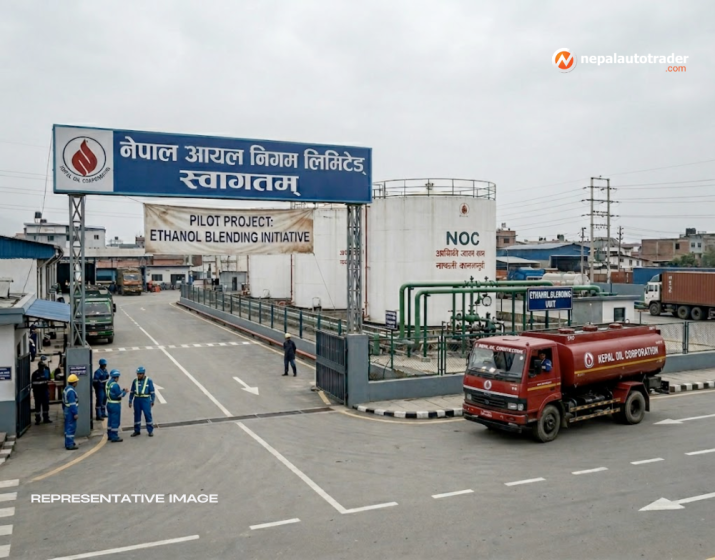
Nepal Oil Corporation, widely known as NOC, has formally asked for applications related to the supply and use of mixed ethanol in petroleum products. The move marks one of the clearest signals yet that Nepal is preparing to explore higher renewable fuel participation inside its fuel distribution network.
The report indicates that the corporation is moving ahead with preparations tied to ethanol integration, a step already common in several international fuel markets. That matters. Nepal has long depended almost entirely on imported petroleum products, and every shift toward fuel diversification carries both economic and strategic weight.
While the report does not specify commercial rollout dates or blending percentages, the application call itself confirms that institutional groundwork has started. Quietly, but significantly.
| Key Area | Current Situation | Potential Impact |
|---|---|---|
| Fuel Supply | Heavy dependence on imported petroleum | Possible diversification through ethanol blending |
| Energy Strategy | Traditional fossil fuel focus | Introduction of renewable fuel component |
| Market Readiness | Limited ethanol fuel infrastructure | Need for storage and distribution upgrades |
The development also aligns Nepal with broader regional discussions around cleaner mobility and lower-emission fuels. Countries across South Asia have already accelerated ethanol blending policies over the last few years. Nepal appears ready to test that path in its own way.
Ethanol is commonly blended with gasoline in multiple global markets to reduce emissions and improve fuel sustainability. In practical terms, ethanol is an alcohol-based renewable fuel generally produced from agricultural feedstock.
The significance here is larger than a single application notice. If implemented properly, ethanol blending could gradually reshape parts of Nepal’s petroleum ecosystem.
Potential advantages include:
Still, this is not a simple transition. Fuel quality consistency becomes critical once ethanol enters the supply chain. Storage conditions matter. Vehicle compatibility matters too.
That changes things.
Modern vehicles generally tolerate low ethanol blends without issue, but older engines and smaller machinery can face compatibility concerns depending on blend ratios and fuel system condition. Nepal’s vehicle fleet is diverse, aging in many areas, and heavily dependent on imported used vehicles. That creates additional complexity for regulators and distributors.
The application process may only be the first step, but it immediately raises questions around infrastructure readiness. Ethanol-blended fuel requires careful handling compared to conventional petrol, especially in storage and long-term distribution.
Nepal’s fuel supply chain already operates through a tightly controlled import and distribution structure led by NOC. Any transition involving blended fuels will likely require:
Dealership networks and fuel retailers could eventually become part of the adjustment phase if ethanol-mixed petrol enters public fuel stations. Importers may also need to clarify compatibility guidance for vehicles sold in Nepal.
| Stakeholder | Likely Role | Possible Challenge |
|---|---|---|
| NOC | Fuel management and approval | Quality control implementation |
| Fuel Dealers | Distribution and retail supply | Storage adaptation |
| Vehicle Importers | Consumer guidance | Compatibility communication |
| Consumers | Fuel adoption | Awareness and confidence |
The article does not mention dealership-specific partnerships or importer agreements at this stage. That absence is notable. It suggests the process remains at an early administrative level rather than a commercial rollout phase.
Nepal is not operating in isolation here. Across Asia, governments are gradually increasing renewable fuel mandates and encouraging blended fuel strategies to reduce oil dependence.
India has aggressively pushed ethanol blending targets in recent years, and regional fuel policy discussions continue to influence neighboring markets. Nepal’s latest move from NOC appears connected to that broader energy transition narrative.
But implementation in Nepal will likely move differently.
The country’s geography, logistics complexity, and fuel distribution limitations make rapid nationwide transitions difficult. Fuel quality consistency between urban and remote regions will become one of the most important operational challenges if ethanol-blended petrol reaches commercial pumps.
Consumers will also demand clarity on:
Those questions are coming. Fast.
The biggest takeaway from the latest development is simple, Nepal Oil Corporation has moved the conversation beyond speculation and into procedural action.
Applications have now been requested. That means evaluation, technical review, and policy coordination are likely to follow.
The report does not specify:
So the immediate focus remains administrative rather than consumer-facing. Still, this marks a notable shift in Nepal’s fuel policy direction.
For vehicle owners, the impact may not be immediate. For the industry, though, the signal is unmistakable. Nepal is beginning to explore a future where conventional petrol may no longer remain entirely conventional.
And once fuel policy changes begin, they rarely stay small for long.
Q: What has Nepal Oil Corporation announced?
A: Nepal Oil Corporation has called for applications related to ethanol blending in fuel supplies. The move indicates the corporation is preparing groundwork for renewable fuel integration.
Q: Will ethanol-mixed petrol launch immediately in Nepal?
A: The report does not mention an immediate commercial rollout timeline. The current stage appears focused on applications and procedural preparation.
Q: Can all vehicles use ethanol-blended fuel?
A: Lower ethanol blends are generally compatible with many modern petrol vehicles, but compatibility can vary depending on vehicle age and engine design. Official guidance will become important if blended fuel reaches public pumps.
Q: Why is ethanol blending important?
A: Ethanol blending can help reduce dependence on imported fossil fuels while supporting cleaner fuel strategies. It may also support long-term fuel diversification efforts.
Q: Will ethanol-blended fuel affect mileage?
A: Ethanol contains different energy characteristics compared to pure gasoline, so fuel economy can vary slightly depending on blend ratios and engine type.
Q: Has NOC confirmed fuel prices for ethanol blends?
A: No pricing details were mentioned in the report. Commercial pricing structures have not yet been announced.

Nepal Auto-Trader is one-stop platform for all automotive needs. We provide unbiased and unparalleled news/reviews of all auto-motives being launched in Nepalese Auto-Industry. Find recent updates and price of bikes/cars, compare and review recently launched bikes/cars, buy/sell/trade reconditioned cars/bikes and all government news about changing rules and regulation, road safety by subscribing us.

Subscribe to our Newsletter
© Copyright 2026, Nepal Autotrader



.png)
.png)