

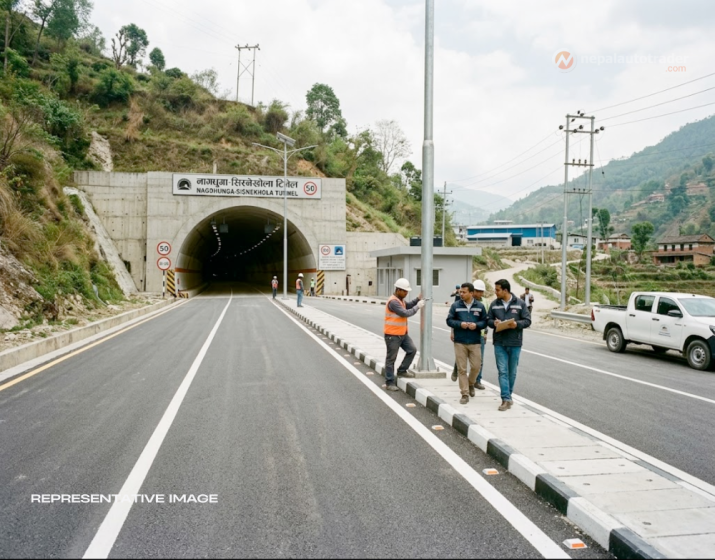
Nepal’s long delayed but strategically critical Nagdhunga-Sisnekhola Tunnel has moved into a new phase, staffing. Authorities have started preparations to recruit and mobilise manpower needed to operate the country’s first road tunnel, a project that has already crossed more than 98 percent physical progress according to project officials. That matters.
The tunnel, built along the busy Kathmandu-Dhading section of the Tribhuvan Highway, has technically reached a stage where vehicles can move through it. Yet the tunnel remains unopened because operation, maintenance, emergency response and traffic management systems still need trained manpower and a dedicated operating company.
Officials say the Department of Roads lacks both the workforce and tunnel management experience required for such an advanced infrastructure facility. Because of that, the government called an international tender to select an experienced service provider for five years of operation and maintenance. The move is bigger than one tunnel. Nepal is quietly building institutional knowledge for future projects, including expressways and additional tunnels.
The proposed staffing structure reveals just how complex tunnel operations can become. Authorities estimate at least 150 employees will be required to keep the tunnel functioning safely on a 24-hour basis. Nepal has never operated a tunnel of this scale before. This changes things.
| Operational Unit | Planned Staff | Primary Responsibility |
|---|---|---|
| Security Management | 64 | Safety monitoring and emergency response |
| Toll Collection | 54 | Vehicle toll operation and lane management |
| Traffic Monitoring | 14 | Traffic surveillance and control systems |
| Civil Maintenance | 8 | Structural inspection and repairs |
| Other Infrastructure Maintenance | 8 | Equipment and system upkeep |
Project officials explained that labour regulations prevent workers from operating beyond fixed daily limits, forcing the tunnel to run on a three-shift structure. Tunnel systems also require immediate response capacity in case of fire, accidents, ventilation failure or electrical disruption.
The service provider selected through the international bidding process will need to recruit, train and deploy the manpower. Authorities have repeatedly stressed that tunnel safety standards cannot be compromised simply to meet an opening deadline.
The tender process attracted significant foreign interest. According to project officials, 10 joint venture companies initially submitted applications, including firms from China, India and Turkey, all partnered with Nepali companies.
| Tender Process | Status | Details |
|---|---|---|
| Global Tender Announcement | Completed | International operation and maintenance bid invited |
| Total Applicants | 10 Companies | Chinese, Indian and Turkish participation |
| Technical Evaluation | Completed | 7 companies shortlisted |
| Operational Contract | 5 Years | Includes operation, maintenance and toll management |
| Training Period | Approximately 2 Months | Before full commercial operation |
After technical evaluation, only seven companies remained in contention. Authorities said firms failing to meet technical standards were removed from the process before financial proposals were opened.
The selected operator will manage:
Reports later indicated that a Chinese joint venture was selected through financial evaluation, though operational preparations and staffing mobilisation still require time before commercial opening.
The infrastructure itself is significant by Nepali standards. The main tunnel measures 2.7 kilometres, while the emergency tunnel extends 2.6 kilometres. Once operational, the route is expected to dramatically reduce congestion and travel time along one of the country’s busiest highway corridors.
The tunnel also introduces operational systems Nepal has not previously managed at this scale:
Authorities have already fixed toll rates for different vehicle categories. Cars and vans entering Kathmandu through the tunnel will pay Rs 65, while outbound vehicles will pay Rs 60. Larger vehicles face higher charges depending on classification.
The operational guidelines also ban certain vehicles from entering the tunnel, including motorcycles, auto-rickshaws and petroleum tankers carrying flammable materials. Oversized vehicles exceeding prescribed dimensions are also restricted.
The tunnel was initially expected to begin operation around the English New Year period, but delays in selecting the service provider pushed the timeline back. Officials now admit that recruitment, technical training and operational testing cannot be rushed.
And honestly, that restraint may be the smartest decision in the entire project.
Unlike conventional highways, tunnels demand constant supervision. A ventilation failure, smoke incident or traffic collision inside a confined structure can escalate rapidly. Nepal’s authorities appear determined to avoid a symbolic opening that compromises operational readiness.
There is also a deeper significance here. The Nagdhunga project is becoming Nepal’s first real-world training ground for tunnel operations. Engineers, maintenance staff and emergency teams trained here could eventually support future strategic infrastructure across the country.
The tunnel is no longer simply a construction project. It is turning into a systems project, manpower, technology, emergency response and operational discipline all stitched together. That transition is finally underway.
Q: How many staff are required to operate the Nagdhunga Tunnel?
A: Authorities have proposed 150 personnel for full tunnel operation. The workforce includes security staff, toll operators, traffic monitoring teams and maintenance crews working in multiple shifts.
Q: What is the length of the Nagdhunga-Sisnekhola Tunnel?
A: The main tunnel measures 2.7 kilometres, while the emergency tunnel runs for 2.6 kilometres.
Q: Why has the tunnel not opened yet despite construction being nearly complete?
A: Officials say operation cannot begin until trained manpower, emergency systems and the service provider are fully prepared. Staffing and technical training are currently underway.
Q: How many companies applied to operate the tunnel?
A: A total of 10 joint venture companies applied through the international tender process. Seven companies passed technical evaluation.
Q: What vehicles are restricted inside the tunnel?
A: Motorcycles, auto-rickshaws, petroleum tankers and oversized vehicles exceeding specified dimensions are not permitted inside the tunnel.
Q: Who will collect tolls and manage tunnel operations?
A: The selected international service provider, working with Nepali partners, will manage tunnel operations, toll collection, maintenance and emergency response for five years.

Nepal Auto-Trader is one-stop platform for all automotive needs. We provide unbiased and unparalleled news/reviews of all auto-motives being launched in Nepalese Auto-Industry. Find recent updates and price of bikes/cars, compare and review recently launched bikes/cars, buy/sell/trade reconditioned cars/bikes and all government news about changing rules and regulation, road safety by subscribing us.

Subscribe to our Newsletter
© Copyright 2026, Nepal Autotrader



.png)
.png)