

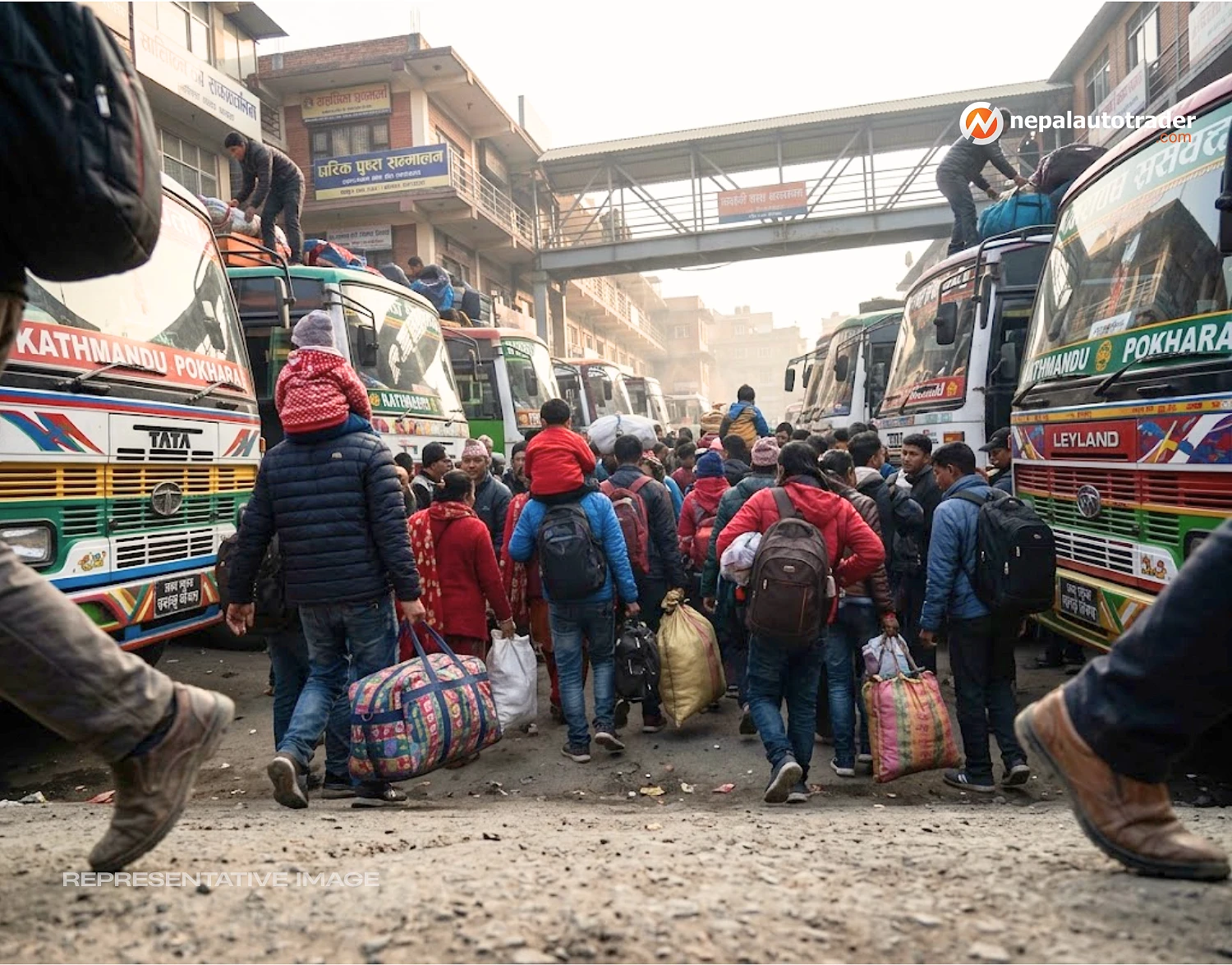
Nepal's Dashain travel rush is gathering pace, with advance bus-ticket bookings climbing as people leave Kathmandu Valley to celebrate the festival with family. The numbers are substantial, but the challenge facing transport operators is not simply about finding enough buses. Damaged roads and delays are making it harder to keep vehicles moving between destinations.
According to a report published by Nepal Auto on Ashoj 28, 2083, a total of 130,129 passengers had booked advance tickets for Dashain. Meanwhile, public transport had carried 187,774 passengers out of Kathmandu Valley since Ghatasthapana began.
These figures describe two different measures. Advance bookings count passengers who have reserved tickets, while departures record people who have already left. Together, they show the scale of the seasonal movement and the pressure building across Nepal's road transport network.
The advance booking figures show how quickly travel demand has accumulated since ticket sales opened. The report breaks down reservations across four booking dates, with the largest combined total recorded across Ashoj 24 and Ashoj 25.
| Booking date | Passengers booked |
|---|---|
| Ashoj 23, 2083 | 21,300 |
| Ashoj 24 and 25, 2083 | 76,079 |
| Ashoj 26, 2083 | 17,197 |
| Ashoj 27, 2083 | 15,553 |
| Total | 130,129 |
The figures show a sharp concentration of bookings on Ashoj 24 and 25. Those two days together accounted for 76,079 reservations, making them the busiest period in the reported booking breakdown.
However, bookings alone do not reveal how many seats remain available on individual routes. The report does not provide route-by-route availability, bus capacity or a breakdown of reservations by destination. Travellers heading to popular destinations should therefore check directly with authorised ticket counters rather than assume seats are still available.
Departures have also increased as families begin their Dashain journeys. Deputy Superintendent of Police Ravindra Khanal of the Kathmandu Valley Traffic Police Office told Nepal Auto that 78,138 passengers left Kathmandu Valley during the latest reported 24-hour period, from Tuesday morning until Wednesday morning.
Since Ghatasthapana began, the cumulative number of passengers leaving by public transport had reached 187,774.
| Reporting period | Passengers leaving |
|---|---|
| Ashoj 25, 2083 | 52,827 |
| Ashoj 26, 2083 | 56,809 |
| Latest 24-hour period | 78,138 |
| Total since Ghatasthapana | 187,774 |
The latest daily figure is higher than either of the two earlier daily totals listed in the report. That points to a growing flow of passengers leaving the capital as the festival approaches.
Travellers have been departing through several major exits, including Pharping, Nagdhunga, Thankot, Bhimdunga, Tinpiple, Sankhu, Jagati in Bhaktapur and Bhatte Danda in Lalitpur. These routes serve different parts of the valley's road network, so the effects of increased traffic will not be identical at every exit.
The published figures cover passengers using public transport. They should not be treated as a count of every person leaving Kathmandu Valley, since the report does not provide a combined total for private cars, motorcycles and other forms of travel.
The immediate problem for bus operators is the condition of the roads. Rajendra Acharya, treasurer of the Nepal Transport Entrepreneurs National Federation and chairman of Nepal Microbus Company, said damaged national highways were making transport management difficult.
When buses cannot reach their destinations on schedule, the disruption can spread through the day's operations. Vehicles arriving late may be unable to begin their next scheduled journey on time. That leaves operators with fewer vehicles ready for departing passengers, even when demand is already high.
The report specifically identifies the Prithvi Highway at Galaundi in Dhading, where the road had subsided and traffic was disrupted on the day advance booking opened. The incident left many vehicles held up in Kathmandu, adding to the difficulty of managing bus availability.
There is an important distinction here. Ticket reservations can be managed at counters and through booking systems, but they cannot by themselves resolve a road closure or make a delayed bus reach its destination sooner.
For passengers, this means allowing for uncertainty when planning connections and onward travel. A confirmed ticket is useful, but it is not a guarantee that the journey will run exactly to schedule when road conditions are poor.
The Nepal Transport Entrepreneurs National Federation has urged travellers to take a few basic precautions during the festival rush. These are especially relevant when buses are crowded and highway conditions are changing.
Passengers should also keep their ticket and booking details available during the journey. If the departure time changes, checking with the relevant transport operator is more useful than relying on unverified information circulating online.
The coming days will test the ability of transport operators and authorities to keep passengers moving while managing road disruptions. The booking total already shows substantial demand, while the departure figures indicate that the seasonal movement is well underway.
For transport operators, the priority is to keep vehicles in service and coordinate departures despite delays. For authorities, highway conditions, traffic management and passenger safety remain central concerns.
The report does not provide a final forecast of how many people will leave Kathmandu Valley, nor does it give a confirmed timetable for repairs at Galaundi. It would therefore be premature to predict the final number of travellers or when every affected route will return to normal.
One thing is clear. Dashain travel depends on more than the number of tickets sold. The condition of the roads and the ability to move buses between destinations will shape the experience for thousands of families heading home.
Q: How many passengers have booked advance Dashain bus tickets?
A: According to Nepal Auto's report published on Ashoj 28, 2083, a total of 130,129 passengers had booked advance tickets for Dashain.
Q: How many passengers have left Kathmandu Valley for Dashain?
A: The report records 187,774 passengers leaving by public transport since Ghatasthapana began. This figure is separate from the total number of advance bookings.
Q: When did advance Dashain ticket booking open?
A: Advance booking opened on Ashoj 23, 2083. The reported booking total includes reservations made through Ashoj 27.
Q: Why are bus journeys facing delays?
A: Damaged national highways have complicated vehicle movements and scheduling. The report specifically mentions disruption caused by a subsidence incident on the Prithvi Highway at Galaundi in Dhading.
Q: Where should passengers buy Dashain bus tickets?
A: The Nepal Transport Entrepreneurs National Federation has advised passengers to buy tickets through authorised counters, pay the prescribed fare and avoid unauthorised agents.
Q: Has the government announced when all affected highways will be repaired?
A: The source report does not provide a confirmed completion date for repairs at Galaundi or other affected highway sections. Passengers should check with transport operators and relevant authorities for current route conditions.

Nepal Auto-Trader is one-stop platform for all automotive needs. We provide unbiased and unparalleled news/reviews of all auto-motives being launched in Nepalese Auto-Industry. Find recent updates and price of bikes/cars, compare and review recently launched bikes/cars, buy/sell/trade reconditioned cars/bikes and all government news about changing rules and regulation, road safety by subscribing us.

Subscribe to our Newsletter
© Copyright 2026, Nepal Autotrader



.png)
.png)