

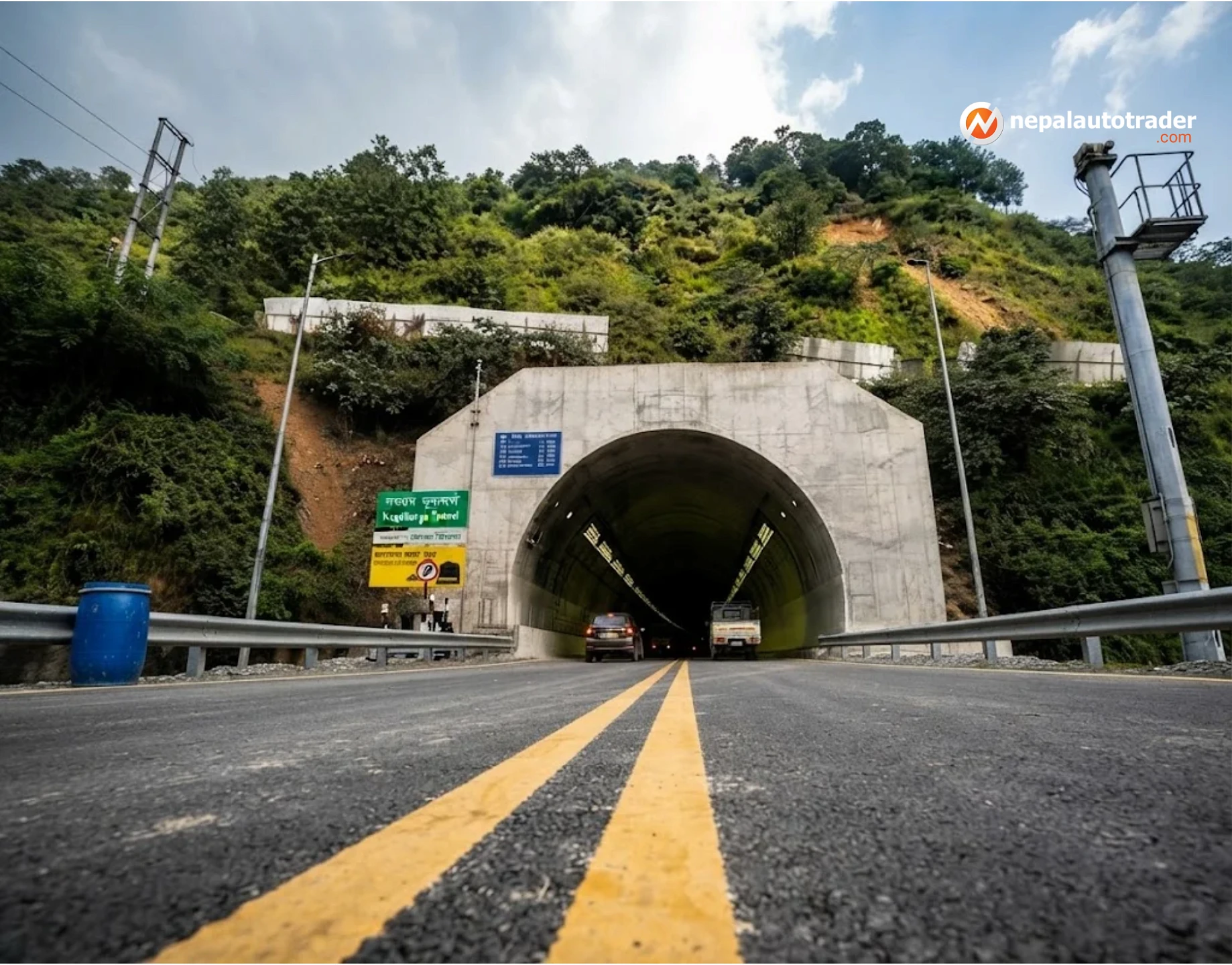
Drivers travelling between Kathmandu and Dhading now have a new expense to factor into their journeys. The Nagdhunga-Sisnekhola Tunnel, which has been allowing vehicles to pass without charge, officially moves to a paid operating system from Sunday, November 1.
The change brings an end to the temporary free-use arrangement that followed a road collapse near Nagdhunga in September. From now on, motorists choosing the tunnel will pay according to their vehicle category and direction of travel.
For private car owners, the charge is Rs 65 when entering Kathmandu and Rs 60 when leaving the valley. The difference may appear small, but regular commuters will now have to account for the toll as part of their travel costs.
The decision to begin collecting tolls follows the Road Board's executive committee decision of 12 Ashoj 2083 and a notice published in the Nepal Gazette on 26 Chaitra 2082.
The toll structure was established before the tunnel opened to general traffic. However, the start of collection was affected by events on the existing Nagdhunga road.
According to the report, vehicles had been allowed to use the tunnel without paying until Saturday, 14 Kartik. The free arrangement followed a road subsidence incident at Nagdhunga Dhunga on 17 Bhadra, which disrupted traffic on the conventional route. Authorities subsequently allowed all eligible vehicles to use the tunnel without a toll.
That temporary arrangement has now ended. Drivers should expect the published charges to apply from the first day of November.
The toll structure divides vehicles into four categories. Charges also vary depending on whether a vehicle is travelling towards Kathmandu or leaving the valley.
| Vehicle Category | Entering Kathmandu | Leaving Kathmandu |
|---|---|---|
| Category 1 Cars, vans and light vehicles | Rs 65 | Rs 60 |
| Category 2 Mini buses, mini trucks | Rs 115 | Rs 80 |
| Category 3 Buses and trucks | Rs 260 | Rs 200 |
| Category 4 Heavy trucks and heavy vehicles | Rs 600 | Rs 250 |
The largest difference between the two directions applies to heavy vehicles. A heavy truck entering Kathmandu will pay Rs 600, while the same category travelling out of the valley will pay Rs 250.
For everyday motorists, the first category is the most relevant. Cars and vans face a relatively small individual charge, although the cost becomes more noticeable for people using the route frequently.
Commercial operators have a different calculation. Buses, trucks and delivery vehicles will need to consider the toll alongside fuel, driver costs and other operating expenses. The actual effect will depend on how often they use the tunnel.
The strongest argument for using the tunnel remains the time it can save. The project says vehicles can travel from Sisnekhola in Dhading to Kisipidi in Balambu in around seven minutes through the tunnel.
Before the tunnel became available, travel on the Nagdhunga uphill section could take considerably longer during periods of congestion. According to the project information , smaller vehicles could take around 15 minutes, while larger vehicles could need approximately 35 minutes.
| Route or Condition | Reported Travel Time |
|---|---|
| Through the tunnel | Approximately 7 minutes |
| Old Nagdhunga route, smaller vehicles | Approximately 15 minutes during congestion |
| Old Nagdhunga route, larger vehicles | Approximately 35 minutes during congestion |
These figures describe the reported journey under the conditions outlined by the project. Actual travel times can still change with traffic, operating conditions and congestion around the tunnel entrances.
There is another important restriction. The tunnel has a prescribed speed limit of 40 km/h. Drivers should follow the posted signs and maintain lane discipline rather than treating the shorter route as an opportunity to drive faster.
The tunnel's transition to paid operation follows a long and gradual opening process. It did not become available to every vehicle at once.
After construction began, the project took 80 months to reach its operational opening on 11 Shrawan 2083. Initial access was given to emergency vehicles, including ambulances, fire engines and security agency vehicles.
The next stage began on 8 Bhadra, when smaller vehicles with seating capacity for up to nine people were permitted to use the tunnel. Authorities were preparing further access for smaller microbuses and mini buses travelling out of Kathmandu when the road subsidence incident changed the operating plan.
Rather than continue the gradual rollout, authorities opened the tunnel to all eligible vehicles without charge while the conventional road remained disrupted.
The transition can be understood through three key stages:
The sequence shows how an infrastructure project can move from a controlled opening to wider public use in response to changing road conditions. The introduction of tolls marks another step towards its regular operating arrangement.
For private motorists, the decision creates a choice between paying for the tunnel and using the existing road. That choice will depend on traffic conditions, travel schedules and the value a driver places on saving time.
For commercial vehicles, the calculation is more complicated. A truck operator may benefit from a shorter journey, but repeated toll payments will form part of the operating cost. Whether those savings outweigh the additional expense will depend on individual routes and schedules.
The tunnel also comes with restrictions that drivers should understand before approaching the entrance. Not every road user or vehicle can use it.
These restrictions are part of the tunnel's operating and safety framework. Drivers whose vehicles are not permitted must continue using the available conventional road network.
The bigger test now is operational consistency. A tunnel only delivers its full value when motorists can rely on predictable access, safe traffic management and proper maintenance. Toll collection is one part of that system, but the experience on the road will determine whether drivers consider the charge worthwhile.
Q: When does Nagdhunga Tunnel start charging vehicles?
A: Toll collection begins on Sunday, November 1, 2026, corresponding to 15 Kartik 2083. Vehicles were permitted to use the tunnel without charge until October 31.
Q: How much does a car pay to use Nagdhunga Tunnel?
A: Cars and vans pay Rs 65 when entering Kathmandu and Rs 60 when travelling out of the valley.
Q: How much do buses and trucks pay?
A: Buses and trucks pay Rs 260 when entering Kathmandu and Rs 200 when leaving. Mini buses and mini trucks have a separate lower toll category.
Q: What is the toll for heavy trucks?
A: Heavy trucks and multi-axle vehicles pay Rs 600 when entering Kathmandu and Rs 250 when travelling out.
Q: How long does it take to cross Nagdhunga Tunnel?
A: The project reports a journey time of around seven minutes between Sisnekhola and Kisipidi in Balambu. The prescribed tunnel speed limit is 40 km/h.
Q: Can motorcycles use Nagdhunga Tunnel?
A: No. Motorcycles, three-wheelers, pedestrians and non-motorised vehicles are not permitted. Vehicles carrying highly flammable materials are also prohibited.

Nepal Auto-Trader is one-stop platform for all automotive needs. We provide unbiased and unparalleled news/reviews of all auto-motives being launched in Nepalese Auto-Industry. Find recent updates and price of bikes/cars, compare and review recently launched bikes/cars, buy/sell/trade reconditioned cars/bikes and all government news about changing rules and regulation, road safety by subscribing us.

Subscribe to our Newsletter
© Copyright 2026, Nepal Autotrader



.png)
.png)