

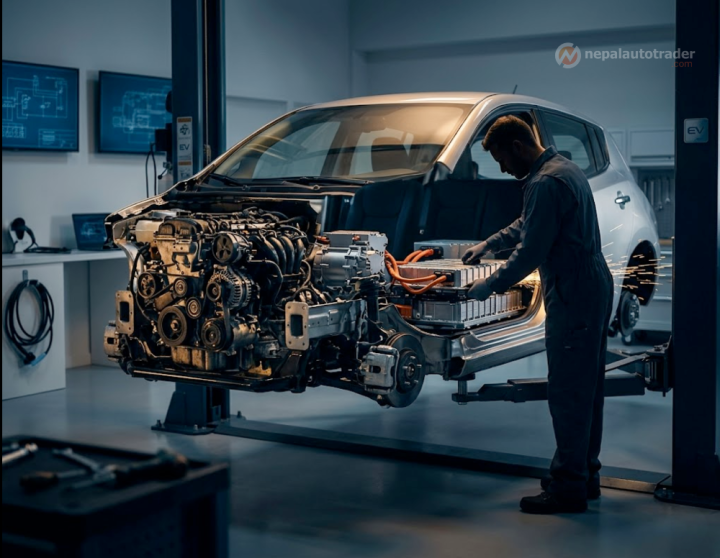
Nepal is drafting a law to allow petrol to EV conversion across the country
The policy targets faster adoption of affordable electric vehicles without buying new cars
Standardization, certification, and safety rules will be central to the framework
Retrofitting could create a new EV jobs and service ecosystem
Strong potential to reduce fuel imports and improve energy independence
Could reshape the used car market and extend vehicle life cycles
Aligns with Nepal’s push toward clean mobility and a stronger EV charging network
The government of Nepal is working on a new law that would allow petrol vehicles to be converted into electric vehicles. This is not just a policy tweak. It is a shift in how people access electric mobility.
Instead of buying a new electric car, owners could convert their existing vehicles. That makes EV adoption faster and far more accessible.
At a time when global demand for best selling EVs is rising, Nepal is exploring a different route. One that could suit price sensitive markets better.
Nepal has already seen steady growth in EV adoption. Lower taxes, better awareness, and gradual expansion of the EV charging network have helped.
Still, one problem remains.
New EVs are expensive.
This creates a gap between demand and affordability. The proposed EV conversion law aims to close that gap.
High upfront cost of new EVs
Limited availability in some segments
Dependence on imports
Uses existing vehicles
Reduces initial investment
Speeds up EV penetration
This puts Nepal in a unique position compared to other markets that focus only on new EV sales.
The law is still in development, but early direction suggests a structured and regulated approach.
| Area | Expected Regulation |
|---|---|
| Certification | Approved conversion kits only |
| Workshops | Licensed EV retrofit centers |
| Safety | Mandatory compliance checks |
| Performance | Defined battery range and efficiency |
| Registration | Updated vehicle classification |
Converting a petrol vehicle into an EV involves replacing key components.
Removing Internal combustion engine
Installing Electric motor
Integrating Battery pack
UpdatingController and wiring
| Component | Importance |
|---|---|
| Battery range | Determines usability and value |
| Motor power | Impacts performance |
| Charging compatibility | Must align with existing infrastructure |
| Safety systems | Critical for certification |
A well executed conversion can deliver a practical urban EV experience at a lower cost.
This policy has clear benefits across the board.
Lower cost than buying a new EV
Reduced fuel and maintenance expenses
Access to electric mobility with familiar vehicles
New market for conversion kits and services
Growth in EV skilled labor
Opportunities for local innovation
Reduced fuel imports
Lower emissions
Stronger domestic EV ecosystem
| Factor | New EV | Converted EV |
|---|---|---|
| Cost | High | Lower |
| Technology | Latest | Moderate |
| Availability | Limited | Immediate |
| Sustainability | High | Very high due to reuse |
| Adoption speed | Gradual | Faster |
This comparison highlights why conversion could accelerate Nepal’s EV transition.
Globally, most countries focus on manufacturing or importing EVs.
Nepal is exploring something different.
| Country | EV Strategy |
|---|---|
| India | Manufacturing and scaling new EVs |
| China | Global EV production leader |
| Nepal | EV conversion and circular mobility |
This approach could give Nepal a niche leadership role in electric vehicle retrofit solutions.
If implemented well, the EV conversion law could reshape the entire automotive landscape in Nepal.
Rapid growth in EV adoption
Expansion of the charging network
Rise of local EV service industries
Increased demand for standardized conversion kits
The key challenge will be maintaining quality and safety. Without strong regulation, conversion risks could slow adoption.
If done right, Nepal may not just follow the EV trend. It could set one.

Nepal Auto-Trader is one-stop platform for all automotive needs. We provide unbiased and unparalleled news/reviews of all auto-motives being launched in Nepalese Auto-Industry. Find recent updates and price of bikes/cars, compare and review recently launched bikes/cars, buy/sell/trade reconditioned cars/bikes and all government news about changing rules and regulation, road safety by subscribing us.

Subscribe to our Newsletter
© Copyright 2026, Nepal Autotrader



.png)
.png)