

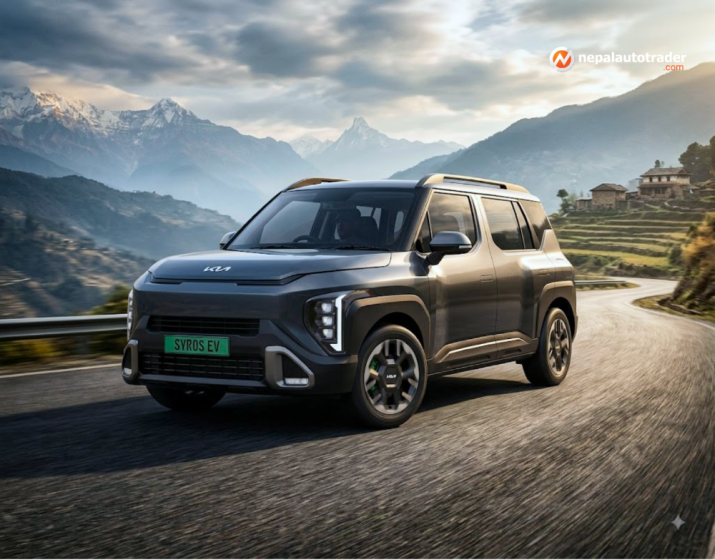
The small SUV market in Nepal has another serious contender, and this time Kia is bringing an electric powertrain to the equation. Kia Syros EV bookings have opened in Nepal, giving buyers a compact electric SUV with a combination of range, power and equipment that looks unusually ambitious for its segment.
The timing matters. Electric SUVs are no longer being judged simply by how little they cost to run. Buyers increasingly want usable range, quick charging, good cabin technology and the sort of road presence associated with larger SUVs. The Syros EV appears designed around exactly that expectation.
Continental Trading, Kia's official distributor in Nepal, opened bookings for the Syros EV during the ongoing NADA Mobility Expo. The company has set the official price at Rs 37.90 lakh. For the first 100 customers, however, a NADA offer reduces the price by Rs 2 lakh, bringing it down to Rs 35.90 lakh.
That launch offer gives the Syros EV a sharper opening position. It also creates a very clear incentive for early buyers, although the discounted price is explicitly limited to the first 100 customers.
| Pricing | Details |
|---|---|
| Official price | Rs 37.90 lakh |
| NADA offer | Rs 2 lakh discount |
| First customer offer price | Rs 35.90 lakh |
| Offer availability | First 100 customers |
The booking announcement was published on Thursday, Sawan 28, 2083, with the vehicle being introduced at the NADA Mobility Expo.
Nepal will initially receive the 42 kWh battery version of the Syros EV. Kia offers the model in India with 42 kWh and 51.4 kWh battery options, but the larger pack is not the one being introduced in Nepal at this stage.
The 42 kWh version is claimed to deliver 443 km on a full charge. That figure will naturally depend on driving conditions in the real world, but on paper it gives the compact SUV enough range to look beyond purely urban commuting.
Power comes from an electric motor producing 171 PS. The battery uses nickel manganese cobalt chemistry and comes with liquid-cooled thermal management. It is also rated IP67, while the vehicle itself is based on Kia's K1 platform.
| Specification | Kia Syros EV |
|---|---|
| Battery | 42 kWh |
| Power | 171 PS |
| Claimed range | 443 km |
| DC charging | 100 kW |
| 10 to 80 percent charging | 39 minutes |
| Ground clearance | 197 mm |
| Platform | K1 |
The charging numbers are equally important. With support for a 100 kW DC fast charger, the Syros EV can go from 10 to 80 percent in 39 minutes, according to the source. For owners who regularly travel outside the Kathmandu Valley, charging speed could matter almost as much as headline range.
Kia has not reinvented the Syros design for its electric version. Instead, the EV receives a set of visual changes that make its identity clear without losing the character of the petrol model.
At the front, the conventional grille makes way for a closed grille and revised bumper. The charging flap sits on the front left side, while Kia's vertical ice-cube LED headlamps remain a defining feature.
The result is still recognisably a Syros, but with enough EV-specific detailing to separate it from its internal-combustion counterpart. Earlier coverage of the model's development and design is available in the Kia Syros EV development report.
The cabin is where the Syros EV starts to make a particularly strong impression. Its dashboard features a 30-inch triple panoramic display, made up of a 12.3-inch HD touchscreen, a 12.3-inch digital instrument display and a 5-inch touchscreen climate-control panel.
There is plenty of technology beyond the screens. Standard equipment listed in the source includes wireless Android Auto and Apple CarPlay, a shift-by-wire column shifter, paddle control for regenerative braking, rear AC vents, an electronic parking brake with auto hold, rear sunshades, a covered frunk and disc brakes on all four wheels.
Depending on variant, buyers can also get a panoramic sunroof, Harman Kardon eight-speaker audio, ventilated front and rear seats, a powered driver's seat, Kia Connect 2.0 with more than 95 connected functions, over-the-air software updates, wireless charging, a smart dashcam, a 360-degree camera and V2L capability.
The safety package is similarly broad. Available equipment includes six airbags, electronic stability control, hill-start assist, tyre pressure monitoring, rear parking sensors, a virtual engine sound system, blind-view monitoring, side parking sensors and a 16-function Level 2 ADAS package. Availability varies by variant.
The significance of the Syros EV is not simply that Kia has added another electric SUV to its catalogue. The more interesting part is the package. A sub-four-metre SUV with 171 PS, a 443 km claimed range, 100 kW fast charging and a long list of premium equipment is being introduced at a price that puts it firmly into the conversation for mainstream EV buyers.
That makes the competitive landscape more interesting, even without relying on a simple price comparison. Buyers in this part of the market are increasingly looking for a single vehicle that can handle weekday commuting, family use and longer road trips. The Syros EV is clearly aimed at that broader brief.
Its 197 mm ground clearance is another useful detail for Nepal. It does not turn the Syros into an off-road machine, but it does give the compact SUV a specification that should appeal to buyers dealing with uneven urban roads and changing road conditions.
For now, the clearest development is the opening of bookings. Nepal is receiving the 42 kWh version first, while the source does not provide a separate delivery date or a detailed Nepal variant breakdown.
That leaves one important question open. How aggressively will Kia expand the Syros EV lineup once the first batch reaches customers?
The larger 51.4 kWh battery is already part of the model's offering in India, but there is no confirmation in the source that this version will be introduced in Nepal. For the moment, the 42 kWh, 443 km configuration is the one buyers should focus on.
The broader implication is hard to miss. Kia is not entering Nepal's electric compact SUV market with a stripped-down entry model. It is arriving with serious power, fast charging and a technology-heavy cabin. Whether customers respond as strongly as the specification sheet suggests will become clearer once the cars reach the road.
Q: What is the price of the Kia Syros EV in Nepal?
A: The official price is Rs 37.90 lakh. The first 100 customers can receive a Rs 2 lakh NADA offer, reducing the price to Rs 35.90 lakh.
Q: Which battery version of the Kia Syros EV is coming to Nepal?
A: Nepal is initially getting the 42 kWh battery version. The source states that the model is also available with a 51.4 kWh battery in India, but does not confirm that larger battery for Nepal.
Q: What is the range of the Kia Syros EV?
A: The 42 kWh version has a claimed full-charge range of 443 km. Actual range will vary with driving conditions and usage.
Q: How powerful is the Kia Syros EV?
A: The electric motor produces 171 PS of power. The source does not provide a torque figure, so no torque number is stated here.
Q: How quickly can the Kia Syros EV charge?
A: The SUV supports a 100 kW DC fast charger and can charge from 10 to 80 percent in 39 minutes, according to the source.
Q: What premium features are available in the Kia Syros EV?
A: Depending on variant, equipment includes a panoramic sunroof, Harman Kardon eight-speaker audio, ventilated seats, powered driver's seat, 360-degree camera, wireless charging, V2L, over-the-air updates and Level 2 ADAS.

Nepal Auto-Trader is one-stop platform for all automotive needs. We provide unbiased and unparalleled news/reviews of all auto-motives being launched in Nepalese Auto-Industry. Find recent updates and price of bikes/cars, compare and review recently launched bikes/cars, buy/sell/trade reconditioned cars/bikes and all government news about changing rules and regulation, road safety by subscribing us.

Subscribe to our Newsletter
© Copyright 2026, Nepal Autotrader



.png)
.png)