

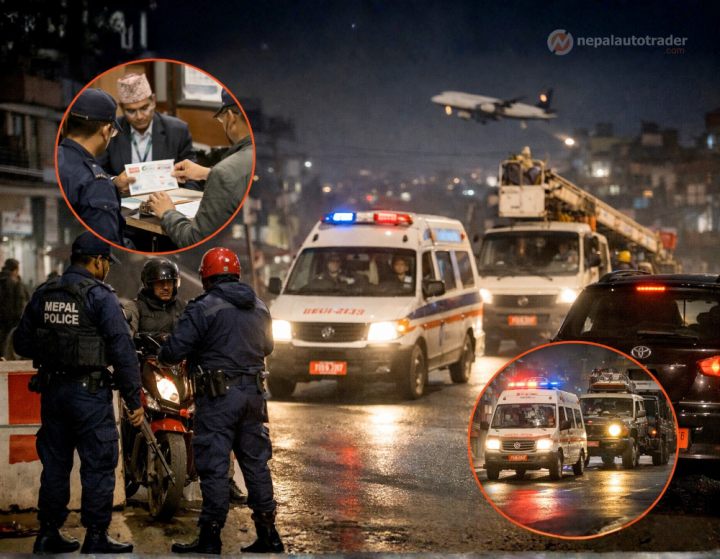
From midnight on Falgun 20 (May 12, 2026) until 12:00 noon on Falgun 21 (voting day), all public and private vehicles will be banned in Kathmandu.
The decision was made by the High-Level Election Security Committee.
Only essential service vehicles will be allowed to operate. These include ambulances, fire engines, hearses, blood bank vehicles, security forces, utility repair vehicles, diplomatic vehicles, and pre-approved election vehicles.
Vehicle passes issued by the Election Commission and the District Administration Office will be distributed at the commission’s secretariat.
Domestic and international flights will operate as usual. Airlines may provide shuttle services for passengers with valid tickets.
The restriction aims to protect polling stations, reduce traffic congestion, and prevent election-related misconduct.
There may be high demand for authorized vehicles and possible delays at pass distribution centers.
The High-Level Election Security Committee met last week to prepare a security plan for the Falgun 21 parliamentary election. Their decision was to shut down Kathmandu’s road network from midnight until noon on voting day.
The main goal is to improve security. With fewer vehicles on the road, there is less risk of voter intimidation, vote-buying, or traffic accidents that could delay voters.
Kathmandu is known for heavy traffic congestion. Even one blocked lane can cause long delays. By limiting most vehicles, authorities hope polling stations will open on time and remain accessible to voters who truly need transportation.
Only specific categories of vehicles are permitted. Vehicles outside these categories may face fines or confiscation.
Essential Services
Ambulances
Fire engines
Hearses (for official mortuary duties only)
Blood bank vehicles
Purpose: Emergency and life-saving services
Security Forces
Police vehicles
Military vehicles
Purpose: Maintain law and order during voting
Utility Repair Vehicles
Electricity repair vehicles
Water supply repair vehicles
Sewer maintenance vehicles
Telecommunications repair vehicles
Purpose: Maintain essential public services
Diplomatic Vehicles
Embassy vehicles
High-level diplomatic mission vehicles
Must display valid diplomatic plates and carry an election-day pass.
Pre-Approved Election Vehicles
Vehicles with official passes issued by the Election Commission
Purpose: Transport election staff, ballot boxes, and observers
Any vehicle claiming to be “essential” but without proper authorization will be stopped at checkpoints.
Vehicle passes will be distributed at the Election Commission’s secretariat.
Visit the secretariat between 8:00 AM and 4:00 PM on Falgun 20.
Bring:
Government-issued ID
Vehicle registration documents
Authorization letter (if applicable)
Collect the official stamped pass.
Display the pass clearly on your windshield.
The pass is valid only during voting hours. The vehicle ban will be lifted at 12:00 noon on Falgun 21.
>Flights (both domestic and international) will continue as scheduled.
Passengers with confirmed tickets may use airline-provided shuttle services.
Private vehicles without an official pass are not allowed.
Taxi drivers without a pass may be stopped at checkpoints and turned back.
This plan allows air travel to continue while maintaining security restrictions on city roads.
The vehicle ban will temporarily change daily routines:
Businesses that depend on walk-in customers may see fewer visitors.
Ride-sharing services will likely experience a major drop in bookings.
Ambulance services may receive more calls, as people avoid using private vehicles.
Although inconvenient for some, authorities believe the restrictions will strengthen public trust in a safe and fair election process.
Once voting concludes at noon on Falgun 21:
Police will gradually remove roadblocks, starting with major roads.
Public transportation will fully resume at 1:00 PM.
Utility crews will check for any service disruptions caused during the restriction period.
Officials will review voter turnout, security incidents, and traffic data. If successful, similar measures could be considered for future elections.
Q: Which vehicles can operate during the ban?
Only essential service vehicles, security forces, utility repair vehicles, diplomatic vehicles, and vehicles with official election passes.
Q: Where can I get a vehicle pass?
At the Election Commission’s secretariat on Falgun 20 between 8:00 AM and 4:00 PM. Bring valid ID, registration documents, and authorization if needed.
Q: Can private taxis operate after voting ends?
No. Taxis without an official pass cannot operate until the ban is lifted at noon on Falgun 21.
Q: How will airport passengers travel?
Passengers must use airline-provided shuttles or vehicles with official passes.
Q: Will traffic congestion increase after the ban ends?
There may be temporary congestion as vehicles return to the roads, but police will manage traffic and remove checkpoints gradually.
Q: Could this system be used in future elections?
Yes. Authorities will evaluate its effectiveness and may apply similar measures in future national or local elections.

Nepal Auto-Trader is one-stop platform for all automotive needs. We provide unbiased and unparalleled news/reviews of all auto-motives being launched in Nepalese Auto-Industry. Find recent updates and price of bikes/cars, compare and review recently launched bikes/cars, buy/sell/trade reconditioned cars/bikes and all government news about changing rules and regulation, road safety by subscribing us.

Subscribe to our Newsletter
© Copyright 2026, Nepal Autotrader



.png)
.png)