

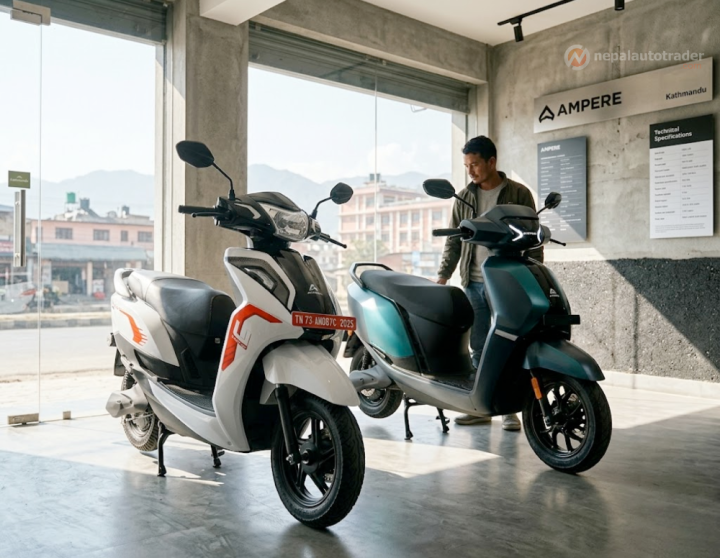
The Indian two‑wheel brand Ampere finally crossed the border, and Kathmandu’s streets will see a new breed of commuter today. STC Auto Solution Pvt. Ltd., the authorised Nepali distributor, opened sales for the Magnus Neo and the Nexus at a modest price point that undercuts many imported alternatives. The event, held on Thursday at the dealer’s showroom, featured live demos, battery stress tests at –40 °C and +60 °C, and a quick‑charge showcase that left the audience buzzing. That matters because range‑anxiety has been the biggest barrier for Nepalese riders considering an EV.
The Magnus Neo is positioned as the entry‑level model, but it does not skimp on practicality. Its 2.5 kW motor delivers smooth torque for city traffic, while the 2.3 kWh LFP pack promises a 100 km range under mixed‑use conditions. The scooter sits on a 165 mm ground clearance, enough to roll over potholes common in Kathmandu’s older neighborhoods. Load capacity is listed at 150 kg, meaning a rider plus a passenger or a heavy backpack can be carried without compromising stability.
Key features include:
If the Magnus Neo is the starter, the Nexus is the performance sibling. Its 3.3 kW motor pushes the scooter into a higher‑speed bracket, while the 3 kWh LFP battery extends the claimed range to 107 km. The extra power translates into a more confident climb on the hilly routes that lead out of the valley. The Nexus also inherits the same robust chassis, disc brakes and LED suite, but adds a mid‑mount motor that improves weight distribution.
The model offers five distinct drive modes, including a reverse gear that is rare in the scooter segment. Riders can switch between Eco, Urban, Sport, Off‑road and Reverse with a single button press, giving the scooter a versatility that rivals many imported models. That changes things for commuters who need a single bike for both daily office runs and weekend trips to the hills.
Ampere’s pricing strategy is deliberately aggressive. The Magnus Neo starts at NPR 3 lakh, while the Nexus is priced at NPR 3.35 lakh. Both prices are inclusive of mandatory road tax and registration fees, a clarity that many rivals fail to provide. The dealer also bundles a 5‑year or 75,000 km battery warranty, whichever comes first, and offers a home‑charging kit that can fill the pack from 0 % to 100 % in 3.5 hours using a standard 220 V outlet.
| Model | Price (NPR) | Battery Capacity (kWh) | Motor Power (kW) | Warranty |
|---|---|---|---|---|
| Magnus Neo | 300,000 | 2.3 | 2.5 | 5 years / 75,000 km |
| Nexus | 335,000 | 3.0 | 3.3 | 5 years / 75,000 km |
Charging is handled by an on‑board LFP charger rated at 1.5 kW. Plugging the scooter into a regular household socket will bring it to full capacity in just 3 ½ hours – a stark contrast to the 8‑hour charge times of many lithium‑ion competitors. The battery’s 2,000‑cycle rating means it should retain usable capacity for well beyond a decade, assuming normal riding habits.
The Nepali two‑wheel market has been dominated by gasoline scooters for decades, with electric options limited to premium imports or low‑capacity city bikes. Ampere’s entry at the NPR 3 lakh price tier directly challenges that status quo. By offering a reasonable range, fast home charging, and a robust warranty, the brand addresses the three pain points that have kept many riders on petrol.
Competitors such as Bajaj, TVS and Yamaha have announced EV concepts, but none have yet delivered a mass‑market model with comparable specs at this price. If Ampere can maintain supply and service support through its dealer network, the Magnus Neo and Nexus could become the benchmark for affordable electric mobility in Nepal. The real test will be how quickly riders adopt the new charging habits and whether the government’s incentives for EVs keep pace with demand.
The launch also signals a broader trend: Indian manufacturers are eyeing Nepal as a low‑entry market for EVs, leveraging shared borders and similar regulatory environments. As more brands follow suit, the competition will likely drive prices down further, benefitting consumers and the environment alike. That matters for Kathmandu’s air quality, which has struggled with particulate spikes during winter.
Q: What is the exact price of the Magnus Neo and Nexus in Nepal? A: The Magnus Neo is priced at NPR 300,000, while the Nexus costs NPR 335,000. Prices include mandatory taxes and registration.
Q: How long does it take to fully charge either scooter at home? A: Both models use a 1.5 kW on‑board charger and reach 100 % charge in about 3.5 hours when plugged into a standard 220 V household outlet.
Q: What warranty does Ampere provide for the battery? A: Ampere offers a 5‑year or 75,000 km warranty on the LFP battery, whichever comes first, covering any manufacturing defects.
Q: How does the range claim compare to real‑world usage? A: Ampere states 100 km for the Magnus Neo and 107 km for the Nexus under mixed‑city riding. Real‑world range will vary with rider weight, terrain and riding mode.
Q: Are there any government incentives for buying these scooters? A: As of the launch date, Nepal’s Ministry of Physical Infrastructure and Transport provides a tax rebate on electric two‑wheelers, but the exact amount depends on the model’s battery capacity and registration year.
Q: Where can I test ride the new Ampere scooters? A: Test rides are available at STC Auto Solution Pvt. Ltd. showroom in Kathmandu. Appointments can be booked through the dealer’s website or by calling their sales desk.

Nepal Auto-Trader is one-stop platform for all automotive needs. We provide unbiased and unparalleled news/reviews of all auto-motives being launched in Nepalese Auto-Industry. Find recent updates and price of bikes/cars, compare and review recently launched bikes/cars, buy/sell/trade reconditioned cars/bikes and all government news about changing rules and regulation, road safety by subscribing us.

Subscribe to our Newsletter
© Copyright 2026, Nepal Autotrader



.png)
.png)