

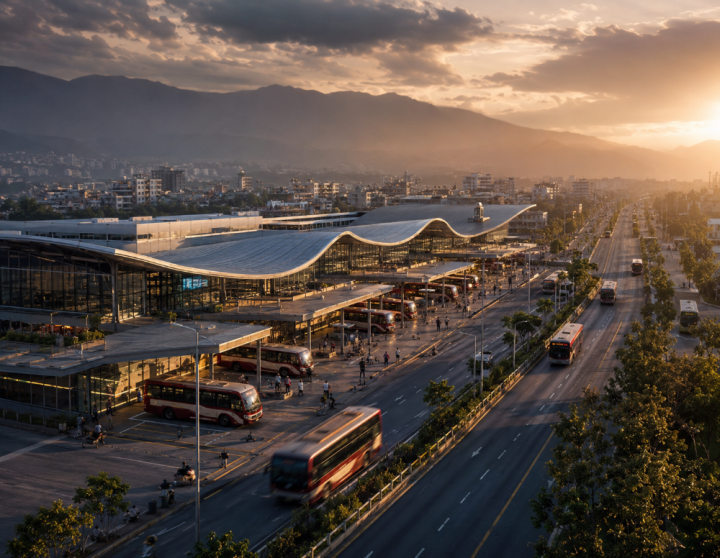
Kathmandu Valley's long-running struggle with congestion, fragmented bus services and weak transport infrastructure may finally be headed toward a structural rethink.
A report prepared under the Kathmandu Sustainable Urban Transport Project (KSUTP) has proposed the construction of nine modern bus terminals across key locations in the Valley. The study, originally completed in 2014 and recently made public by the Ministry of Infrastructure Development, outlines an ambitious roadmap to modernize public transportation and improve passenger mobility.
What makes this development noteworthy is not its scale, but its timing. Kathmandu's road network has expanded in patches over the past decade, yet public transport infrastructure has struggled to keep pace.
The consequences are already being felt across the industry, and by commuters who spend hours navigating unpredictable routes every day.
The report identifies nine strategic locations where major terminal facilities would be developed to support primary transport corridors.
| Proposed Terminal Location | Role in Network | Status |
|---|---|---|
| Narayangopal Chowk | Primary corridor terminal | Proposed |
| Jorpati | Primary corridor terminal | Proposed |
| Koteshwor | Primary corridor terminal | Priority phase |
| Suryabinayak | Primary corridor terminal | Proposed |
| Satdobato | Primary corridor terminal | Proposed |
| Ekantakuna | Primary corridor terminal | Proposed |
| Kalanki | Primary corridor terminal | Proposed |
| Naikap | Primary corridor terminal | Proposed |
| New Bus Park | Primary corridor terminal | Proposed |
According to the report, these terminals would not function as isolated facilities. Instead, they would be connected with feeder services operating from outer Ring Road settlements and secondary road networks, allowing passengers to transfer between routes more efficiently.
The significance emerges when viewed in a broader context. Kathmandu's transport system currently relies heavily on overlapping routes, small vehicles and informal operational structures. A hub-and-feeder model could fundamentally change how people move through the Valley.
One of the most significant recommendations involves relocating major intercity bus operations away from the traditional city core.
The report proposes a new intercity and urban bus terminal in the Lokanthali area near Koteshwor, on the eastern bank of the Manahara River north of the Arniko Highway. The objective is straightforward, reduce traffic pressure inside the central business district and free up valuable urban space.
While Kathmandu's historic bus parks have long served as transport anchors, they also concentrate congestion in already crowded districts.
The proposal would shift passenger movement toward the urban edge before distributing travelers through a more organized network.
| Project Component | Proposed Action | Expected Outcome |
|---|---|---|
| Old Bus Park | Operations relocated | Urban redevelopment opportunity |
| Lokanthali Terminal | New intercity hub | Reduced CBD congestion |
| Route Integration | Feeder service network | Improved passenger transfers |
| Interchange Facilities | Ratnapark and major nodes | Faster route changes |
The move comes as cities across Asia increasingly push transport infrastructure toward peripheral hubs to ease inner-city traffic pressure.
The report also recommends creating dedicated interchange facilities around Ratnapark, Kantipath and Durbar Marg, rather than developing large bus terminals within the city centre.
Under the proposed model, buses would pass through commercial districts instead of beginning or ending their journeys there.
That may sound like a technical adjustment. In reality, it could significantly alter traffic flow patterns across central Kathmandu.
Additional interchange facilities have also been suggested for:
For consumers, the change could be substantial. Faster transfers often matter more than faster vehicles.
Beyond terminals, the proposal includes a major upgrade to passenger infrastructure.
The study recommends building modern bus stations at intervals of roughly 400 to 600 metres throughout Kathmandu Valley. Dedicated bus lanes on major roads are also part of the plan.
The goal is to reduce travel times, improve reliability and cut fuel consumption.
Key recommendations include:
The real challenge isn't cost, it's execution. Dedicated lanes only work when enforcement is consistent and route planning remains disciplined.
Perhaps the most transformative element is hidden inside the route strategy.
The report recommends restructuring or consolidating nearly 200 public transport routes and categorizing services into three operational tiers. Primary routes would use buses with 80-seat capacity, secondary routes would use 60-seat capacity vehicles, while tertiary routes would rely on smaller electric vehicles.
It also proposes integrating scattered transport operators into larger operating companies or cooperatives, while creating dedicated public transport regulatory structures within government.
| Network Category | Vehicle Type | Capacity |
|---|---|---|
| Primary Route | Large Bus | 80 seats |
| Secondary Route | Medium Bus | 60 seats |
| Tertiary Route | Electric Vehicle | Not specified |
If implemented in full, the government estimates congestion across the Valley could fall by 12 percent, while annual operating costs could be reduced by approximately USD 34 million.
That is the headline figure. The bigger story is whether Kathmandu can finally transition from a loosely connected transport ecosystem into a genuinely integrated urban mobility network.
The effect becomes clearer over time. Infrastructure alone does not transform transport. Coordinated operations, enforcement and passenger trust do.
Q: How many bus terminals are proposed in Kathmandu Valley?
A: The report proposes the construction of nine major bus terminals across strategic locations including Koteshwor, Kalanki, Satdobato and Narayangopal Chowk.
Q: Where will the new intercity bus terminal be built?
A: The priority proposal places a new intercity and urban bus terminal in the Lokanthali area near Koteshwor, close to the Manahara River and Arniko Highway.
Q: How far apart will the proposed bus stations be?
A: The plan recommends modern bus stations at intervals of approximately 400 to 600 metres across Kathmandu Valley.
Q: Will dedicated bus lanes be included?
A: Yes. Dedicated bus lanes on major roads form part of the proposed transport modernization strategy.
Q: What vehicle capacities are proposed for the new route system?
A: Primary routes would use 80-seat buses, secondary routes would use 60-seat buses, while tertiary routes would rely on smaller electric vehicles.
Q: How much congestion reduction is expected?
A: The report claims full implementation could reduce Kathmandu Valley traffic congestion by 12 percent while generating annual operating savings of USD 34 million.

Nepal Auto-Trader is one-stop platform for all automotive needs. We provide unbiased and unparalleled news/reviews of all auto-motives being launched in Nepalese Auto-Industry. Find recent updates and price of bikes/cars, compare and review recently launched bikes/cars, buy/sell/trade reconditioned cars/bikes and all government news about changing rules and regulation, road safety by subscribing us.

Subscribe to our Newsletter
© Copyright 2026, Nepal Autotrader



.png)
.png)