

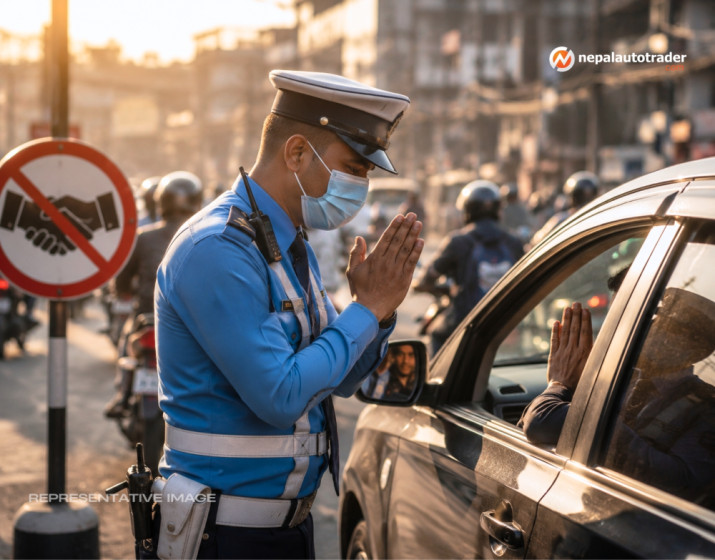
A seemingly harmless gesture has become the focus of a new directive from the Kathmandu Valley Traffic Police Office.
Traffic police officers stationed across the valley have been instructed not to shake hands with drivers or service seekers while carrying out their duties. The order was circulated to subordinate traffic offices, including traffic police ranges, circles, divisions and posts, following concerns raised by citizens and discussions on social media.
On the surface, the move may appear minor. Yet the bigger issue lies elsewhere.
Public confidence in traffic enforcement often depends as much on appearance as action. When officers are seen shaking hands with motorists during roadside checks, the interaction can easily be interpreted in different ways, especially in an era where every encounter can end up online within minutes.
The circular leaves little room for ambiguity.
According to the directive, traffic officers must completely refrain from shaking hands with drivers, vehicle owners or other service seekers while on duty. Instead, officers have been instructed to acknowledge people respectfully from a distance using Namaskar.
| Directive Area | Previous Practice | New Instruction |
|---|---|---|
| Greeting Drivers | Handshake permitted in practice | Handshake prohibited |
| Public Interaction | Physical greeting possible | Namaskar from a distance |
| Traffic Checks | No specific restriction | Applies throughout duty period |
The language used by the office suggests the policy is intended to eliminate any behavior that could create doubt about the integrity of roadside enforcement.
Sometimes optics matter as much as procedure. This appears to be one of those cases.
The directive did not emerge in isolation.
Officials noted that complaints had been received regarding images and videos showing traffic police officers shaking hands with motorists and service recipients during checks and other operational duties. Those visuals, according to the office, generated criticism on social media and among members of the public.
More importantly, authorities acknowledged that such interactions have often been portrayed as evidence of unofficial arrangements or bribery.
Whether those allegations were justified or not is beside the point. The perception itself became the issue.
The consequences are already being felt across the traffic policing system. Officers now have a clearer standard for public interactions, reducing room for misunderstanding.
Traffic police work is highly visible.
Every stop, inspection and conversation unfolds in public view. Unlike many government functions that take place behind office doors, traffic enforcement happens on busy roads where thousands of people can observe interactions in real time.
That visibility creates unique challenges.
For consumers, drivers and everyday commuters, confidence in enforcement depends heavily on transparency. A brief handshake may be intended as a gesture of courtesy, but observers often interpret actions through their own assumptions.
| Public Concern | Potential Interpretation | Policy Response |
|---|---|---|
| Handshake during checking | Possible informal arrangement | Ban physical greeting |
| Roadside interaction | Questions about neutrality | Standardized Namaskar greeting |
| Social media footage | Rapid spread of allegations | Uniform conduct guidelines |
What makes this development noteworthy is not its scale, but its timing.
Traffic enforcement agencies across Nepal are increasingly operating under public scrutiny, with smartphone cameras and social platforms amplifying even routine interactions.
This directive may be focused on handshakes, but its significance emerges when viewed in a broader context.
Modern traffic management is no longer limited to issuing fines and directing vehicles. Agencies are expected to maintain professionalism, transparency and accountability at every stage of public interaction.
The move comes as road users continue to demand:
Readers following developments such as recent licensing fee revisions, public transport GPS initiatives, electric shuttle bus projects and traffic management reforms will recognize a common theme. Institutions are increasingly focused on visibility, accountability and public trust.
The effect becomes clearer over time. Small procedural changes often signal larger cultural shifts inside enforcement agencies.
The immediate impact is straightforward. Traffic police officers across the Kathmandu Valley are now expected to replace handshakes with a respectful Namaskar while carrying out their duties.
Whether the directive changes public perception remains to be seen.
Still, the reasoning behind it is easy to understand. In an environment where public trust can be influenced by a single image or video clip, authorities have chosen to remove a gesture that can be misunderstood.
Sometimes institutional credibility is built through major reforms. Other times, it starts with something as simple as how an officer says hello.
Q: Who issued the new handshake restriction for traffic police?
A: The directive was issued by the Kathmandu Valley Traffic Police Office and circulated to subordinate traffic units operating under its jurisdiction.
Q: Are traffic police completely banned from shaking hands while on duty?
A: Yes. The circular instructs officers to fully refrain from shaking hands with drivers, service seekers and other members of the public during duty hours.
Q: What greeting should officers use instead?
A: Officers have been directed to greet people respectfully with Namaskar from a distance rather than through physical contact.
Q: Why was the directive introduced?
A: Authorities cited complaints from citizens and social media discussions where handshakes were sometimes portrayed as evidence of improper arrangements or bribery.
Q: Does the rule apply only during vehicle checks?
A: No. The directive applies broadly during traffic duty, including vehicle inspections and other interactions with service seekers.
Q: Will the policy affect how traffic enforcement is conducted?
A: Enforcement procedures remain unchanged. The directive focuses on officer conduct and public interaction standards rather than enforcement rules themselves.

Nepal Auto-Trader is one-stop platform for all automotive needs. We provide unbiased and unparalleled news/reviews of all auto-motives being launched in Nepalese Auto-Industry. Find recent updates and price of bikes/cars, compare and review recently launched bikes/cars, buy/sell/trade reconditioned cars/bikes and all government news about changing rules and regulation, road safety by subscribing us.

Subscribe to our Newsletter
© Copyright 2026, Nepal Autotrader



.png)
.png)