

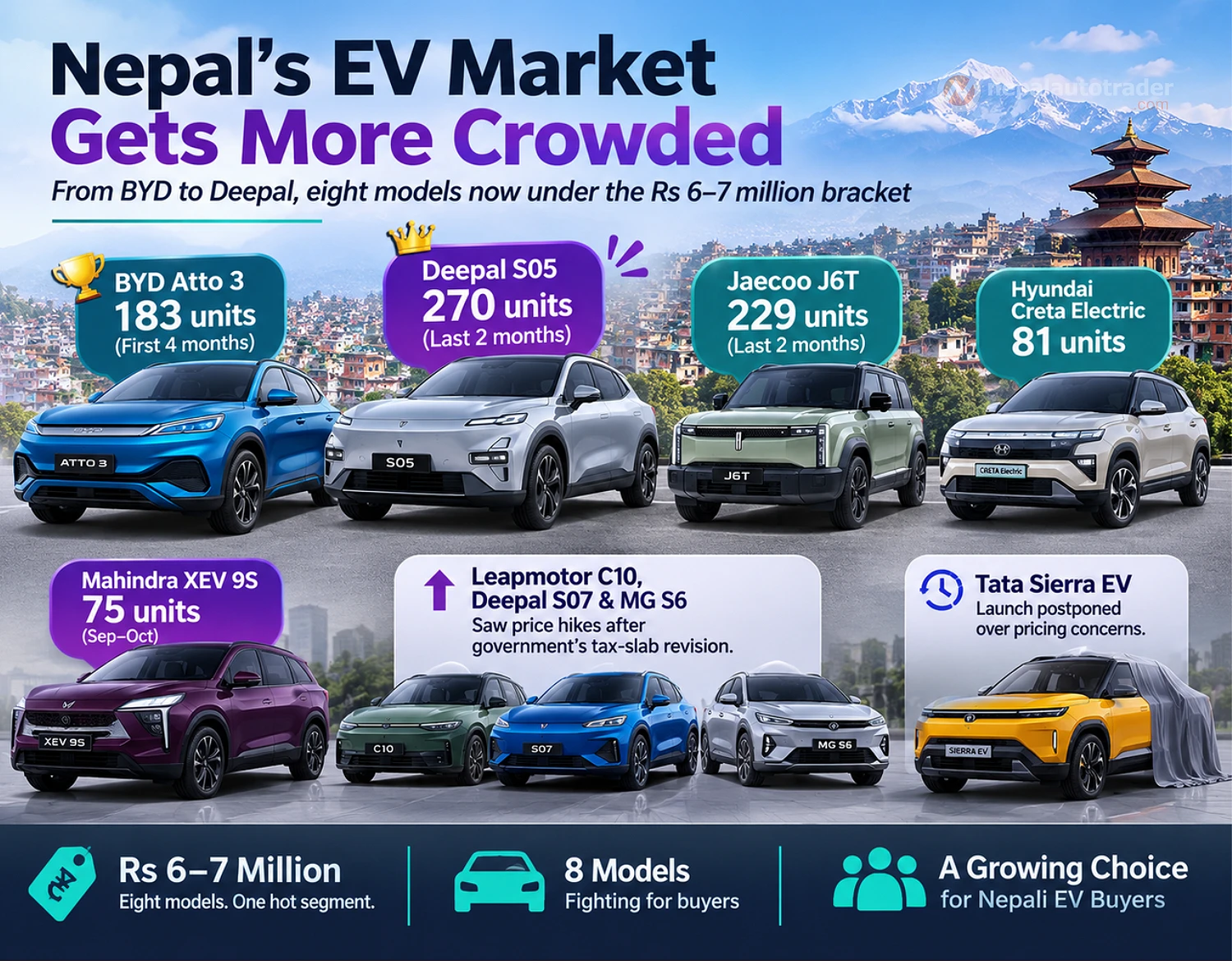
The Nepali electric‑vehicle market is still in its infancy, yet the Rs 6‑7 million bracket has become the battleground for manufacturers targeting middle‑class buyers. The government’s recent tax‑slab revision nudged several imported models upward, squeezing margins and prompting dealers to renegotiate terms. Despite the price pressure, total import volumes for the segment stayed robust, indicating a growing appetite for cleaner mobility.
Import data for the current fiscal year shows a clear split: the first four months captured early‑year demand, while the final two months highlighted a late‑year surge driven by new model launches and promotional offers. The segment’s overall health can be gauged by looking at the numbers behind each key player.
Below is a snapshot of the most active models, their import volumes and the price band they occupy.
| Model | Units Imported | Import Period | Notes |
|---|---|---|---|
| BYD Atto 3 | 183 | First four months | Flagship of BYD’s global line, strong resale value. |
| Hyundai Creta Electric | 81 | First four months | Korean brand’s first fully electric SUV. |
| Deepal S05 | 270 | Last two months | Leads the segment, price unchanged. |
| Jaecoo J6T | 229 | Last two months | Chinese‑made compact crossover. |
| Mahindra XEV 9S | 75 | September‑October | Seven‑seat electric SUV, niche appeal. |
These figures illustrate a market where Chinese manufacturers dominate volume, while Indian brands are carving a niche with larger, family‑oriented SUVs. The BYD Atto 3 and Hyundai Creta Electric set the early‑year tone, but the surge of Deepal S05 and Jaecoo J6T in the closing months suggests that price stability and aggressive marketing can quickly shift buyer preferences.
In early November the Nepali government announced a revised import‑tax schedule for electric vehicles. The move pushed Leapmotor C10, Deepal S07 and MG S6 into a higher bracket, raising their on‑road prices by several lakhs of rupees. While the official import data for these three models shows zero units moved during the reporting period, the price hikes have already reshaped dealer strategies.
Dealers of Leapmotor C10 and Deepal S07 are now offering extended warranty packages or cash‑back incentives to soften the impact on buyers. The MG S6, a compact hatchback, faces a similar dilemma; its brand‑recognition in Nepal is still low, and the added cost could deter price‑sensitive shoppers.
The tax shift underscores a broader risk: manufacturers that rely heavily on a narrow price window may see sales evaporate if policy changes are not anticipated. For the Rs 6‑7 million segment, where every lakh matters, even a modest increase can tip the scales toward a competitor with a steadier price tag.
One name that keeps resurfacing in industry chatter is the Tata Sierra EV. Planned as a rugged, affordable SUV, the model was slated for a mid‑year launch. However, Tata Motors postponed the debut, citing “pricing concerns” after the tax revision. Analysts believe the delay could be strategic, giving Tata time to re‑engineer the vehicle’s cost structure before entering a market that now demands tighter price discipline.
Meanwhile, Mahindra XEV 9S is testing the waters with its seven‑seat layout, targeting larger families who previously relied on diesel SUVs. Though its import volume is modest, the model’s presence hints at a potential shift: if Indian manufacturers can combine spaciousness with competitive pricing, they may capture a segment that Chinese brands have largely ignored.
Talk on the streets of Kathmandu and Pokhara reveals a pragmatic buyer base. Many consumers appreciate the lower running costs of EVs, yet they remain wary of upfront price spikes. The recent tax‑slab revision reinforced this caution, prompting shoppers to compare total cost of ownership rather than just sticker price.
Financing options are improving; several Nepali banks now offer lower‑interest loans for electric cars, but the loan‑to‑value ratio still caps at 70 % for vehicles above Rs 6 million. This means buyers must still bring a sizable down‑payment, a hurdle for many middle‑class families.
The market’s response to the price hikes can be seen in the surge of Deepal S05 imports. The model kept its price stable while offering a respectable range and modern infotainment, making it an attractive alternative for buyers who might have considered the now‑more‑expensive Leapmotor C10.
Looking ahead, the segment will likely see a tightening of competition. Manufacturers that can maintain price stability while adding features, such as faster charging, longer warranties, or localized service networks, will win the loyalty of Nepali buyers.
If the government revisits the tax policy later in the fiscal year, we may see a second wave of price adjustments. For now, the data suggests that volume leaders are those that moved quickly to absorb the tax impact or that were already positioned below the new threshold.
The Rs 6‑7 million band remains a sweet spot: it balances affordability with enough cabin space and tech to satisfy modern expectations. As infrastructure improves and consumer confidence grows, this segment could become the cornerstone of Nepal’s electric‑mobility transition.
Q: Which model imported the most units in the last two months? A: The Deepal S05 led the segment, moving 270 units during that period.
Q: Did the tax‑slab revision affect any imports in the reporting window? A: No units of Leapmotor C10, Deepal S07 or MG S6 were recorded, but all three saw price increases.
Q: How many seven‑seat electric SUVs are currently in Nepal? A: The Mahindra XEV 9S is the only seven‑seat EV on the market, with 75 units imported between September and October.
Q: Is there any electric vehicle priced below Rs 6 million? A: The data provided focuses on the Rs 6‑7 million segment; lower‑priced models exist but are not covered in this report.
Q: What caused the delay of the Tata Sierra EV? A: Tata Motors postponed the launch due to concerns about meeting the price expectations set by the new tax schedule.
Q: Are there financing options for cars in this price range? A: Nepali banks offer loans up to 70 % of the vehicle value for cars above Rs 6 million, meaning buyers must still provide a sizable down‑payment.

Nepal Auto-Trader is one-stop platform for all automotive needs. We provide unbiased and unparalleled news/reviews of all auto-motives being launched in Nepalese Auto-Industry. Find recent updates and price of bikes/cars, compare and review recently launched bikes/cars, buy/sell/trade reconditioned cars/bikes and all government news about changing rules and regulation, road safety by subscribing us.

Subscribe to our Newsletter
© Copyright 2026, Nepal Autotrader



.png)
.png)