

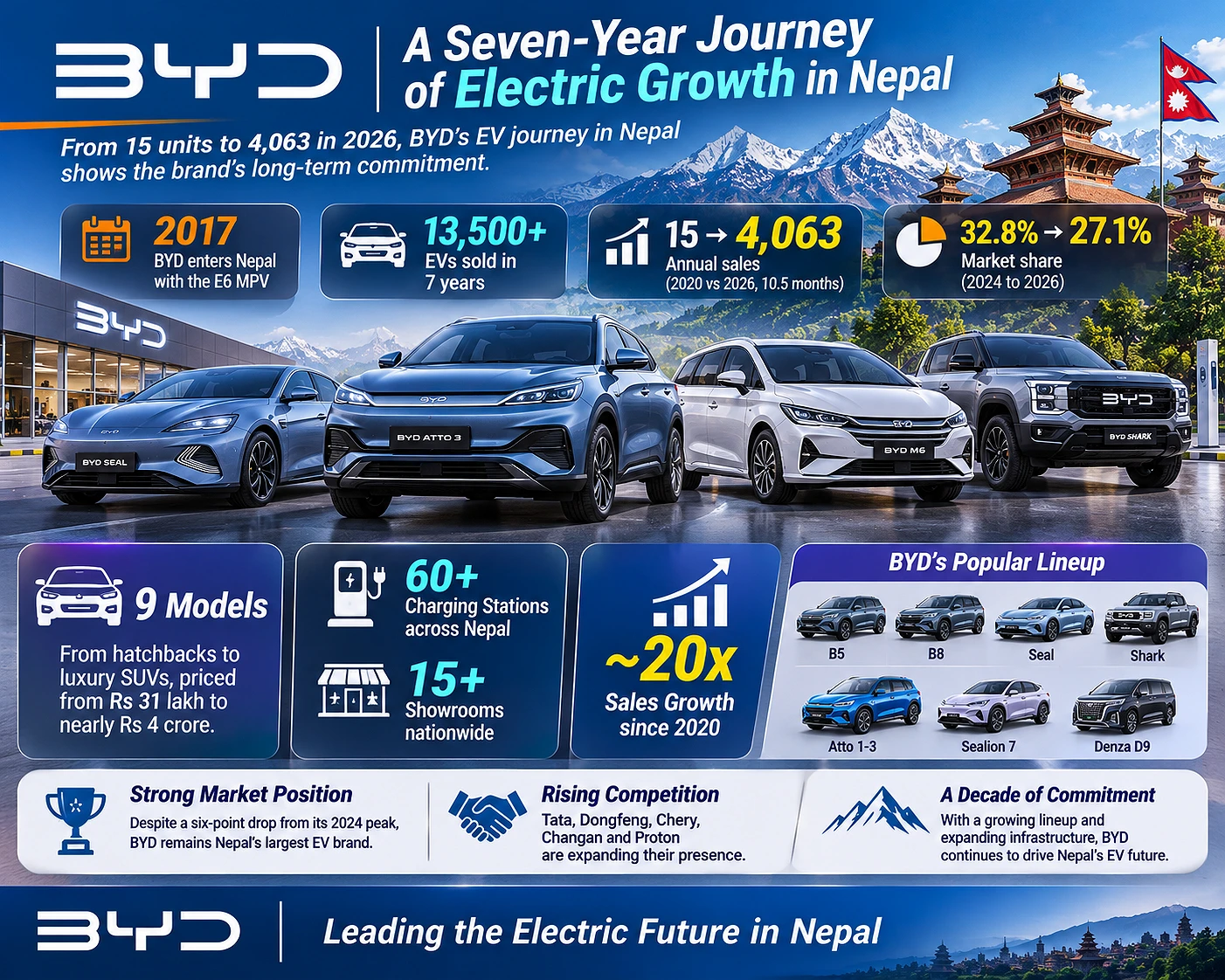
BYD first set foot in Nepal in 2017, when Cimex Inc., the authorized distributor, introduced the electric MPV E6 in March. The E6 was positioned as a practical family vehicle for Kathmandu’s congested streets and quickly became the reference point for electric mobility in the country. During the first three years, BYD’s presence was modest, mostly limited to pilot projects and a handful of demonstration units, but the brand built a reputation for reliability and low‑running costs.
The market truly opened up in 2020. BYD imported 15 units, capturing 5.8 % of the passenger EV market when total annual EV sales hovered around 100 units. By 2021, imports rose to 71 units, and the market began expanding rapidly. The turning point arrived in 2022 when BYD shipped 192 units and started selling passenger cars in October, adding the Atto 1 hatchback to the roster.
Sales accelerated dramatically thereafter:
Overall, BYD’s sales have risen roughly 20‑fold in five years, while its share of the overall EV market slipped six percentage points, a sign that the market itself is becoming crowded with new entrants.
Today BYD offers nine models across hatchback, sedan, SUV, MPV and pickup categories. A total of eleven models have been introduced since 2017, covering M6, Atto 3, Atto 2, Atto 1, Sealion 7, Denza D9, B5, B8, Seal and Shark.
| Model | Segment | Starting Price (Rs) |
|---|---|---|
| Atto 1 | Hatchback | Rs 31 lakh |
| Atto 2 | Sedan | Rs 38 lakh |
| Atto 3 | SUV | Rs 45 lakh |
| Sealion 7 | Luxury SUV | Rs 1.2 crore |
| Denza D9 | MPV | Rs 2.5 crore |
| Shark | Pickup | Rs 3 crore |
| Top‑end models | Various | Nearly Rs 4 crore |
The pricing spread, from Rs 31 lakh for the entry‑level Atto 1 to nearly Rs 4 crore for premium offerings, covers a broad buyer base, from first‑time EV owners to affluent families seeking a luxury electric SUV.
More than three dozen EV brands now operate in Nepal. Newcomers such as Tata, Dongfeng, Chery, Changan and Proton are adding pressure, especially in the affordable sedan and compact SUV segments. While BYD’s share fell from 33 % to 27 %, the overall EV market grew from roughly 100 units in 2020 to well over 5,000 units annually by 2026.
BYD’s advantage lies in its comprehensive model range, established dealer network, and early charging infrastructure. Competitors often focus on a single niche, Tata on affordable hatchbacks, Dongfeng on commercial vans, whereas BYD can attract buyers across income brackets.
Cimex Inc. has built more than 15 showrooms and service centers, ensuring that owners can access maintenance without traveling far. The brand also supports over 60 charging stations spread across Kathmandu, Pokhara, Biratnagar and other major hubs. These stations are a mix of fast‑charge (50 kW) and standard (22 kW) units, reducing range anxiety for long‑distance trips.
The growing network has been a key factor in BYD’s sales surge. Customers cite easy service access and reliable charging as primary reasons for choosing BYD over newer entrants that still lack a comparable footprint.
Looking forward, BYD’s challenge will be to maintain growth while its share of an expanding market naturally dilutes. The brand is expected to launch two additional models by the end of 2027, likely an affordable compact SUV and a high‑capacity commercial van. Both would fill gaps left by competitors and keep BYD’s lineup fresh.
Policy incentives, such as reduced import duties for electric vehicles and tax rebates for charging infrastructure, remain crucial. If the Nepali government continues to favor EV adoption, BYD’s sales could breach the 5,000‑unit mark annually within the next two years.
In summary, BYD’s journey from a single MPV in 2017 to a market‑dominant brand in 2026 illustrates how early entry, diversified products, and robust after‑sales support can translate into sustained growth, even as competition intensifies.
Q1: How many BYD electric vehicles have been sold in Nepal since 2017? A: Over 13,500 EVs have changed hands, with roughly 13,300 sold in the last 46 months.
Q2: Which BYD model is the most affordable? A: The Atto 1 hatchback starts at about Rs 31 lakh, making it the entry‑level choice.
Q3: Where can I charge a BYD vehicle in Nepal? A: BYD operates more than 60 charging stations across major cities, and many public fast‑charge points accept BYD’s standard connector.
Q4: Who distributes BYD cars in Nepal? A: Cimex Inc. is the authorized distributor, handling sales, service and charging infrastructure.
Q5: How does BYD’s market share compare to other EV brands? A: BYD peaked at 32.8 % in 2024 and sits at 27.1 % in 2026, still the largest single share despite a six‑point dip.
Q6: What new BYD models are expected soon? A: Industry sources hint at a compact SUV and a commercial van slated for launch by late 2027, aimed at expanding the brand’s reach in both passenger and fleet segments.

Nepal Auto-Trader is one-stop platform for all automotive needs. We provide unbiased and unparalleled news/reviews of all auto-motives being launched in Nepalese Auto-Industry. Find recent updates and price of bikes/cars, compare and review recently launched bikes/cars, buy/sell/trade reconditioned cars/bikes and all government news about changing rules and regulation, road safety by subscribing us.

Subscribe to our Newsletter
© Copyright 2026, Nepal Autotrader



.png)
.png)