

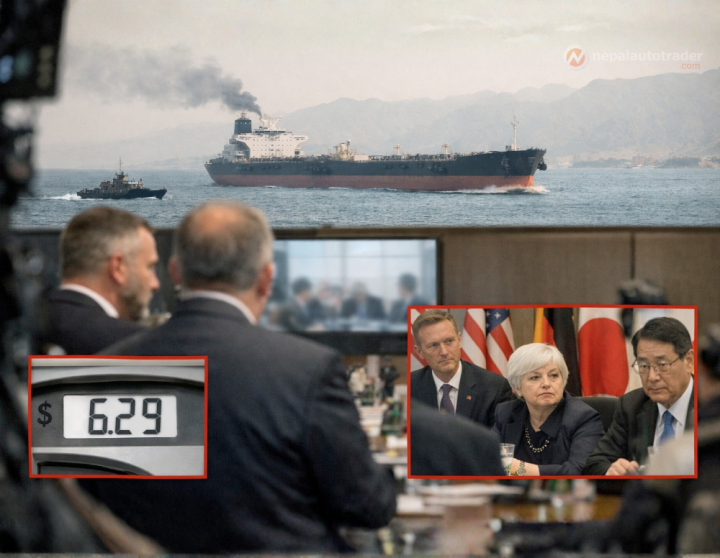
G7 nations agree not to release emergency oil reserves yet despite crude approaching $119 per barrel
Disruptions around the Strait of Hormuz, a key global oil shipping route, triggered the recent price spike
Global strategic reserves coordinated through the International Energy Agency exceed 1.8 billion barrels
Officials say there is no immediate supply shortage in North America or Europe
A coordinated release of 300 to 400 million barrels remains possible if markets tighten further
High fuel prices could accelerate demand for electric vehicles, hybrids, and energy efficient mobility
The situation echoes past oil shocks that helped speed up the shift toward alternative energy
Oil markets rarely stay calm when geopolitics enter the picture.
Recent tensions involving Iran and regional security risks near major shipping routes pushed crude prices close to $119 per barrel, the highest levels seen in several years.
In response, energy officials from the Group of Seven economies met to discuss releasing emergency oil reserves.
The verdict for now is simple. Wait.
Officials say global supply remains stable enough to avoid tapping stockpiles immediately. The group prefers to keep its strategic reserves available in case the crisis escalates.
Sometimes the signal matters as much as the action. By showing readiness to intervene, governments hope to calm markets without actually releasing oil.
The latest surge in oil prices is tied to concerns around the Strait of Hormuz, one of the most critical energy corridors on the planet.
Roughly one fifth of global seaborne oil flows through this narrow waterway connecting the Persian Gulf to global markets.
Any disruption here sends shockwaves through the energy system.
| Factor | Detail |
|---|---|
| Global oil share transported | About 20 percent |
| Key exporters | Saudi Arabia, UAE, Kuwait, Iraq |
| Strategic importance | Primary supply route to Asia and Europe |
| Risk factor | Military tension and shipping disruptions |
When markets fear disruptions, prices move fast. That is exactly what happened this week.
Emergency reserves act like a global insurance policy for energy markets.
Countries store massive amounts of crude oil that can be released during supply shocks such as wars, natural disasters, or severe production cuts.
| Metric | Estimate |
|---|---|
| Public emergency reserves | ~1.2 billion barrels |
| Industry reserves | ~600 million barrels |
| Total emergency buffer | ~1.8 billion barrels |
| Potential coordinated release under discussion | 300 to 400 million barrels |
These reserves are coordinated largely through the International Energy Agency, which helps align responses across major economies.
At first glance, it may seem odd that governments would hold back reserves while oil prices jump.
The reasoning is strategic.
No immediate supply shortage
Oil continues flowing into major consuming markets.
Strategic flexibility
Using reserves too early could limit options if the crisis worsens.
Market signaling
Sometimes simply announcing readiness to act helps cool speculation.
In other words, policymakers are keeping their powder dry.
High oil prices rarely stay confined to energy markets. They ripple across transportation and mobility.
Historically, fuel price spikes accelerate interest in:
Electric vehicles
Hybrid vehicles
Fuel efficient cars
Alternative energy infrastructure
When gasoline prices jump, consumers start looking for ways to escape the pump.
This dynamic has played out repeatedly.
| Oil shock | Result for vehicle market |
|---|---|
| 1970s oil crisis | Rise of fuel efficient cars |
| 2008 oil spike | Growth of hybrid vehicles |
| 2022 energy crisis | Rapid EV adoption |
| Current market volatility | Potential boost for affordable EVs |
Automakers promoting long battery range, fast charging, and expanding charging networks could benefit if high fuel prices persist.
The world today is better prepared for oil disruptions than in previous decades.
Energy systems are more diversified and economies are less dependent on crude oil than they once were.
Still, markets remain sensitive to geopolitical shocks. Oil remains the backbone of global transport and industry.
The current situation shows how quickly prices can spike when a major supply route is threatened.
For now, the Group of Seven is watching the situation closely.
If disruptions worsen, a coordinated release of strategic oil reserves could still happen. Markets know that hundreds of millions of barrels are available if needed.
But the bigger story may be structural rather than short term.
Every oil shock nudges the world a little faster toward electrification.
If prices remain elevated, consumers and governments may double down on the transition toward electric vehicles, renewable energy, and lower oil dependence.
History suggests one thing.
When oil gets expensive, innovation moves faster.

Nepal Auto-Trader is one-stop platform for all automotive needs. We provide unbiased and unparalleled news/reviews of all auto-motives being launched in Nepalese Auto-Industry. Find recent updates and price of bikes/cars, compare and review recently launched bikes/cars, buy/sell/trade reconditioned cars/bikes and all government news about changing rules and regulation, road safety by subscribing us.

Subscribe to our Newsletter
© Copyright 2026, Nepal Autotrader



.png)
.png)