

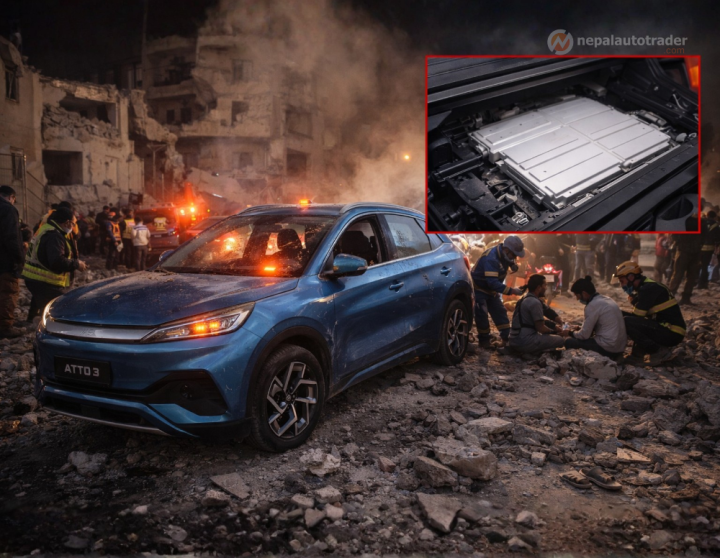
On 1 March 2024 a missile struck a residential building just metres from a civilian convoy. The vehicle at the centre of the chaos was a BYD Atto 3 electric SUV. Five people were inside – the driver, four passengers – and all survived. Local emergency services reported the driver sustained superficial wounds, the others walked away with bruises or shock. Photographs released on social media showed the hazard lights still flashing, the cabin door frames unbent, and the battery pack tucked safely beneath the floor.
That matters because the footage became a viral proof point for a technology that many still view with suspicion. No fire, no smoke, no explosion – the high‑voltage system behaved exactly as engineers intended.
EV safety conversations usually revolve around crash‑test numbers, not war‑zone explosions. Yet the A‑B‑C pillar architecture of the Atto 3, reinforced with a high‑strength steel chassis, kept the passenger cell from collapsing. The vehicle also carries a low‑voltage electrical system that automatically isolates the high‑voltage pack when a severe impact is detected. In this case the system acted like a safety net, preventing any thermal runaway in the LFP blade battery.
The incident sparked a wave of social‑media posts with the tagline “Safety is the new luxury”. For potential buyers in Nepal, where road safety is already a concern, this real‑world validation could tip the scales toward EV adoption.
These engineering choices are not marketing fluff; they are the result of BYD’s decades‑long focus on structural integrity and battery chemistry that tolerates abuse.
| Specification | Value | Source |
|---|---|---|
| Battery Capacity | 49.9 kWh | BYD Nepal brochure |
| Range (WLTP) | 340 km | BYD Nepal brochure |
| Euro NCAP Rating | 5 stars | Euro NCAP database |
| Adult Occupant Score | 91 | Euro NCAP database |
| Price in Nepal | 5,690,000 NPR | Simeks Inc price list |
The BYD Atto 3 is already sold in Nepal through Simeks Inc, with the advanced variant positioned as a mid‑range family SUV. Its price of 5,690,000 NPR places it between the Hyundai Ioniq 5 (price recently cut by 1.4 million NPR) and the Tata Nexon EV. The safety narrative emerging from Jerusalem could give BYD a distinct advantage in a market where consumer confidence is still fragile.
If the story continues to circulate, dealers may see a surge in test‑drive bookings, and financing institutions could adjust risk models to reflect the perceived safety premium. In the longer run, regulators might look to incorporate real‑world blast‑resistance data into future EV safety standards.
Analysts caution that a direct missile hit would still be lethal for any vehicle. The Jerusalem event was a near‑miss, a blast that tested the vehicle’s ability to absorb shock, not to survive a direct strike. Nonetheless, the fact that the high‑voltage battery stayed cool and the cabin remained sealed is a data point that cannot be ignored.
For Nepal, where the government is pushing EV adoption through subsidies and tax incentives, the Atto 3’s demonstrated resilience could accelerate the transition. Consumers will likely weigh the Euro NCAP rating, the LFP blade battery safety, and the real‑world proof together when deciding between a conventional SUV and an electric one.
Q: What is the exact price of the BYD Atto 3 advanced variant in Nepal? A: The advanced variant is priced at 5,690,000 NPR as listed by Simeks Inc.
Q: Does the Atto 3’s LFP blade battery guarantee no fire in all crash scenarios? A: The LFP chemistry is far less prone to thermal runaway than nickel‑based cells, but a direct high‑energy impact could still breach the pack.
Q: When will the next batch of Atto 3 units arrive in Kathmandu? A: Simeks Inc expects a fresh shipment in April 2024, with dealer allocations announced shortly before arrival.
Q: How does the Atto 3 compare to the Hyundai Ioniq 5 in safety? A: Both hold Euro NCAP 5‑star ratings, but the Atto 3 scores 91 in Adult Occupant Protection, slightly higher than the Ioniq 5’s 88.
Q: Is the Atto 3 eligible for Nepal’s EV subsidy program? A: Yes, the model qualifies for the current 30 % subsidy on battery‑electric vehicles, reducing the effective price for end‑users.
Q: Will the vehicle’s hazard lights always work after a severe impact? A: The low‑voltage lighting circuit is isolated from the high‑voltage pack, so it remains operational even if the main battery is compromised.

Nepal Auto-Trader is one-stop platform for all automotive needs. We provide unbiased and unparalleled news/reviews of all auto-motives being launched in Nepalese Auto-Industry. Find recent updates and price of bikes/cars, compare and review recently launched bikes/cars, buy/sell/trade reconditioned cars/bikes and all government news about changing rules and regulation, road safety by subscribing us.

Subscribe to our Newsletter
© Copyright 2026, Nepal Autotrader



.png)
.png)