

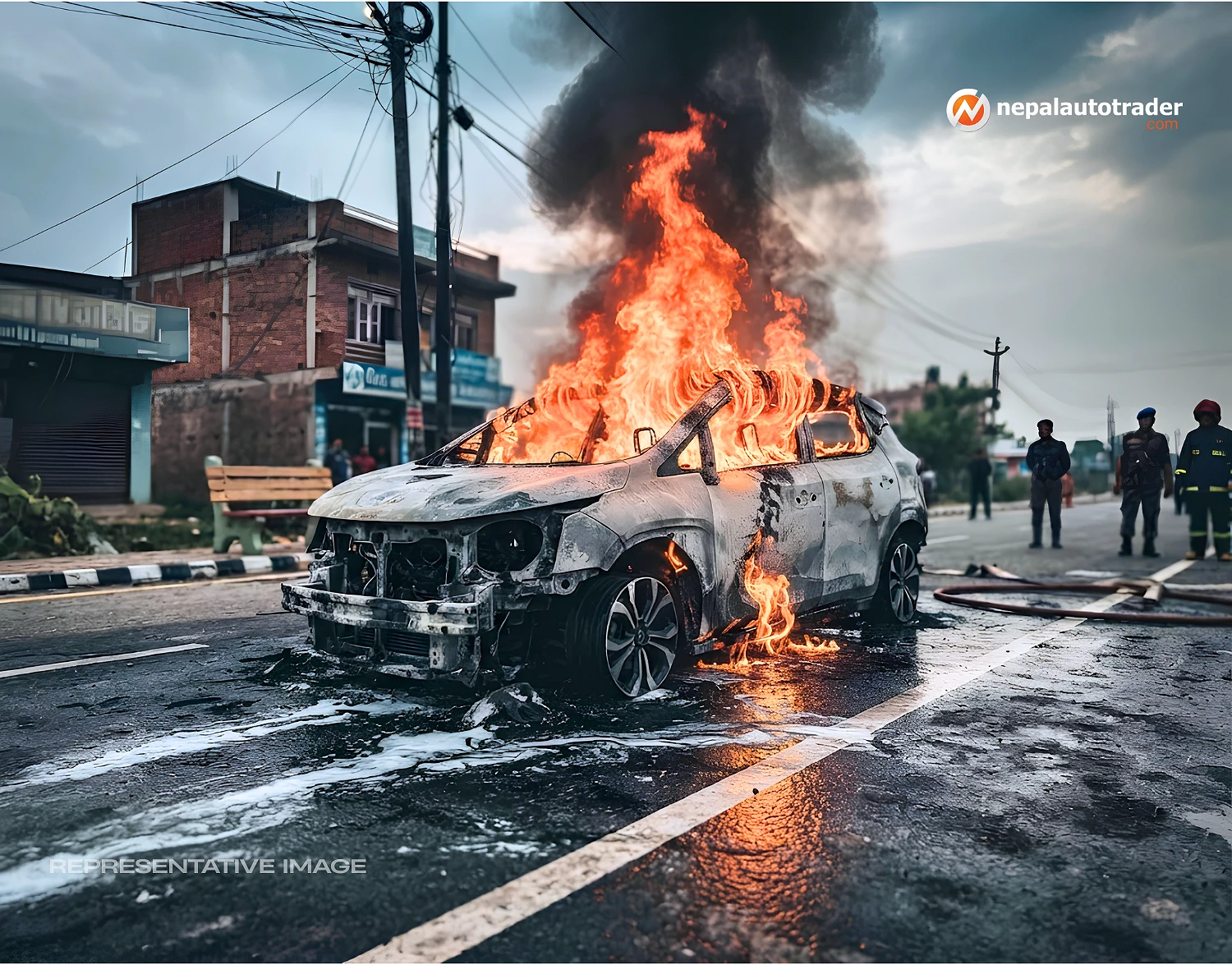
A vehicle fire is frightening enough. When the driver is found dead inside the car, the incident becomes something else entirely, a case that demands answers rather than assumptions.
An electric car caught fire on the East-West Highway in Bharatpur Metropolitan City–9 on the morning of September 11, 2026. According to Nepal Samaj, the driver was found dead inside the vehicle after the fire was brought under control. The report does not provide the exact time of the incident, but confirms that it happened Friday morning.
The vehicle was identified by its registration number, Ba.Pra.01-030 Cha 5579. Police said the car was completely burnt in the incident. The extent of the fire also made identification of the deceased difficult, according to Superintendent of Police Rameshwar Paudel of the District Police Office.
That is the confirmed picture for now. And it is important to leave it there.
The initial report is short, but it establishes several important facts. It does not, however, establish why the vehicle caught fire or whether the fire began inside the passenger compartment, around the electrical system, after an impact, or from another source.
Those distinctions matter. A vehicle fire alone cannot establish a battery defect, a charging problem, a manufacturing issue, or any other technical cause. At this stage, attaching one would be speculation.
The lack of technical detail is not unusual for an initial breaking-news report. A proper investigation would need to establish the sequence of events before the fire, the condition of the vehicle, and the circumstances surrounding the driver's death.
One of the most striking omissions is also one of the most important. The report does not name the EV brand or model.
That means there is currently no responsible way to attach this incident to a particular manufacturer, battery supplier, vehicle platform, or model year. It also means a meaningful comparison with rival electric cars would be premature.
For automotive readers, that restraint matters. EVs are not one single type of vehicle, and manufacturers use different platforms, battery chemistries, electrical architectures, thermal systems, and safety strategies. But none of those details are available for this particular car in the initial report.
Until investigators identify the vehicle and establish the cause, the useful question is not which brand is to blame. It is what happened.
The timing is significant because Nepal's electric vehicle market is no longer a niche corner of the automotive industry.
Recent reporting by Nepal Samaj shows the scale of that transition. In June 2026, 775 electric vehicles entered Nepal through the Korala checkpoint during the last week of May and the first week of June. Customs had completed checks on 649 of those vehicles before the wider import investigation was resolved.
The country's major automotive events have also reflected the shift. At the NADA Auto Show 2026, Vice President Ram Sahaya Prasad Yadav called for greater promotion of electric vehicles and stronger charging infrastructure. NADA president Surendra Kumar Upreti also pointed to the need for policy clarity and investment as EV adoption grows.
That wider expansion makes every serious safety incident more closely watched. Not because one fire proves anything about electric cars as a category, but because a growing vehicle population naturally creates a larger need for reliable safety systems, trained responders, clear procedures, and credible investigations.
The consequences are already being felt across the industry. As more EVs move onto Nepal's roads, the country has to become better at understanding them when something goes wrong.
The next stage should be evidence-led. With the vehicle reportedly destroyed, investigators may face a difficult examination, particularly if critical components were heavily damaged by the fire.
Several questions will be central to understanding the incident:
None of those questions can be answered from the initial report. That is not a weakness in the reporting. It is simply the point where the investigation currently stands.
For context on the broader EV environment, Nepal Samaj has also reported proposals involving electric vehicle charging and a potential road accident relief fund, reflecting how transport policy is increasingly having to account for the country's changing vehicle mix.
Electric mobility in Nepal is moving quickly. The country's policy direction is increasingly supportive of electrification, manufacturers and importers are bringing more models into the market, and charging infrastructure is becoming a larger part of the national transport conversation.
That progress makes public confidence valuable. It also makes transparency after serious incidents essential.
A fatal vehicle fire should not automatically become an argument for or against EVs. Equally, it should not be dismissed simply because electric cars are becoming more common. The right response sits between those extremes, investigate carefully, publish the facts, and fix whatever the evidence shows needs fixing.
For now, the confirmed facts are stark. An electric car caught fire on the East-West Highway in Bharatpur Metropolitan City–9. The vehicle was destroyed. Its driver was found dead inside. The identity of the deceased had not been established when the report was published, and the cause of the fire remains undisclosed.
What happens next will matter more than the speculation surrounding the fire today.
Q: Where did the electric car fire happen?
A: The incident occurred on the East-West Highway in Bharatpur Metropolitan City–9, Chitwan, on Friday morning, September 11, 2026.
Q: What was the registration number of the electric car?
A: Nepal Samaj identified the vehicle by registration number Ba.Pra.01-030 Cha 5579.
Q: Was the electric car brand or model identified?
A: No. The available report does not identify the manufacturer, model, model year, battery specification, or trim.
Q: What caused the electric car to catch fire?
A: The initial report does not state the cause. It would be premature to attribute the fire to the battery, charging system, collision, manufacturing, or any other specific factor without investigation findings.
Q: What happened to the driver?
A: The driver was found dead inside the vehicle. Police said the body was badly burnt, making identification difficult at the time of reporting.
Q: Does this incident prove electric cars are unsafe?
A: No. One incident, without a confirmed cause or identified vehicle model, cannot establish a broader safety conclusion about electric vehicles. The significance will depend on the findings of the investigation.

Nepal Auto-Trader is one-stop platform for all automotive needs. We provide unbiased and unparalleled news/reviews of all auto-motives being launched in Nepalese Auto-Industry. Find recent updates and price of bikes/cars, compare and review recently launched bikes/cars, buy/sell/trade reconditioned cars/bikes and all government news about changing rules and regulation, road safety by subscribing us.

Subscribe to our Newsletter
© Copyright 2026, Nepal Autotrader



.png)
.png)