

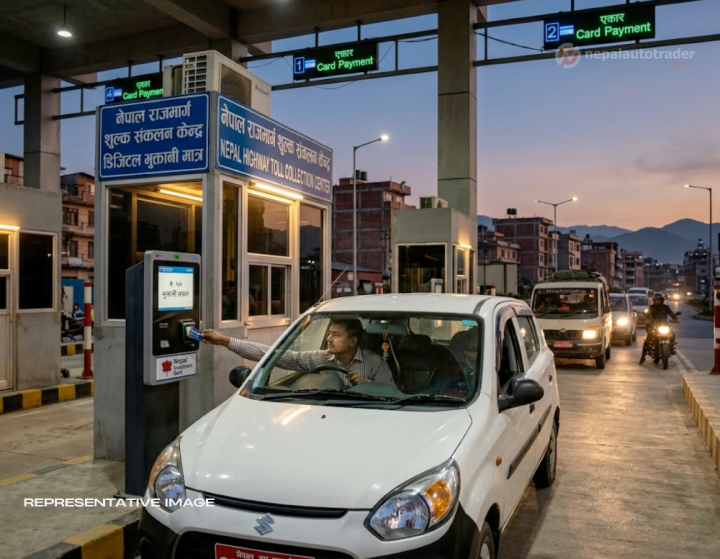
The shift has been coming. Quietly, steadily, and now, officially. Nepal Rastra Bank has granted permission to issue road toll payment cards, opening the door for a more structured, cashless toll collection system across the country’s highway network. This is not just a policy tweak. It is infrastructure thinking, reworked.
The central bank’s approval allows financial institutions to develop and distribute dedicated toll payment cards, enabling drivers to pay without stopping for cash transactions. That matters. Because toll booths, as they stand today, are friction points. Small delays. Big accumulations.
This decision aligns with Nepal’s broader push toward digital payments adoption, where sectors beyond retail and banking are now being integrated into a unified ecosystem. Roads, finally, are part of that conversation.
At its core, the system is simple. But execution will define success. The road toll payment cards will function as prepaid or linked financial instruments issued by banks and financial institutions. These cards can be used at designated toll gates equipped with compatible digital readers.
Drivers approach, tap or scan, and move. No cash exchange. No counting change. No extended queues.
| Component | Function | Impact |
|---|---|---|
| Toll Payment Card | Prepaid or linked payment instrument | Eliminates cash dependency |
| Reader System | Installed at toll booths | Enables fast transaction processing |
| Bank Integration | Transaction settlement and tracking | Improves financial transparency |
| User Account | Recharge or link to bank wallet | Convenience for frequent users |
It sounds straightforward. But behind this lies coordination between banks, toll operators, and regulatory bodies. This changes things. Because once digital rails are laid, scaling becomes inevitable.
Traffic congestion at toll gates is not just an inconvenience. It is lost time, fuel inefficiency, and operational drag for commercial vehicles. The introduction of cashless toll systems directly addresses this bottleneck.
The implications stretch beyond convenience:
This is where infrastructure meets behavior. Once drivers adapt, the expectation shifts. Cash becomes the exception, not the norm.
There is another layer here. Subtle, but significant. The involvement of banks in toll payments means financial institutions are no longer confined to traditional roles. They are becoming part of mobility infrastructure.
With NRB’s approval, banks can:
This opens pathways for bundled offerings. Think transport-linked financial products. Loyalty systems. Even dynamic pricing in the future. It starts with a card. It rarely ends there.
Approval is one thing. Execution is another. The rollout of road toll payment cards will depend heavily on infrastructure readiness at toll points. Not all toll gates are currently equipped for digital transactions.
Key challenges include:
| Challenge | Current Status | Implication |
|---|---|---|
| Hardware Installation | Limited deployment | Slower initial adoption |
| User Awareness | Early stage | Education required for drivers |
| Interoperability | Not fully defined | Potential fragmentation risk |
| Network Reliability | Variable across regions | Transaction delays possible |
That matters. Because digital systems only work as well as their weakest node. A single failed transaction lane can undo the promise of speed.
The approval signals intent. The next phase will define scale. Pilot deployments are expected to lead the way, followed by gradual expansion across major highways.
In the bigger picture, this move fits into Nepal’s evolving transport modernization strategy. It connects with discussions around smart highways, integrated payment systems, and eventually, real-time traffic management.
There is also a behavioral shift underway. As users get accustomed to digital payments in daily life, expectations from public infrastructure rise. Roads cannot remain analog forever.
This is the beginning of that transition. Quiet, but foundational.
Q: What did Nepal Rastra Bank approve regarding toll payments?
A: Nepal Rastra Bank has approved the issuance of road toll payment cards, allowing financial institutions to facilitate cashless toll transactions across highways.
Q: How will the toll payment cards work?
A: The cards will function as prepaid or linked payment tools that can be used at equipped toll gates, enabling quick digital transactions without cash handling.
Q: When will the system be implemented?
A: The rollout is expected to begin in phases, starting with pilot deployments. A full nationwide timeline has not been specified.
Q: Will all toll booths accept these cards immediately?
A: No, infrastructure upgrades are required. Only toll points equipped with compatible digital systems will support the cards initially.
Q: What are the benefits for drivers?
A: Drivers will experience reduced waiting times, smoother travel, and less dependence on cash during highway journeys.
Q: Can these cards be linked to bank accounts or wallets?
A: Yes, the system is expected to integrate with banking and digital payment platforms, depending on the issuing institution.

Nepal Auto-Trader is one-stop platform for all automotive needs. We provide unbiased and unparalleled news/reviews of all auto-motives being launched in Nepalese Auto-Industry. Find recent updates and price of bikes/cars, compare and review recently launched bikes/cars, buy/sell/trade reconditioned cars/bikes and all government news about changing rules and regulation, road safety by subscribing us.

Subscribe to our Newsletter
© Copyright 2026, Nepal Autotrader



.png)
.png)