

Road crashes are the leading cause of death among young people in Nepal
Over 70% of road fatalities involve youth, mostly motorcyclists
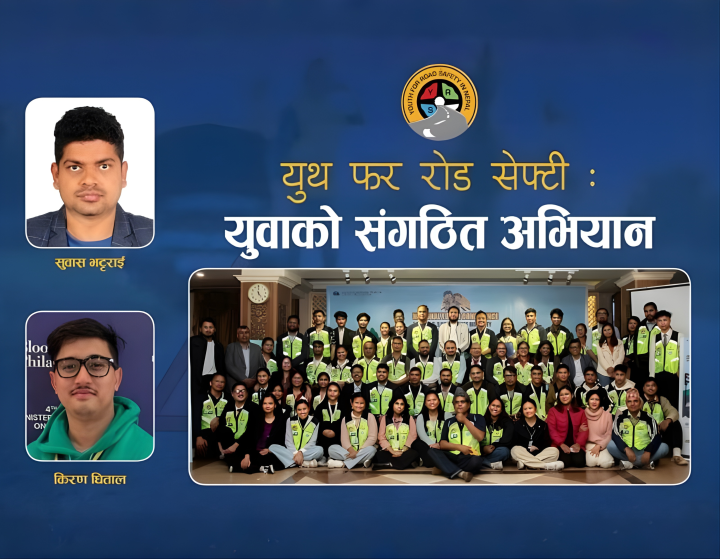
Youth movements like Youth for Road Safety (YRS) are reshaping road safety advocacy
The right to safe mobility is a fundamental human right
Awareness, education, and policy reform are key to lasting change
We are in an age where Generation Z is stepping up with purpose and clarity. They’re not just social media natives — they are thinkers, doers, and leaders who refuse to stay silent about issues that affect their generation. One of those urgent issues is road safety.
Every year, thousands of young lives are lost to preventable crashes. Nepal’s youth are now standing together to demand safer roads, better infrastructure, and a stronger commitment to the right to safe mobility.
The ability to move freely and safely is a basic human right. Yet for many young people, every ride feels like a risk. According to national and UN reports, Nepal loses over 7,000 people every year to road crashes, with youth making up more than 70 percent of the fatalities.
Behind every number is a story — a student, a friend, a dream cut short. Road crashes are not just accidents; they’re a symptom of poor systems, weak enforcement, and a lack of accountability.
If safety isn’t built into the way we travel, progress remains out of reach.
Gen Z is proving to be the generation that challenges norms and questions authority. Their energy and creativity are reshaping how Nepal addresses road safety.
Historically, Nepalese youth have led transformation — from Gangalal and Dharma Bhakta to Pushpa Lal and Pasang Lhamu. Today’s generation continues that legacy through Youth for Road Safety (YRS), a campaign that blends activism with innovation to make roads safer for everyone.
This is more than protest. It’s a call to responsibility, to redesign how we move and how we protect life on the road.
Road crashes are now the number one cause of premature death among Nepal’s youth, particularly motorcyclists. Urban expansion has increased vehicle numbers but not safety standards. Poor road planning, lack of education, and minimal enforcement have created a deadly mix.
Weak enforcement of traffic laws
Limited driver education and training
Poor road design and unsafe crossings
Lack of helmets and seatbelts in regular use
Minimal awareness about safe mobility
The crisis is preventable — but only if prevention becomes the priority.
Real change begins in the classroom. Road safety education should be a lifelong skill, not an afterthought. Schools and colleges can become hubs for awareness campaigns, simulations, and practical learning.
Programs such as Safe School Zones, community road audits, and digital awareness campaigns are helping students become more mindful travelers. Youth clubs and universities can lead research on smart helmets, visibility gear, and digital driving tools that encourage responsible mobility.
Education builds empathy and discipline — two values that save lives on the road.
Awareness alone is not enough. The system must change. Government agencies, law enforcement, and local municipalities have a duty to create safer environments for young travelers.
Digitize traffic monitoring and fine systems
Make defensive driving courses mandatory
Design roads for pedestrians and cyclists
Improve crash data collection and analysis
Include youth representatives in transport policy discussions
Collaboration between youth and policymakers is crucial. When young people are part of the solution, policies become more relevant and effective.
Digital innovation can save lives. Nepal’s youth are increasingly using technology to raise awareness and track unsafe roads.
Mobile apps can crowdsource hazard reports, and AI cameras can monitor speeding or reckless driving. Social media campaigns can educate millions faster than traditional programs. With digital tools and motivated youth, road safety can evolve from reactive to proactive.
Changing behavior is the hardest step but the most important. We need to build a culture of care on the road. That means wearing helmets, respecting lanes, stopping for pedestrians, and refusing to drink and drive.
Parents, teachers, and community leaders should set examples. Safety isn’t a restriction — it’s a form of respect. The message must be simple and consistent: every trip should end safely.
The Youth for Road Safety (YRS) initiative reflects the strength of Nepal’s young generation. It’s a movement built on awareness, advocacy, and unity. These young leaders are not waiting for change — they are creating it.
The vision is clear. A Nepal where roads are safe, where every rider and walker feels secure, and where mobility is no longer a threat but an opportunity.
We stand at a critical moment. Road safety must be treated as a shared responsibility, not a government task alone. With education, technology, and strong leadership from youth, we can turn tragedy into transformation.
The right to mobility without fear belongs to everyone. Together, we can ensure that no young life is lost for simply choosing to move forward.

Nepal Auto-Trader is one-stop platform for all automotive needs. We provide unbiased and unparalleled news/reviews of all auto-motives being launched in Nepalese Auto-Industry. Find recent updates and price of bikes/cars, compare and review recently launched bikes/cars, buy/sell/trade reconditioned cars/bikes and all government news about changing rules and regulation, road safety by subscribing us.

Subscribe to our Newsletter
© Copyright 2026, Nepal Autotrader



.png)
.png)