

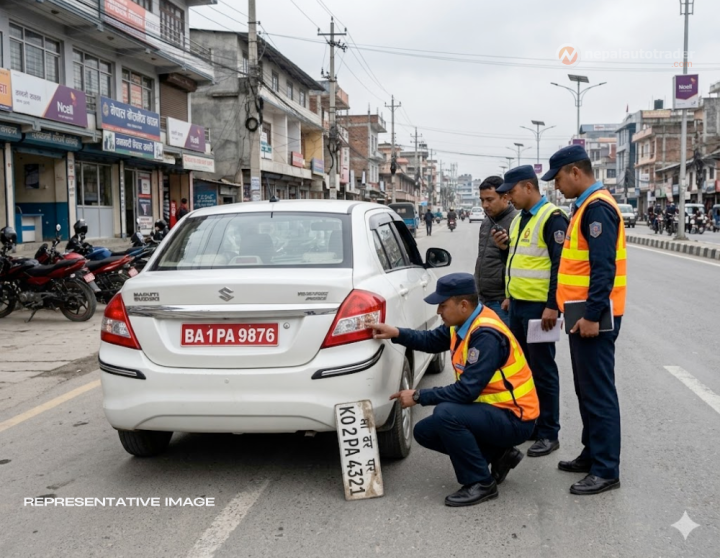
It starts quietly. A vehicle disappears. No noise, no immediate trace. Then, weeks later, it is back on the road, wearing a different identity. This is the growing pattern behind fake number plates being used on stolen cars across Nepal.
Authorities have confirmed that stolen vehicles are being fitted with duplicate or manipulated registration plates, allowing them to blend into everyday traffic. It is not random. It is methodical. And it is spreading.
The process is simple on the surface, but effective. Once a vehicle is stolen, its original identity is stripped. A new number plate, often copied from a legitimately registered vehicle, is installed. From there, the car becomes almost invisible to routine checks. That matters.
What makes this particularly concerning is how easily these vehicles can pass through checkpoints without raising suspicion. Without immediate access to centralized verification systems, enforcement officers rely heavily on visual inspection. And that is no longer enough.
This is not just about stolen cars. It is about identity manipulation at scale. The use of fake number plates introduces a deeper layer of complexity into vehicle tracking and law enforcement.
Here is how the system typically unfolds:
This is not opportunistic crime. It is structured. It involves coordination, access to data, and a clear understanding of enforcement gaps. This changes things.
The rise of fake plates exposes critical weaknesses in Nepal’s vehicle registration and monitoring framework. At its core, the system still depends heavily on physical verification, rather than real-time digital validation.
The gaps are becoming visible:
These are not minor issues. They create an environment where stolen vehicles can circulate with minimal friction. And once a car is re-registered informally through illegal channels, tracing it becomes exponentially harder.
This is not just a law enforcement problem. It directly affects everyday vehicle owners. Imagine purchasing a car, only to later discover it carries a fraudulent identity. Ownership disputes follow. Legal complications escalate. Trust erodes.
The broader implications are serious:
| Impact Area | Current Risk | Implication |
|---|---|---|
| Vehicle Buyers | High | Risk of unknowingly purchasing stolen vehicles |
| Law Enforcement | High | Difficulty in tracking and recovery |
| Insurance Claims | Moderate | Disputes due to identity mismatch |
| Public Safety | High | Untraceable vehicles involved in incidents |
The presence of untraceable vehicles on public roads introduces a layer of unpredictability. Accountability becomes blurred. And that is where the real risk lies.
There is a reason this issue is accelerating. It sits at the intersection of demand, opportunity, and weak oversight.
Several factors are driving the rise:
Each of these elements reinforces the other. Together, they create a system where stolen vehicles can be recycled back into the market with alarming ease.
This is not unique to Nepal, but the scale and visibility of the issue suggest an urgent need for intervention. The longer it persists, the harder it becomes to reverse.
There is growing recognition that the current system needs an upgrade. Not incremental tweaks, but structural changes.
Potential solutions being discussed include:
| Solution | Function | Expected Impact |
|---|---|---|
| Digital vehicle database | Centralized real-time verification | Improved traceability |
| Smart number plates | Embedded identification technology | Reduced duplication risk |
| Enhanced roadside tools | Instant plate verification | Faster enforcement |
| Stricter manufacturing controls | Regulated plate production | Lower fraud incidence |
These are not futuristic ideas. Many markets have already implemented similar systems. The question is not whether change is needed. It is how quickly it can be executed.
The road ahead is clear. The tools exist. What remains is the will to deploy them at scale. That matters.
Q: What are fake number plates in vehicles?
A: Fake number plates are illegally created or duplicated registration plates used to disguise a vehicle’s true identity. They are often used on stolen cars to avoid detection.
Q: How do stolen cars get fake identities?
A: After theft, original plates are removed and replaced with duplicated or altered ones, often copied from legitimate vehicles, allowing the stolen car to operate unnoticed.
Q: Can authorities easily detect fake number plates?
A: Detection is difficult without real-time digital verification systems. Most checks rely on visual inspection, which fake plates can bypass.
Q: What risks do buyers face when purchasing used cars?
A: Buyers risk unknowingly purchasing stolen vehicles with fake identities, leading to legal disputes and potential financial loss.
Q: What solutions are being considered to address this issue?
A: Authorities are exploring digital databases, smart plates, stricter controls, and improved roadside verification tools to reduce fraud.

Nepal Auto-Trader is one-stop platform for all automotive needs. We provide unbiased and unparalleled news/reviews of all auto-motives being launched in Nepalese Auto-Industry. Find recent updates and price of bikes/cars, compare and review recently launched bikes/cars, buy/sell/trade reconditioned cars/bikes and all government news about changing rules and regulation, road safety by subscribing us.

Subscribe to our Newsletter
© Copyright 2026, Nepal Autotrader



.png)
.png)