

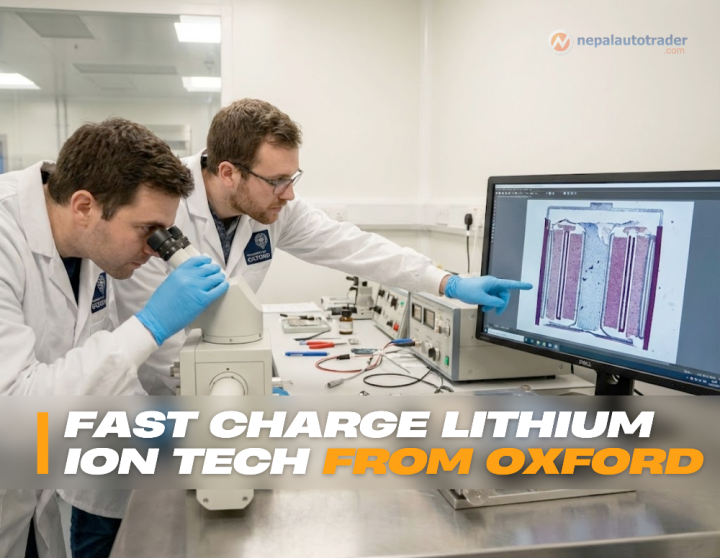
The research team at Oxford University has cracked a problem that has haunted the industry for years: how to watch the invisible polymer binder that holds lithium‑ion electrodes together. By coating the binder with trace amounts of silver and bromine markers, the scientists created a staining technique that survives the harsh vacuum of an electron microscope. The result? A crystal‑clear view of layers thinner than 10 nanometres, a scale previously thought impossible to resolve.
That matters because the binder is the hidden bottleneck that creates internal resistance. When the team measured cells treated with the new stain, they recorded a 40 percent reduction in internal impedance. In plain language: charge‑times could shrink by almost half without redesigning the entire cell.
The process is deceptively simple:
The table below captures the core parameters the team reported.
| Parameter | Value | Impact |
|---|---|---|
| Resolution | ≈ 10 nm | Enables visualization of binder distribution |
| Marker composition | Silver + bromine | High contrast in TEM imaging |
| Resistance reduction | ≈ 40 % | Faster charge, lower heat build‑up |
| Applicable cell types | Current Li‑ion, future silicon‑based | Broad industry relevance |
The implications ripple through two of the biggest battery markets:
Both sectors have been chasing silicon‑based anodes for higher energy density. The Oxford method works just as well with those emerging chemistries, meaning the next generation of cells could inherit the fast‑charge advantage from day one.
Professor Patrick Grant, co‑author and materials‑science lead at Oxford, stressed the interdisciplinary nature of the work: “Combining chemistry, electron microscopy, electrochemical testing and modelling gave us a fresh window onto the binder’s role.” The study was funded by the Faraday Institution’s NexTROD project, a clear signal that the UK’s battery research engine is betting on this route.
Automakers have already taken note. In a brief statement, a senior engineer at a major European EV maker said the findings “could shave minutes off the charging experience and improve cycle life, both of which are key to consumer acceptance.”
The research team plans three concrete actions:
Silicon promises up to three times the capacity of graphite, but it swells dramatically during charge, stressing the binder. By mapping exactly where the binder fails, engineers can redesign polymer chemistries to accommodate that expansion. The Oxford breakthrough therefore acts as a diagnostic lens for the silicon challenge.
If the industry can marry this insight with solid‑state electrolyte advances, we may see a convergence where fast charge, high energy, and long life finally coexist. That would reshape not only the EV market but also grid‑scale storage, where rapid response is increasingly valuable.
Q: When will the new staining technique be available to battery manufacturers? A: The Oxford team expects pilot‑scale trials with industry partners by Q4 2026, with broader adoption possible in 2027 once the process is validated on production‑line cells.
Q: Does the method add extra cost to the battery? A: The marker solution uses inexpensive silver nitrate and bromine salts, and the coating step fits within existing electrode‑drying lines, so cost impact is expected to be minimal.
Q: Will the technique work on existing EV models on the road today? A: It is a manufacturing‑stage diagnostic, not a retrofit. However, the insights gained will influence the next batch of cells that power future models.
Q: How does this compare to other fast‑charging research, such as high‑power charging protocols? A: Most approaches focus on external hardware or electrolyte tweaks. Oxford’s method targets the internal binder, offering a complementary pathway that can be combined with high‑power chargers for additive gains.
Q: Is the research linked to any commercial patents? A: The authors have filed provisional patents covering the marker composition and application process, but the underlying data will be openly published under the NexTROD project’s open‑science policy.
Q: Where can I read the full scientific paper? A: The peer‑reviewed article is available on ScienceDaily and will be indexed in the journal Advanced Energy Materials later this year.

Nepal Auto-Trader is one-stop platform for all automotive needs. We provide unbiased and unparalleled news/reviews of all auto-motives being launched in Nepalese Auto-Industry. Find recent updates and price of bikes/cars, compare and review recently launched bikes/cars, buy/sell/trade reconditioned cars/bikes and all government news about changing rules and regulation, road safety by subscribing us.

Subscribe to our Newsletter
© Copyright 2026, Nepal Autotrader



.png)
.png)