

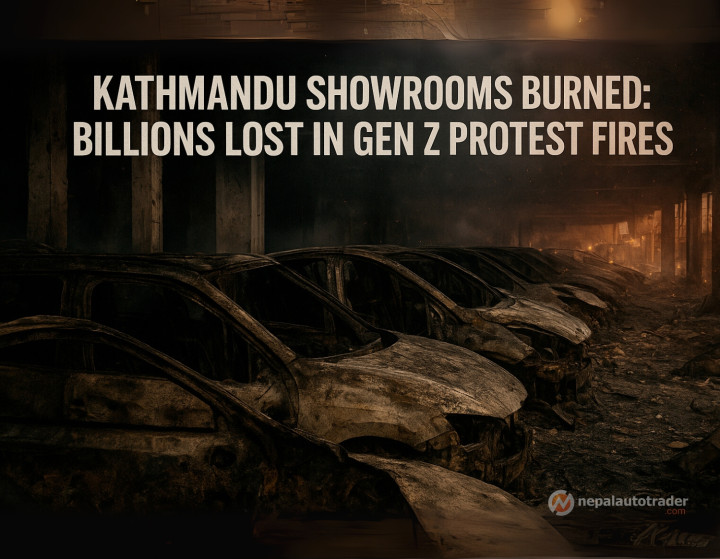
On Tuesday, September 9, 2025, a wave of violence erupted in Kathmandu’s Thapathali area during Gen Z protests, targeting key car showrooms. At least six major automobile brand showrooms—including Tata Motors, CG Motors, Mahindra, Suzuki, and Hyundai—were deliberately vandalized and set ablaze.
The damage was comprehensive: most of the showrooms were completely destroyed, and virtually all display vehicles were gutted by fire. Estimates of the financial losses remain preliminary, but reports suggest the toll could reach billions of Nepali rupees, with hundreds of vehicles damaged or destroyed.
This unprecedented event poses serious risks for Kathmandu’s automotive retail industry, urban infrastructure, investor confidence, and insurance sector. In this article, we unpack the full scale of the incident, explore its aftermath, and propose a robust response plan to restore stability and protect the sector’s future.
The Gen Z protest movement in Kathmandu, while fueled by a variety of socio-political grievances, quickly escalated in Thapathali—an area known for its concentration of automobile showrooms.
Protesters specifically attacked showrooms of Tata Motors, CG Motors, Mahindra, Suzuki, and Hyundai, smashing windows, igniting fires, and destroying infrastructure.
The strategy appeared to focus not only on symbolic economic targets but also on inflicting maximum material damage: vehicles on display, parts inventory, and showroom facilities were all destroyed.
Almost all targeted showrooms were “completely destroyed” by fire.
Hundreds of vehicles—both display and privately parked—were attacked or burned.
Initial loss estimates run into the billions of Nepali rupees, placing severe strain on local insurers and the auto retail ecosystem.
Vehicles on display are high-value assets: brand-new cars, often with minimal depreciation, complete with accessories, parts, and electronics. When these are destroyed, dealers face not only the MSRP loss but also inventory costs, financing liabilities, and lost opportunity.
Showroom real estate, service bays, spare-part inventories, customer waiting areas, and administrative offices all suffer when a facility is burned down. Rebuilding costs multiple layers of investment: real estate, construction, fit-out, licensing, and staffing.
With hundreds of vehicles destroyed and full showrooms damaged, non-life insurers in Nepal are likely to see a massive spike in claims. While not all assets may have been insured, the scale suggests:
A sharp increase in total claims payout
Possible premium hikes in future auto and property insurance policies
Greater caution among insurers to underwrite high-risk showroom locations
Supply disruption: Replacement of inventory takes time and financial resources, creating gaps in availability for customers.
Pricing pressure: Dealers may pass remediation and risk-mitigation costs onto customers through higher margins or service fees.
Investor risk: The perceived instability may deter new auto dealerships, especially foreign-invested brands, from expanding or even maintaining operations in Kathmandu.
A burning showroom is not an isolated fire hazard. In dense urban settings such as Thapathali, fire can spread rapidly—threatening nearby businesses, residential buildings, and critical infrastructure.
Smoke, emergency vehicles, and protest-related roadblocks can paralyze traffic.
Secondary damage to private vehicles and street assets compounds the chaos.
Although no major casualties have been reported, the potential for injury to showroom employees, neighboring residents, firefighters, and protesters is real and alarming.
To navigate this crisis and safeguard the auto retail ecosystem (and its broader economic impact), we propose a comprehensive, multi-pronged strategy:
Rapid damage assessment: Deploy structural engineers, fire investigators, and insurer assessors to evaluate buildings and assets, and establish immediate safety perimeters.
Activate business continuity plans: Dealers with multiple locations should redirect customers to intact branches, offer mobile or remote sales, and communicate transparently with customers about delays or shortages.
Coordinate with fire and city authorities: Implement enhanced firefighting readiness in high-risk zones, and plan for urban fire containment.
Streamlined claims processing: Non-life insurers should establish fast-track processes for damaged inventory, real estate, and business interruption claims, while ensuring verification and fraud prevention.
Government-backed financial relief: Given the extraordinary nature of the unrest, consider government grants or low-interest loans to affected dealerships for rebuilding and replenishment.
Risk revaluation and mitigation: Future insurance policies should incorporate localized risk assessments, potentially incentivizing dealers to adopt robust fire suppression, surveillance, and access control systems.
Enhanced physical security: Installing sturdier shutters, reinforced glass, fire doors, and perimeter fencing.
Surveillance and rapid alert systems: High-definition CCTV, fire and intrusion sensors, panic alarms, and direct lines to police and fire departments.
Community engagement: Dealerships should foster better community ties, participate in local dialogues, and contribute to positive neighborhood developments to reduce their vulnerability as protest targets.
Zoning reconsideration: Authorities might review the density of high-value showrooms in protest-prone urban corridors and consider relocating some to business parks or areas with easier fire containment.
Fire code upgrades: Mandate sprinkler systems, firewalls, and access lanes for emergency vehicles in auto-commercial zones.
Public-private coordination: City planners, auto-dealer associations, and civic authorities should collaborate to create “safe corridors” for high-value businesses that include rapid response infrastructure.
Diversified distribution channels: Dealers should invest in digital showrooms, remote sales, and “hub-and-spoke” strategies to avoid over-dependence on a single high-risk location.
Crisis simulation drills: Regular training for staff on emergency evacuation, fire response, protest-related disruptions, and continuity protocols.
Insurance-linked risk financing: Dealers might explore parametric insurance products, captive insurance funds, or mutual aid frameworks to share risk across the sector.
Stakeholder communication plans: Transparent messaging to customers, suppliers, employees, and the public can help restore confidence and reduce reputational fallout.
The fallout from the Thapathali showroom fires is more than just a physical loss—it is a hit to market sentiment, customer trust, and institutional confidence. To lead a rebound, auto-dealers and public authorities must commit to:
Visible and rapid action: Start cleanup, rebuilding, and public communication immediately.
Demonstrating resilience: Quickly resume basic operations—even if scaled down—to signal that the market remains functional.
Improving transparency: Publish damage assessments, progress updates, and recovery milestones.
Investing in prevention: Spending now on security and resilience will reduce future risk—and reassure customers and insurers alike.
Strengthening partnerships: Auto dealers, insurer associations, civic authorities, fire services, and local communities need shared protocols and mutual support.
The torching of multiple automobile showrooms in Kathmandu’s Thapathali district represents a serious shock to Nepal’s automotive retail industry. The damage runs the gamut—from destroyed vehicles and facilities to shaken customer trust and insurance turmoil.
Yet, this crisis also offers an opportunity: by adopting a strategic, resilient, and forward-looking recovery plan, the auto sector can rebuild stronger, safer, and more adaptable than before. With coordinated effort among dealers, insurers, city planners, and civic authorities, Kathmandu’s auto market can transition from vulnerability to durable strength.

Nepal Auto-Trader is one-stop platform for all automotive needs. We provide unbiased and unparalleled news/reviews of all auto-motives being launched in Nepalese Auto-Industry. Find recent updates and price of bikes/cars, compare and review recently launched bikes/cars, buy/sell/trade reconditioned cars/bikes and all government news about changing rules and regulation, road safety by subscribing us.

Subscribe to our Newsletter
© Copyright 2026, Nepal Autotrader



.png)
.png)