

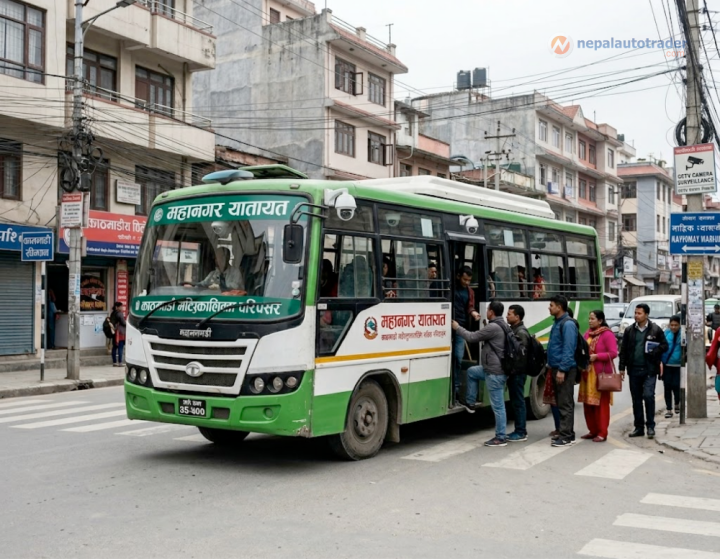
The shift has begun. Quietly at first, then all at once.
The Kathmandu Valley Traffic Police Office has formally initiated the installation of CCTV cameras and dashboard systems in public transport vehicles. The objective is simple on paper, but layered in execution, control theft, reduce misconduct, and understand accident dynamics better.
This is not just about surveillance. It is about accountability inside a moving ecosystem where oversight has traditionally been thin.
Complaints related to theft and misbehavior by drivers and conductors are frequent. That matters.
Now, with cameras watching both the road and the cabin, behavior changes. It always does.
The directive is clear, even if the technical blueprint is still evolving.
Authorities have instructed that public transport vehicles must install both internal CCTV systems and dashboard cameras. At the same time, GPS tracking systems are planned, especially for long-route vehicles.
| Component | Requirement | Purpose |
|---|---|---|
| CCTV Cameras | Mandatory in public vehicles | Monitor passengers and driver behavior |
| Dashboard Cameras | Included in installation | Record road conditions and incidents |
| GPS System | Planned for long-route vehicles | Track movement and route compliance |
| Cost Responsibility | Vehicle owners | Implementation funding |
The structure is straightforward. Implementation will not be.
Vehicle owners are expected to bear the cost. That changes things.
This is where the story gets technical.
A typical multi-camera vehicle setup, often based on MDVR systems, integrates cameras, GPS, and connectivity into a single unit. These systems are not new, but their widespread enforcement is.
Placement is critical. A poorly positioned camera is just dead weight.
For example, driver-facing cameras must clearly capture the driver’s upper body and steering interaction, while cabin cameras must cover passenger areas without blind spots.
GPS antennas, meanwhile, require unobstructed placement, often near the front section of the vehicle, away from interference.
Done right, the system becomes a real-time data engine. Done wrong, it becomes a compliance checkbox.
The reasoning is grounded in reality.
Public transport in urban Nepal has long faced issues around passenger safety, fare disputes, and driver conduct. Cameras provide evidence. GPS provides traceability.
Together, they create a digital audit trail.
This is not just enforcement. It is data-driven policing.
And for passengers, it introduces a layer of psychological safety that did not exist before. That matters.
Interestingly, the response from transport operators has been positive.
Authorities confirm that transport entrepreneurs are cooperating with the rollout.
But cooperation does not erase friction.
Installation costs, system maintenance, and technical know-how will define how smoothly this transition happens.
| Stakeholder | Role | Challenge |
|---|---|---|
| Vehicle Owners | Install and maintain systems | Cost burden |
| Traffic Police | Enforcement and monitoring | Data management |
| Passengers | End users | Privacy concerns |
| Operators | Fleet compliance | Standardization |
The biggest question is not whether this will happen. It will.
The real question is how consistently it will be implemented across fleets.
The rollout is expected to expand rapidly.
The Traffic Police aim to equip all public transport vehicles as soon as possible.
That is ambitious. And necessary.
GPS integration in long-route vehicles is the next step, bringing intercity transport into the same accountability framework.
Once both systems are active, enforcement moves from reactive to proactive.
Incidents are no longer just reported. They are recorded.
This changes the entire equation.
And if implemented correctly, it could redefine how public transport is perceived in Nepal, from unpredictable to monitored, from informal to structured.
That shift will take time. But the direction is now clear.

Nepal Auto-Trader is one-stop platform for all automotive needs. We provide unbiased and unparalleled news/reviews of all auto-motives being launched in Nepalese Auto-Industry. Find recent updates and price of bikes/cars, compare and review recently launched bikes/cars, buy/sell/trade reconditioned cars/bikes and all government news about changing rules and regulation, road safety by subscribing us.

Subscribe to our Newsletter
© Copyright 2026, Nepal Autotrader



.png)
.png)