

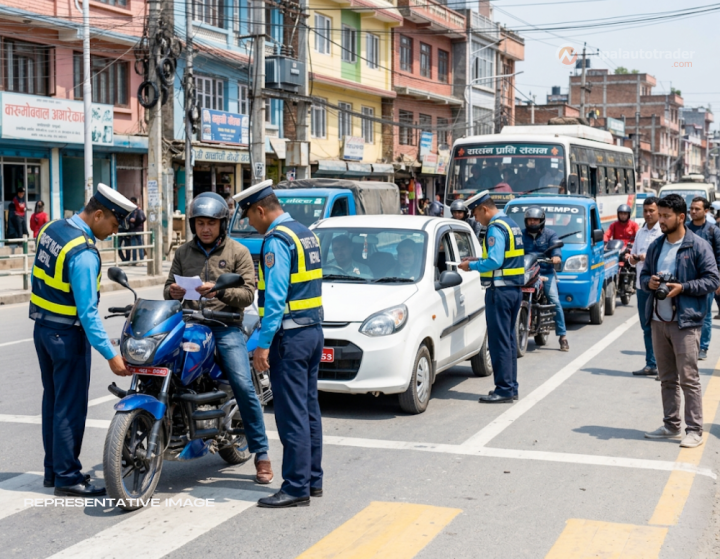
The Kathmandu Valley Traffic Police Office, along with its subordinate units, launched a coordinated surprise inspection across several parts of the capital on Tuesday morning. Officers positioned themselves at multiple traffic points without prior notice, stopping vehicles and checking for both dangerous driving and routine compliance.
The operation resulted in action against 98 drivers in a single sweep. That number is not enormous by metropolitan standards, but the message was unmistakable. Enforcement in the valley is becoming more visible, and more unpredictable.
For drivers who have grown used to predictable checkpoints, this changes the tone.
Among those penalised, 7 drivers were found operating vehicles after consuming alcohol. Drink driving continues to remain one of the most serious concerns for traffic authorities in Nepal because even a small lapse can turn a routine commute into a fatal incident.
| Violation Type | Drivers Penalised | Risk Level |
|---|---|---|
| Drink driving | 7 | High |
| Other offences | 91 | Moderate to high |
| Total action | 98 | Enforcement action |
Traffic police have repeatedly warned that alcohol-related violations remain under close scrutiny, particularly during early morning and late evening hours when roadside monitoring can catch offenders off guard.
The fact that impaired drivers were still detected in a short operation shows the issue has not disappeared.
The remaining 91 drivers were penalised for a range of traffic violations. According to the office, the most common issues included:
Lane misuse in Kathmandu has become one of the most visible symptoms of worsening congestion. Vehicles frequently cut across marked lanes, forcing sudden braking and creating bottlenecks that quickly spread across busy corridors.
Authorities appear to be shifting from reactive policing to a more proactive approach. That matters.
Routine checkpoints often lose effectiveness because regular commuters quickly learn where officers are stationed. A surprise checking campaign removes that familiarity and creates uncertainty for habitual offenders.
| Enforcement Method | Driver Awareness | Effectiveness |
|---|---|---|
| Fixed checkpoint | Usually predictable | Moderate |
| Surprise inspection | Low | Higher deterrence |
Traffic experts have long argued that unpredictable monitoring can improve compliance because drivers are forced to assume enforcement may be waiting around any corner. In congested cities like Kathmandu, where road discipline remains inconsistent, that strategy can have a stronger psychological effect than routine fines.
Sometimes visibility alone can alter behaviour before a ticket is even written.
For motorists inside the valley, the latest action suggests traffic enforcement may become less scheduled and more aggressive in the coming weeks. Drivers can no longer assume checks will happen only at familiar intersections.
Those navigating the city should pay closer attention to:
The roads have not changed overnight. The way they are being watched might have.
Q: How many drivers were penalised during the surprise traffic check in Kathmandu?
A: Traffic police took action against 98 drivers during the surprise inspection conducted across different parts of Kathmandu Valley on Tuesday morning.
Q: How many motorists were caught for drink driving?
A: Police confirmed that 7 drivers were penalised for operating vehicles after consuming alcohol.
Q: What were the most common offences in the operation?
A: The most common violations were red light offences, lane discipline violations, and other general traffic rule breaches.
Q: Why are surprise traffic checks used instead of regular checkpoints?
A: Surprise checks are harder for drivers to predict, making them more effective in discouraging repeat violations.
Q: Will traffic checks continue in Kathmandu?
A: While no official schedule was announced, the latest operation suggests authorities are likely to continue random enforcement across the valley.

Nepal Auto-Trader is one-stop platform for all automotive needs. We provide unbiased and unparalleled news/reviews of all auto-motives being launched in Nepalese Auto-Industry. Find recent updates and price of bikes/cars, compare and review recently launched bikes/cars, buy/sell/trade reconditioned cars/bikes and all government news about changing rules and regulation, road safety by subscribing us.

Subscribe to our Newsletter
© Copyright 2026, Nepal Autotrader



.png)
.png)